

Fast Answer
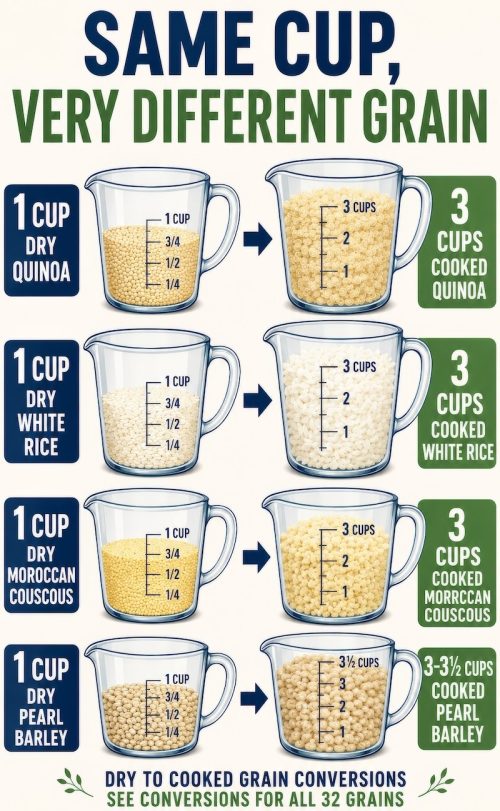
The quick answer: 1 cup of dry grain usually makes about 2½ to 3½ cups cooked. White rice, quinoa and Moroccan couscous make about 3 cups. Pearl barley makes about 3 to 3½ cups. Exact yields vary by grain, so use the calculator or chart below.
Common Grain Conversions
| Grain | Dry Amount | Cooked Yield |
|---|---|---|
| Quinoa | 1 cup | About 3 cups |
| White rice | 1 cup | About 3 cups |
| Brown rice | 1 cup | About 3 cups |
| Moroccan couscous | 1 cup | About 3 cups |
| Bulgur | 1 cup | About 2½–3 cups |
| Pearl barley | 1 cup | About 3–3½ cups |
| Farro | 1 cup | About 3 cups |
Cooked yields are approximate. Grain variety, processing, soaking and cooking method can affect the final volume.
Find Your Grain's Ratio
That’s the short version. The long version is that every grain absorbs liquid differently — quinoa fluffs up more easily than rice, bulgur swells quickly, couscous barely cooks at all.
The chart below covers water ratios, cook times, and yields for all 32, plus a calculator that does the math for whatever amount you’re working with.
| Grain | 1 Cup Dry + Liquid | Yield | Type |
|---|
| Grain | Liquid | Cooked Yield | Cook Time | Method and Notes |
|---|---|---|---|---|
| Arborio rice | About 4 cups | About 3 cups | 18–20 minutes | Use the risotto method. Add the liquid gradually while stirring. |
| Brown basmati rice | 2½ cups | About 3 cups | 40–50 minutes | Use the absorption method. An optional 30-minute soak shortens the cooking time. |
| Brown long-grain rice | 2½ cups | About 3 cups | 40–50 minutes | Use the absorption method. |
| Brown short-grain rice | 2½ cups | About 3 cups | 40–50 minutes | Use the absorption method. Short-grain rice has a naturally stickier texture. |
| Quick-cooking brown rice | 1¼ cups | About 2 cups | 10–12 minutes | Amounts vary by product. Check the package instructions. |
| Jasmine rice | 1½ cups | About 3 cups | 15–18 minutes | Use the absorption method. Rinse before cooking for more separate grains. |
| White long-grain rice | 2 cups | About 3 cups | 18–20 minutes | Use the absorption method. Keep covered during cooking and resting. |
| Pearl barley | 3 cups | About 3–3½ cups | 30–40 minutes | Simmer until tender. Drain any excess liquid. |
| Bulgur | 2 cups | About 2½–3 cups | 10–20 minutes | The yield and cooking time vary according to the grind. |
| Moroccan couscous | 1¼ cups | About 3 cups | 5 minutes | Pour boiling liquid over the couscous, cover and steep off the heat. |
| Pearl couscous | 1½ cups | About 3 cups | 12–15 minutes | Simmer until tender. Drain any remaining liquid. |
| Cracked wheat | 2 cups | About 2¼–2½ cups | 15–20 minutes | Use the absorption method. |
| Farro | 3 cups | About 3 cups | 25–40 minutes | Pearling affects the cooking time. Drain any excess liquid. |
| Freekeh | 2½ cups | About 3 cups | 20–25 minutes | Cracked freekeh cooks faster than whole freekeh. |
| Kamut or Khorasan wheat berries | 3 cups | About 3–3½ cups | 45–60 minutes | Soaking is recommended. Drain any excess liquid after cooking. |
| Rye berries | 3½–4 cups | About 3 cups | 45–60 minutes | Soaking is recommended. Drain any excess liquid. |
| Sorghum | 3 cups | About 3–3½ cups | 50–60 minutes | Simmer until tender. Drain any excess liquid. |
| Spelt berries | 3 cups | About 3 cups | 45–60 minutes | Soaking reduces the cooking time. Drain excess liquid if necessary. |
| Wheat berries | 2½–3 cups | About 3 cups | 50–60 minutes | Simmer until tender, then drain any excess liquid. |
| Amaranth | 2½ cups | About 3 cups | 20–25 minutes | Produces a soft cereal consistency. Use less liquid for a firmer result. |
| Buckwheat groats | 2 cups | About 3 cups | 10–15 minutes | Simmer until tender. Drain any excess liquid. |
| Chia gel | 2 cups per ⅓ cup chia seeds | About 17 ounces of gel | 5–10 minutes resting time | Chia is not cooked. Stir ⅓ cup chia seeds into 2 cups liquid and let the mixture rest. |
| Millet | 2½ cups | About 3½ cups | 15–20 minutes | This ratio produces fluffy millet. Add more liquid for a softer porridge. |
| Quinoa | 2 cups | About 3 cups | 15 minutes | Rinse before cooking. Simmer until the liquid is absorbed, then let it rest covered. |
| Teff | 3 cups | About 3–3½ cups | About 20 minutes | This ratio produces a creamy cereal consistency. |
| Oat bran | 2½ cups | About 2 cups | 1–3 minutes | The final volume depends on the desired cereal thickness. |
| Oat groats | 3 cups | About 3½ cups | 45–60 minutes | Simmer until tender. Drain any excess liquid. |
| Rye flakes | 2 cups | About 3 cups | 10–15 minutes | Cook as a hot cereal. Add more liquid for a thinner porridge. |
| Cornmeal | 4 cups | About 3½–4 cups | 20–30 minutes | The result depends on the grind and desired consistency. Stir frequently. |
| Grits | 4 cups | About 4 cups | 20–45 minutes | The cooking time varies by grind. These amounts do not apply to instant grits. |
| Dried hominy | At least 5 cups | About 3 cups | 1½–2½ hours | Soak before cooking. Cook in excess water until tender, then drain. |
| Polenta | 4 cups | About 4 cups | 30–40 minutes | The final yield depends on the desired consistency. Stir frequently. |
Note: These quantities are approximate. Grain variety, processing, soaking and cooking method can change the amount of liquid required and the final cooked yield.
Quinoa Quick Conversion Chart
1 cup dry quinoa + 2 cups liquid → about 3 cups cooked.
Quinoa cooks faster than rice, usually in 15–20 minutes, and fluffs up lighter. When it is done, you will see the germ pull away into a small white spiral around each seed. Rinse quinoa first unless the package says it is pre-rinsed. Its natural coating tastes bitter, and rinsing makes a noticeable difference.
| Dry Amount | Liquid | Cooked Yield |
|---|---|---|
| ¼ cup | ½ cup | About ¾ cup |
| ½ cup | 1 cup | About 1½ cups |
| 1 cup | 2 cups | About 3 cups |
Red and black quinoa take a few extra minutes and stay firmer than white or golden quinoa. Their cooked yields are close, but not identical.
Rice — White vs. Brown
White rice: 1 cup dry + 2 cups water → about 3 cups cooked. Brown rice: 1 cup dry + 2¼–2½ cups water → about 3 cups cooked, but takes roughly twice as long.
This is one of the substitutions home cooks get wrong most often. Brown rice is not simply rice that takes longer to cook. It needs more water per cup and a longer simmer—about 40–50 minutes compared with 18–20 minutes for white rice—so the bran layer can soften completely. Use the same amount of water for both and you may end up with crunchy brown rice or soggy white rice.
Quick White Rice Conversion Chart
| Dry Amount | Water | Cooked Yield |
|---|---|---|
| ¼ cup | ½ cup | About ¾ cup |
| ½ cup | 1 cup | About 1½ cups |
| 1 cup | 2 cups | About 3 cups |
For more rice conversions and comparisons with pasta, see the Pasta and Rice Conversions guide.
Bulgur Quick Conver Chart
1 cup dry bulgur + 2 cups water → about 2½–3 cups cooked.
Bulgur is parboiled, cracked wheat, so it cooks faster than whole wheat berries. Coarse bulgur usually needs 12–15 minutes of simmering. Fine bulgur may only need to soak in hot water off the heat, as it traditionally does for tabbouleh. Bulgur stays slightly chewy when fully cooked. That texture does not mean it needs more time.
| Dry Amount | Water | Cooked Yield |
|---|---|---|
| ¼ cup | ½ cup | About ¾ cup |
| ½ cup | 1 cup | About 1¼–1½ cups |
| 1 cup | 2 cups | About 2½–3 cups |
A reader once asked how much dry bulgur would make exactly 2 cups cooked without leaving an extra portion. Start with about ¾ cup dry bulgur and 1½ cups water. The final yield will vary slightly with the grind.
Moroccan Couscous Quick Convesion Chart
1 cup dry Moroccan couscous + 1¼ cups boiling liquid → about 3 cups cooked.
Moroccan couscous does not cook like most grains. Instead, it rehydrates in hot liquid. Pour the boiling liquid over the couscous, cover and let it stand off the heat for 5 minutes. Fluff it with a fork before serving. No simmering is necessary.
| Dry Amount | Boiling Liquid | Cooked Yield |
|---|---|---|
| ¼ cup | About ⅓ cup | About ¾ cup |
| ½ cup | ⅝ cup | About 1½ cups |
| 1 cup | 1¼ cups | About 3 cups |
What about pearl couscous? Moroccan and pearl couscous are both pasta products made primarily from semolina, but they are not prepared the same way. Moroccan couscous consists of tiny granules that rehydrate off the heat. Pearl couscous has larger pieces that must simmer until tender.
For pearl couscous, use approximately 1½ cups liquid for every 1 cup dry and simmer for 12–15 minutes. One cup dry makes about 3 cups cooked. Drain any liquid that remains after cooking.
Pearl Barley Quick Conversion Chart
1 cup dry pearl barley + 3 cups liquid → about 3–3½ cups cooked.
Most barley sold in grocery stores is pearl barley. Producers remove the tough outer hull and polish away some or most of the bran, allowing it to cook in approximately 30–40 minutes. If the package says hulled barley or hull-free barley, you have a less processed product that retains more bran and takes longer to become tender.
| Dry Amount | Liquid | Cooked Yield |
|---|---|---|
| ¼ cup | ¾ cup | About ¾–1 cup |
| ½ cup | 1½ cups | About 1½–1¾ cups |
| 1 cup | 3 cups | About 3–3½ cups |
To scale the conversion down, keep the liquid at three times the dry amount. For example, combine ¼ cup dry pearl barley with ¾ cup liquid. If any liquid remains after the barley becomes tender, drain it before serving.
Farro Quick Conversion Chart
1 cup dry farro + 3 cups water → about 3 cups cooked.
Semi-pearled farro, the type most grocery stores sell, usually simmers in about 25–30 minutes. Whole farro, sometimes labeled whole-grain farro or farro integrale, takes considerably longer and benefits from an overnight soak. Farro remains chewy when fully cooked. That texture does not mean it needs additional cooking time.
| Dry Amount | Water | Cooked Yield |
|---|---|---|
| ¼ cup | ¾ cup | About ¾ cup |
| ½ cup | 1½ cups | About 1½ cups |
| 1 cup | 3 cups | About 3 cups |
Cook farro until it reaches the desired tenderness, then drain any water that remains. Farro can also be prepared in a rice cooker, but the required water and setting vary by cooker and by whether the farro is pearled, semi-pearled or whole. Check the appliance and package instructions before using that method.
Frequently Asked Questions About Grain Conversions
How much cooked grain does 1 cup of dry grain make?
One cup of dry grain generally makes about 2½ to 3½ cups cooked. White rice, brown rice, quinoa, Moroccan couscous and farro make approximately 3 cups. Pearl barley makes about 3 to 3½ cups. Check the calculator or chart because every grain absorbs liquid differently.
How do I convert cooked grain back to a dry amount?
Divide the cooked amount you need by the grain’s cooked-yield ratio. For example, quinoa roughly triples in volume, so 3 cups cooked requires about 1 cup dry. To make 1½ cups cooked quinoa, start with approximately ½ cup dry. The cooked-to-dry setting in the calculator performs this calculation automatically.
How much cooked quinoa does ¼ cup dry quinoa make?
¼ cup dry quinoa makes about ¾ cup cooked. Combine it with ½ cup liquid and simmer for about 15 minutes. Let it rest covered before fluffing it with a fork.
Do white and brown rice have the same dry-to-cooked conversion?
Both make approximately 3 cups cooked from 1 cup dry, but they require different amounts of water and cooking time. White rice uses about 2 cups water and cooks in 18–20 minutes. Brown rice generally needs 2¼ to 2½ cups of water and 40–50 minutes.
What is the difference between Moroccan and pearl couscous?
Both are pasta products made primarily from semolina, but they require different preparation. Moroccan couscous consists of tiny granules that rehydrate in boiling liquid off the heat. Pearl couscous has larger pieces that must simmer until tender. One cup dry of either type makes approximately 3 cups cooked, but their liquid requirements and cooking times differ.
How much dry bulgur do I need for 2 cups cooked?
Start with approximately ⅔ to ¾ cup dry bulgur and 1⅓ to 1½ cups water. The exact amount depends on whether the bulgur is fine, medium or coarse. Fine bulgur may only need to soak in boiling water, while coarser bulgur usually requires simmering.
Are pearl barley and hulled barley interchangeable?
Not exactly. Pearl barley has had its hull and much of its bran removed, so it cooks faster. Hulled barley retains more bran and takes longer to become tender. The calculator and chart use pearl barley as the standard unless otherwise noted.
Should I cook every grain until it absorbs all the liquid?
No. Rice, quinoa and Moroccan couscous commonly use the absorption method. Farro, wheat berries, rye berries, dried hominy and several other firm grains cook more reliably in excess water. Cook until tender, then drain any remaining liquid.
Why does my cooked-grain yield differ from the chart?
Grain variety, processing, age, soaking and cooking time can all affect the final volume. Pearled and whole versions of the same grain may also behave differently. Treat the conversions as close cooking guides rather than exact measurements.
Should I rinse grains before cooking?
Rinse quinoa unless the package says it is pre-rinsed. Rinsing removes quinoa’s naturally bitter coating. Rinsing rice removes surface starch and can help produce more separate grains. Most packaged couscous, bulgur, cornmeal, grits, and oat bran do not need rinsing.
Can I use these ratios in a rice cooker or pressure cooker?
The chart provides stovetop guidance. Rice cookers and pressure cookers may require different liquid amounts because they lose less moisture during cooking. Follow your appliance instructions when they conflict with the chart. Also remember that a rice-cooker cup is typically about 180 milliliters, while a standard US measuring cup is about 240 milliliters.
How much does 1 cup of dry grain weigh?
There is no universal weight for a cup of dry grain. One cup of quinoa, rice, barley, couscous and farro will have different weights because the grains differ in size, shape and density. Use a grain-specific weight or the measurement printed on the package rather than converting every dry cup to the same number of grams or ounces.
34 Responses
Hello thanks for the information, just a question tho, when you say liquid are you still referring to water? As in water to cook the bulgur. I need to be clear on this.Thank you
Danny, the reason I say liquid and not water is because besides water, some people like to use chicken, beef or vegetarian stock while others use a combination 50/50 juice/water combination. It really depends on your personal preferences.
I have 1/4 cup barley, how much liquid would I use with that?
1/4 of 3 cups = 3/4 cup of liquid.
What Is the Dry To Cooked Grain Yield
I love this chart! just what I was looking for. We have recently retired and now I trying to create a collection of healthy recipes to become my repeatable menu for my us. I hope to find more info as I peruse your blog.
Thanks
You are very welcome and enjoy retirement.
Just what I was looking for. Thanks so much!
Very useful table I use grains quite a lot but to remember each ratio and yield not easy. Just used your chart to make a barley, mushroom and vegetable ‘risotto’ Lovely cold day lunch. Thank you I think I’ll frame this and hang in my kitchen.
How is it possible that I look up “raw to cooked grits ratio” and come up with a site that doesn’t say “grits” anywhere in it? Why is this so difficult to find online?
Wilder, thanks for pointing this out. Your answer is there now.
I was disappointed not to find these grains included:
Oat Groats (unprocessed whole-grain oats)
Kamut (you do include Spelt—why not Kamut/Khorasan?)
Rye
I assume the Barley you list is Hulled Barley (unprocessed whole grain) and not Pearled Barley or Pot Barley, but it would be really nice if you were explicit.
I’m pleased that you include things like Amaranth, Buckwheat, Chia, and Quinoa, but since none of these is a grain, perhaps you should change the title to be something like “Grains and Seeds.”
All good suggestions and will be added. Thanks Leisureguy.
So Helpful!
Your chart is a godsend, thank you thank you! Working with a scientific, gram-gy-gram doctor I need to know if whole grains’ yield holds for cracked or cereal whole grain as well!
This has everything I was looking for- thanks for the convenient chart -cheers!
Well, aren’t you a wonderful person? Yes, indeed! We just got a Zojirushi rice cooker and Instant Pot Zest rice/grain cooker. I ordered a cookbook for each machine and have watched too many videos about grains! No one provided as much info as you…and that includes the cookbooks! Thank you. When you see happy people holding hands and enjoying their healthy life, know that you could be the reason why!
thank you Sue.
Thank you so much! It’s so aggravating that on the label of every wheat, grain & pasta the weight says “dry”. Like I’m going to cook just a ¼ cup of it. I’m on a diet and I need to know how many calories are in my food, but who knew until now. We would guess double but I was always nervous about it because of the high calories in some of them. Now we know. Sigh of relief!
Again, thank you very much!
You are welcom Hazel.
Thank you! This is the most useful thing I have found on the internet in years!
You are very welcome and thanks for reaching out.
Can these grains be cooked in a rice cooker? Especially wondering about Farro (my new favorite) and barley.
Yes, these grains can be cooked in a rice cooker.
Can you tell me how much liquid in bulgar to equal 2 cups of cooked, all info I have found online is for 3 cups and it seems like I end up wasting some. Thanks!
Hi Brenda, not exact but to get to 2 cups, it’s about 70% of each so .7 cups of rice and 1.4 cups of water should yield around 2 cups of Bulgar rice. If it were me, I would make the 3 cups of rice, use 2 cups for the recipe and save the other cup for lunch or better yet, a nice breakfast bowl with a poached egg on top.
Very useful website! I’m sharing it with friends who like to cook.
This is wonderful. Any idea what the conversions are for grams? Or water used if cooking in an instant pot?
I don’t know, but I could work on a table for gram conversions. As for the amount of water for an Insta pot, no idea.
Hi, I just found this list, thank you.I have a couple of questions:
Do you happen to know how many grams (or ounces) are in the 1 cup measurements. I have found that there can be some differences depending on which measuring cup I use so I prefer to be more exact and use a food scale.
Also, when you indicate 1 cup, especially for the rice, is that a regular dry measure cup or is it a “rice measuring 1 cup” which is actually considerably smaller than a regular cup. I have both a rice cooker and a pressure cooker-type and both refer to the “special cup used for rice measurements”.
Thanks, I look forward to hearing back from you
Sue, great questions. One dry cup is equal to 6.8 US dry ounces or 192.777 grams. I believe this is why rice cookers come with their own measuring cups because they figure people will use their liquid measuring cups. I do this all the time and know it is not accurate, but I find it doesn’t matter that much. Now baking is another story, and you have to be accurate, but cooking rice not as much.
Well, like all the other commenters have said, this is amazing!! And thank you for accommodating all of the questions and tweaks!! ?
Thanks for letting me know Michele.
Thank you for this! Is the yield for whole wheat *fine* couscous the same as whole wheat *pearl* couscous? Thanks!
Hi Rachel, I have not heard of “fine” couscous, but I assume you are speaking of Moroccan couscous. And your reference to “pearl” couscous is Lebanese Pearl, which is roughly the size of a pea and larger than Israeli couscous. Now to their yields. I found online that 1 cup of Pearl couscous yields 3 cups cooked or one cup less than Moroccan. I can’t guarantee this is correct without actually cooking both. If you make some Lebanese Pearl couscous, please send me your yield. Thanks