
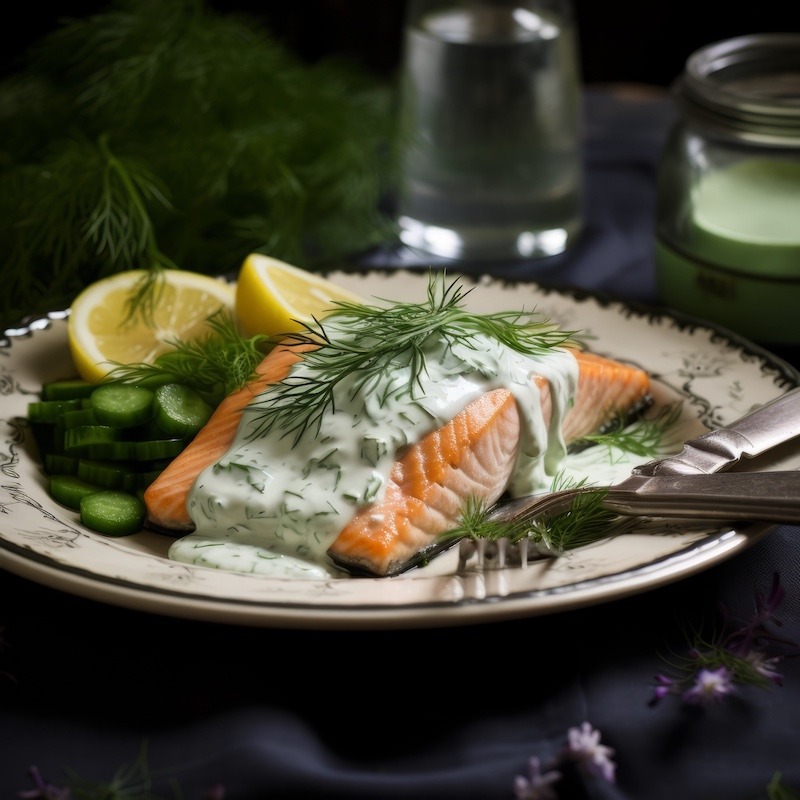
Poached Salmon with Dill Sauce Recipe
Learn how to poach salmon and serve with a delicious dill sauce.
Servings: 4 servings
Ingredients
For the Salmon
- 2 pounds salmon fillet
- salt and pepper to taste
- ½ cup wine
- 2 quarts fish stock broth, enough to cover salmon
For the Poaching Liquid
- bouquet garni
- ½ cup onion diced
- ¼ cup carrot diced
- ¼ cup celery diced
For the Dill Sauce
- 1 bunch dill
- ½ bunch flat-leaf parsley
- 6 ounces crème fraiche
- lemon juice to taste
- salt and pepper to taste
Instructions
For the Salmon
- Salt and pepper the salmon on both sides.
- Add the wine, broth, bouquet garni, onion, carrot, and celery to the poaching pan. Bring the liquid up to about 160°F. Hold at this temperature for fifteen minutes.
- Carefully lower the salmon into the pan. Add more broth, if necessary, to cover.
- Gently poach the salmon until it reaches an internal temperature of 140°F.
For the Dill Sauce
- Remove larger stems from the dill and the parsley.
- Put the ingredients in the bowl of your food processor. Process with on-off pulses until you have a thick sauce.
- Taste, and add more lemon juice, salt, and/or pepper, if you need it.
Serving
- The dish can be served warm or cold. If serving cold, make the salmon well ahead and chill it in its poaching liquid. Before serving, make the sauce. Then, slice the salmon into four portions, topping each with ¼ of the sauce.
- If serving warm, gently warm the sauce on the stove, stirring constantly. Serve over the warm salmon.


16 Responses
Looks divine. Questions: 1) Do you remove the skin from the fish before poaching? 2) What do you recommend as an accompaniment with the fish? i.e. mashed potato or salad etc.?
Hi Peter, thanks for the questions. I leave the skin on the fillet because that’s how I buy it. I suppose I could ask my fishmonger to remove the skin or remove it myself but after you poach it, I may serve it in pieces and the meat comes off the skin easily. As for what to serve, the options are limitless. Go with something in season. Mashed may be too heavy for this dish. I would prefer new potatoes. Salads always work well. – RG
What about salmon steaks?
Hi Lucy, I wouldn’t poach salmon steaks. – RG
Hello! I think this recipe is great! But can i use snapper instead of salmon? Thanks!
Hi Sarsi, I don’t see why not. Give it a try and let me know how it turns out for you. – RG
RG, I adapted your recipe slightly and wrapped the salmon in a filo pastry and popped it in the oven. It was masterful. Thanks for all you great stuff
You are welcome Tim – RG
Wow reading you’re recipe makes me hungry, plus the fact it’s healthy. Thank you for your very informative post. I’m hoping to read more recipes from you.
Hi Lovi, thanks for commenting, and I look forward to more of your comments. – RG
Your recipe looks good. We are white meat lovers and I would like to try this at home. I am also a cook, I know a good recipe just by looking on how it is done.
I really have to thank you for such a delicious and easy to follow recipe. Though I really don’t cook much often. I have managed to follow the instruction perfectly and the result was promising.
Hi Angela, thanks for sharing. – RG
Whew! this meal is so awesome. It suddenly made me hungry. Thumbs up!
Thanks Wendy Jones for sharing. – RG
Why wouldn’t you poach salmon steaks, in re: your response to Lucy Young? Thank you.
Hi Glen, not sure why I said I wouldn’t poach salmon steaks, except I prefer to grill or roast them, but you can certainly poach them if you like. Salmon is just a great fish for poaching, no matter what the cut. – RG
Easy to prepare and a great meal. We poached the salmon following the recipe but we prefer a warm sauce so we made our own. Two tbsp of butter, 1/8 cup of white wine, 2 tbsp of fat free half and half and 1 tbs of fresh dill. This is for 1lb of salmon.
Sounds good Dan, I’ll have to try it. – RG
salmon salmon salmon i love that dish, it’s very delicious and healthy for me with side salad… yummy