

Fast Answer
You don't need to cook from scratch to eat well — you need to assemble well. Buy the shortcuts, then do the one thing the packages can't do for you: taste what you've built and fix what's missing, usually salt, acid, or something fresh.
The Night Five Good Ingredients Still Tasted Like Nothing
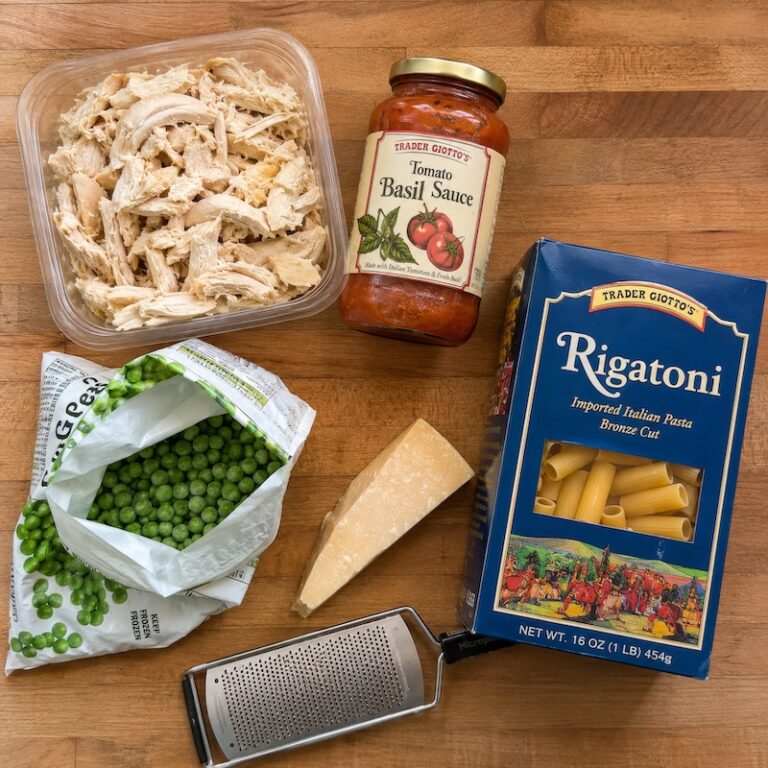
That pasta had every reason to work. Good rotisserie chicken, a decent jarred sauce, frozen peas, rigatoni, real Parmesan — heated, combined, and served the way I’ve done a hundred times. It still tasted like nothing, and the ingredients weren’t the problem.
The pasta water went down the drain unsalted, the sauce never got tasted or adjusted as it simmered, and nothing went in at the end to pull it together. That’s a seasoning problem, not an ingredient problem — and it’s the same gap behind almost every flat shortcut meal.
This page turns the fix into a system you can run on any of them.
Start Here
- You don't need more time — you need fewer steps that still work. The system below has one prep step (open packages) and one skill step (taste and adjust). Nothing here asks you to find more hours in your evening.
- You don't need to become a "real cook." The skill this requires is tasting something and noticing what it's missing — a skill you already use every time you eat. You've just never been asked to apply it mid-cook instead of after the first bite.
- This isn't a workaround for real cooking — it's a real way to cook. Professional kitchens build dishes out of prepped components constantly. Assembly plus adjustment is a legitimate method, not a lesser version of cooking from scratch.
- Start with whatever's already fast in your kitchen. A rotisserie chicken, a can of beans, leftover cooked meat, a bag of frozen shrimp — the method below works with whatever protein takes the least effort tonight.
Why This Works
- Store-bought shortcuts already did most of the work. A rotisserie chicken is seasoned, cooked, and rested by someone doing it dozens of times a day. A jarred sauce has been balanced and tested. You're not starting from zero — you're starting most of the way there.
- What's missing is never a whole recipe — it's one or two small adjustments. Packaged food is built to taste complete on its own, sealed in a jar or a bag, with no idea what you're going to put next to it. It can't season itself for your specific plate. That's your job, and it's a small one.
- You already know how to do the hard part. Tasting something and deciding it needs salt, or brightness, or heat isn't a technique you have to learn — it's something you do every time you eat. This just asks you to do it one bite earlier, before the plate leaves the kitchen.
- Some shortcuts need more help than others. White meat from a store rotisserie chicken is a common one — mild on its own, and it dries out fast when reheated. That's not a reason to skip it, just a reason it needs seasoning to carry its weight, not just heat.
Think Like a Cook
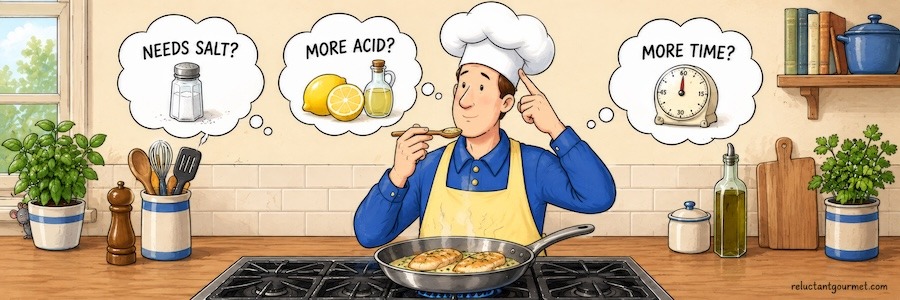
- Your job isn't to cook from scratch — it's to taste at the end and put back whatever got lost along the way. Every shortcut trades something for speed. Your only real job is noticing what got traded away and deciding if it's worth putting back.
- A flat shortcut meal usually isn't missing skill — it's missing an editor. Something to cut through the sameness: salt, acid, chili, fresh herbs, a squeeze of citrus. One sharp edge is usually enough to make four soft ingredients taste like they're in the same dish.
- Treat every shortcut ingredient as a draft, not a finished product. Even something ready to eat straight from the container is a starting point, not the final answer. The jar got you 90% there. Tasting and adjusting gets you the rest.
Common Mistakes
- Skipping the taste before you plate. A jarred sauce simmering on the stove still needs a taste and a pinch of salt partway through — not just a taste at the very end, and often not a taste at all.
- Cooking pasta in unsalted water. Unsalted water leaves pasta flat from the inside out, and it throws away your easiest tool for pulling a sauce together — a ladle of that starchy water, saved before you drain, does more than another splash of sauce ever will.
- Dumping cold additions straight into a simmering sauce. Frozen peas and cold leftover meat both cool the sauce down and add moisture without adding flavor — that's how a sauce goes from thick to watery halfway through cooking. Thaw or drain first, and let the sauce reduce back down.
- No fat or aromatics finished in at the end. Jarred sauces are usually light on olive oil. Parmesan on top is a garnish — it's not a substitute for a knob of butter, a drizzle of olive oil, or a smashed garlic clove stirred into the sauce itself.
Real Example: Fixing a Bland Chicken and Pasta Night
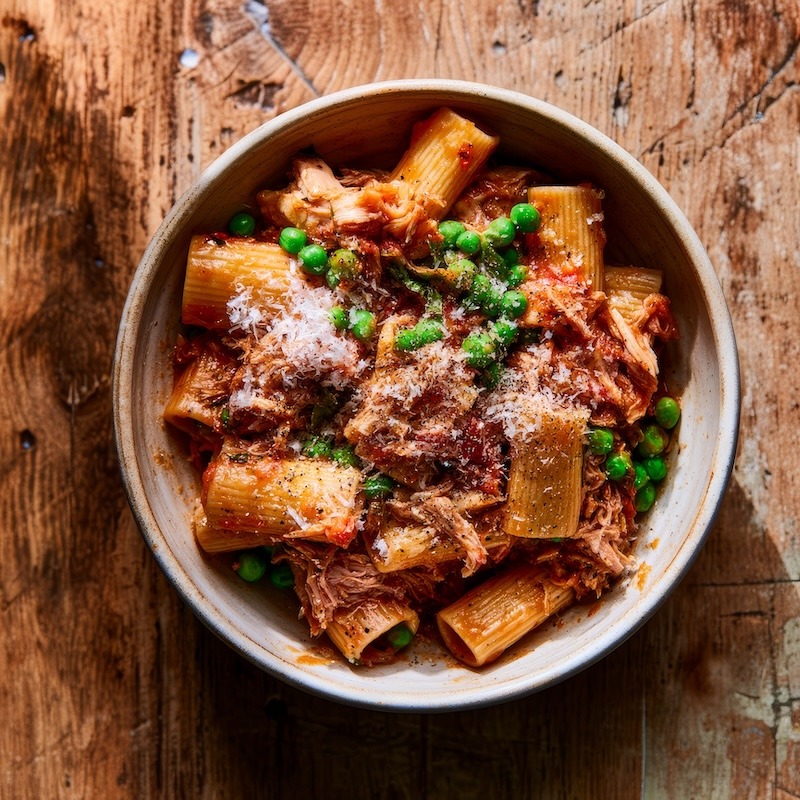
- The dish: leftover rotisserie chicken breast, a jar of Trader Joe's Tomato Basil Sauce, a quarter bag of frozen peas, rigatoni, and fresh Parmesan — heated, combined, and served. Every ingredient was good. The plate still tasted like nothing.
- Protein: covered, but mild on its own — white meat rotisserie chicken needed seasoning to carry its weight, not just heat.
- Starch: covered, but the pasta water went down the drain unsalted — a missed chance to season the pasta itself and loosen the sauce later.
- Something fresh: missing. The peas went in frozen, straight into the sauce, cooling it down and adding moisture without adding flavor.
- Something to tie it together: the jarred sauce was doing all the work alone, with no fat or aromatics added and no adjustment for everything it was being stretched to cover.
- Taste and adjust: skipped entirely — the sauce went from jar to pot to plate without a single taste along the way.
- The fix: salt the pasta water like the ocean. Thaw and drain the peas before they go in, and let the sauce reduce back down instead of thinning out. Taste the sauce as it simmers and season it — salt, pepper, a smashed garlic clove, maybe red pepper flakes. Off heat, stir in a splash of the reserved pasta water, a knob of butter or drizzle of olive oil, and the Parmesan. That's the whole fix, and it's the same fix for almost any bland shortcut meal: not more ingredients, more attention paid to the ones already there.
Frquently Asked Questions
Is assembling a meal from shortcuts actually cooking? Yes. Cooking is judgment applied to ingredients, not a count of how many steps you performed from raw materials. A cook who tastes a dish and adjusts it is doing the actual work of cooking, even when someone else roasted the chicken.
What if I don’t have leftovers or a rotisserie chicken on hand? The checklist still works with a can of beans, a bag of frozen shrimp, or a couple of eggs. Protein doesn’t have to be pre-cooked — it just has to be fast. The method matters more than having one specific ingredient in the fridge.
How is this different from just eating a frozen meal? A frozen meal is fixed — whatever’s in the tray is what you get. This gives you the same speed but keeps every piece adjustable, so you can taste it and fix what’s missing. A sealed tray never gives you that option.
Explore More Shortcut Meals
- This checklist applied directly to a jarred sauce, start to finish: How to Doctor Store-Bought Tomato Sauce.
- Same method, applied to a rotisserie-chicken bowl: Chicken Teriyaki Bowls (coming soon).
- Same method, applied to leftover rice: Pork Fried Rice (coming soon).
- Same method, applied to a specific marinade and prep: Greek Chicken Gyros (coming soon).