
Quick Reference: What Is Gastronomy
- What gastronomy actually means: the study of food and culture, not just cooking technique. Lesson: if you’ve ever asked why a dish tastes like where it’s from, you’re already doing it.
- Gastronomy in the industry: shows up in menu R&D, food media, food policy, and tourism – not just fine-dining kitchens. Lesson: most gastronomy jobs aren’t in a kitchen at all.
- Gastronomy vs. culinary arts: culinary arts is the practice of cooking; gastronomy is the study of why it exists. Lesson: most serious cooks end up doing both without noticing.
- History of the word: coined in 1801, popularized by Brillat-Savarin’s 1825 “Physiology of Taste.” Lesson: every food “trend” is the same 200-year-old argument continuing.
- Studying gastronomy: real degree programs exist at Boston University, NYU, and Italy’s University of Gastronomic Sciences. Lesson: it’s a food-culture degree that happens to teach you to cook, not the reverse.
What Gastronomy Actually Means
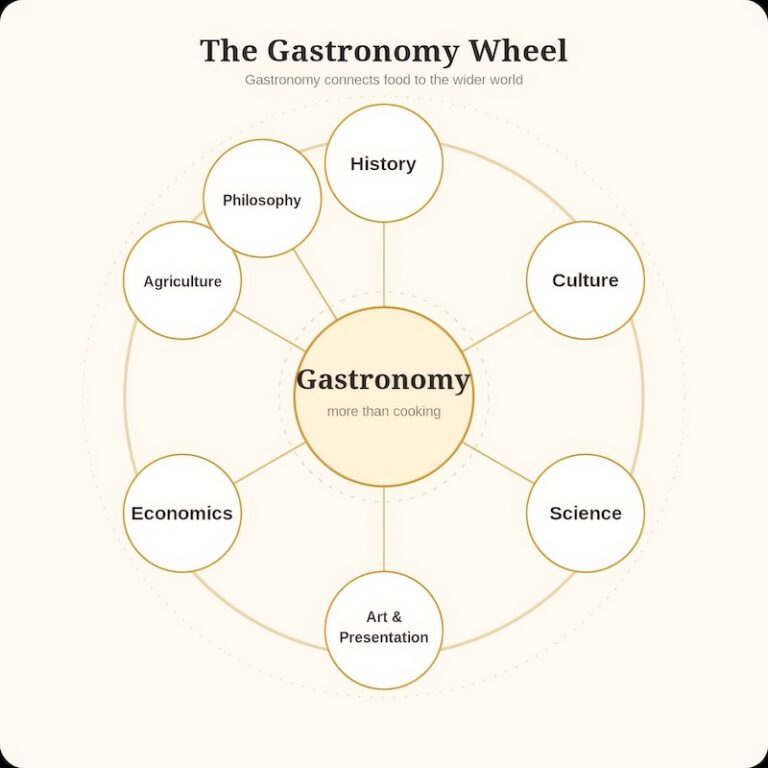
- Gastronomy is the study of the relationship between food and culture – not just cooking, but why people cook the way they do.
- It covers ingredient selection, technique, and presentation, as well as history, geography, and social customs.
- You don’t need a professional kitchen to practice it. A home cook asking why a recipe works is doing gastronomy, whether they call it that or not.
The lesson: if you’ve ever wondered why a dish tastes like where it’s from, you’re already thinking like a gastronomist.
How Gastronomy Shows Up in the Food Industry
- Restaurant concept and menu development: chefs and consultants use gastronomy research – regional history, ingredient origin, technique lineage – to build a restaurant’s point of view, not just its dishes.
- Molecular gastronomy: the fine-dining end of the field, using food science to change texture and form – foams, spherification, that sort of thing. A specialty, not the whole discipline.
- Food media and criticism: food writers, critics, and historians are doing gastronomy even when nobody calls it that – the job is explaining why a dish matters, not just whether it tastes good.
- Food policy and sustainability: gastronomy training shows up in work on food systems, sourcing, and public health – the kind of work covered in what a food activist actually does.
- Gastronomy tourism: tour companies and destination marketers use the term literally – food-focused travel built around regional cuisine and culinary history.
The lesson: you don’t have to work in a restaurant to work in gastronomy. Most of the field is writing, research, and policy – not a kitchen at all.
Gastronomy vs. Culinary Arts: What’s the Difference
- Culinary arts is the practice of cooking – technique, execution, what happens on the line.
- Gastronomy is the study of cooking – why a dish exists, what it means, how it fits into a culture.
- A chef practices culinary arts. A food writer, historian, or curious home cook practices gastronomy. Plenty of people do both.
The lesson: you don’t have to choose one. Most serious cooks end up doing both without noticing.
A Short History of Gastronomy
The word is new. The practice isn’t. Cooking with fire changed what food could taste like, and civilizations have been arguing about how to do it best ever since.
Egypt had organized kitchens. Greece turned meals into philosophy – symposiums where food and drink were the excuse for debate. Rome documented recipes outright: Apicius’s De Re Coquinaria is one of the oldest cookbooks we have.
Trade routes brought spices into medieval Europe, and monasteries – of all places – became places where cooking techniques were preserved and refined. The Renaissance turned cooking into performance, and haute cuisine took shape in the courts of France and Italy.
By the 1800s, gastronomy had a name and a text to go with it. French poet Joseph Berchoux coined the word itself in a burlesque poem back in 1801, but it was Jean Anthelme Brillat-Savarin who made it stick — his 1825 book, The Physiology of Taste, is still what people mean when they talk about the philosophy of eating. Marie-Antoine Carême, meanwhile, plated food like architecture and became, by most accounts, the first celebrity chef.
Industrialization and global trade reshaped what appeared in kitchens throughout the 20th century. Nouvelle cuisine, in the ’60s and ’70s, pushed back toward lighter dishes and cleaner flavor. Today it’s sustainability and food science doing the pushing.
Can You Major in Gastronomy?
Yes. It’s a real degree at a handful of schools, and it’s not the same as culinary school – less knife skills, more why-does-this-dish-exist.
Where to Study Gastronomy
- Boston University: Master of Liberal Arts in Gastronomy – food history and culture paired with hands-on culinary courses.
- University of Gastronomic Sciences (Italy): founded by the Slow Food movement; bachelor’s through PhD, focused on sustainable food systems.
- NYU: Food Studies program – undergrad and graduate degrees centered on the cultural and sociological side of food.
- Auckland University of Technology: BA in Culinary Arts that blends gastronomy theory with practical training.
- Rouxbe / Apicius (Florence): shorter, non-degree options if a four-year program isn’t what you’re after.
What a Gastronomy Degree Leads To
- Chef or culinary instructor
- Food writer or critic
- Food historian or anthropologist
- Food policy analyst
- Culinary consultant or food entrepreneur
The lesson: a gastronomy degree is a food-culture degree that happens to also teach you to cook — not the other way around.
Closing
I came to this without a gastronomy degree, without any formal training in it at all – just curiosity about a word that kept showing up in places I respected. If you’re the same, the resources and schools above are a real place to start, whether you’re after a career in it or just a better answer next time someone asks you what gastronomy actually means.
Frequently Asked Questions
What is gastronomy in simple terms?
Gastronomy is the study of food and culture — why we eat what we eat, not just how to cook it.
What is the difference between gastronomy and culinary arts?
Culinary arts is the practice of cooking. Gastronomy is the study of why that cooking exists and what it means.
What does “gastronomic” mean in food?
“Gastronomic” describes anything related to the art and science of good eating — a gastronomic tour, a gastronomic society, a menu built around the experience of eating well, not just the food itself.
Who came up with the word gastronomy?
French poet Joseph Berchoux coined it in his 1801 poem “La Gastronomie.” Brillat-Savarin’s 1825 book “The Physiology of Taste” is what actually made the word stick.
Can you get a degree in gastronomy?
Yes – Boston University, NYU, and the University of Gastronomic Sciences in Italy all offer gastronomy programs, and none require a professional kitchen background to enroll.
Is gastronomy the same as being a foodie?
No. A foodie enjoys food; a gastronomist studies why it exists in the form it does. Every gastronomist is probably a foodie, but not the reverse.
2 Responses
I am passionate about gastronomy. Cooking is an art that awakens people in wonderful sensations in people.
Informative.