
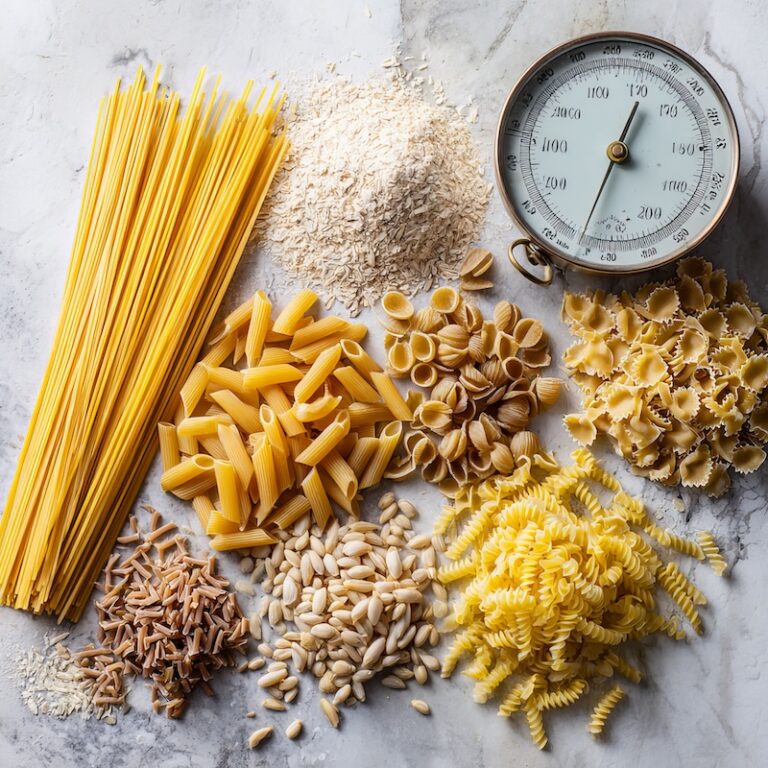
The quick rules: 2 oz dry pasta = 1 serving = about 1 cup cooked. 1 cup dry white rice = 3 cups cooked = 3 to 4 servings. Working backwards from a cooked amount? Divide by 2 for pasta, divide by 3 for white rice
Pasta & Rice Conversions & Equivalents
Quick Reference: The Numbers That Cover Most Situations
- Dry pasta per person: 2 oz (side dish) or 3–4 oz (main)
- 1 lb dry pasta yields about 8 cups cooked, serves 4–5
- 1 cup dry white rice yields 3 cups cooked, serves 3–4
- 1 cup dry brown rice yields 4 cups cooked
- Rice-to-water ratio: 1 cup rice : 2 cups water (the 1-2-3 rule)
- Working backwards? Divide the cooked amount by 3 for white rice, by 2 for pasta.
Pasta Amounts & Yields
Quick rule: Plan on about 2 ounces of dry pasta per person for a side dish or 3–4 ounces for a main course. Cooked volume varies by pasta shape.
| Dry Amount | Approximate Yield |
|---|---|
| 2 oz long pasta | About 1 cup cooked |
| 2 oz penne, ziti or rigatoni | About 1¼ cups cooked |
| 2 oz elbow macaroni | About 1⅛ cups cooked |
| 2 oz rotini or fusilli | About 1 cup cooked |
| 2 oz medium shells | About 1⅛ cups cooked |
| 2 oz orzo | About ⅘ cup cooked |
| 1 lb dry pasta | Serves about 4–5 as a main course or 8 as a side dish |
| 1 lb dry pasta | Yields approximately 6⅖–10 cups cooked, depending on shape |
Pasta Conversions & Equivalents
Convert dry ounces, grams, pounds or cups into cooked pasta and servings.
For long pasta, weight is more reliable than measuring dry strands in cups.
Conversions are approximate. Brand, shape, cooking time and how thoroughly the pasta is drained can change the final volume.
Dry pasta amounts and approximate cooked yields for common pasta shapes
| Pasta type | Dry measure for 2 oz | 2 oz dry yields | 8 oz dry yields | 1 lb dry yields |
|---|---|---|---|---|
| Long pastaSpaghetti, linguine, fettuccine | About a 2⅛-inch bundle | About 1 cup cooked | About 4 cups cooked | About 8 cups cooked |
| Penne or zitiShort, hollow tubes | ⅔ cup dry | About 1¼ cups cooked | About 5 cups cooked | About 10 cups cooked |
| RigatoniLarge, hollow tubes | ¾ cup dry | About 1¼ cups cooked | About 5 cups cooked | About 10 cups cooked |
| Elbow macaroniSmall curved tubes | ½ cup dry | About 1⅛ cups cooked | About 4½ cups cooked | About 9 cups cooked |
| Rotini or fusilliSpirals and corkscrews | ½ cup dry | About 1 cup cooked | About 4 cups cooked | About 8 cups cooked |
| FarfalleBow ties | ¾ cup dry | About 1¼ cups cooked | About 5 cups cooked | About 10 cups cooked |
| Medium shellsConchiglie | ¾ cup dry | About 1⅛ cups cooked | About 4½ cups cooked | About 9 cups cooked |
| OrzoRice-shaped pasta | ⅓ cup dry | About ⅘ cup cooked | About 3⅕ cups cooked | About 6⅖ cups cooked |
| DitaliniVery short tubes | ⅓ cup dry | About 1¼ cups cooked | About 5 cups cooked | About 10 cups cooked |
| Pastina or stellineTiny soup pasta | ⅓ cup dry | About 1¼ cups cooked | About 5 cups cooked | About 10 cups cooked |
Keep in mind: Pasta shape, brand and cooking time can change the final volume. Use these figures as practical kitchen estimates. Measure long pasta by weight whenever possible.
Pasta Amounts & Yields
Quick rule: Most dried pasta roughly doubles when cooked, so plan about 2 ounces dry per person.
| Amount | Yield / Serves |
|---|---|
| 1 lb dried pasta (16 oz) | Serves 4–5 people |
| 2 oz long pasta | About 1 cup cooked |
| 2 oz short pasta | About 1¼ cups cooked |
| 2 oz soup pasta | About ⅔ to 1 cup cooked |
| 2 oz shells | About 1 cup cooked |
| 1 lb dried pasta | About 4 cups dry |
| 1 cup dry pasta | About 2 cups cooked |
| 1 lb dry pasta | About 8 cups cooked |
| 2 oz (1 cup) dry egg noodles | About 1 cup cooked |
Dry pasta weight conversions and approximate servings
| Dry Ounces | Dry Grams | Pounds | Side Servings (2 oz each) |
Main Servings (3–4 oz each) |
|---|---|---|---|---|
| 1 oz | 28g | 1/16 lb | ½ serving | Less than 1 |
| 2 oz | 57g | ⅛ lb | 1 serving | Small portion |
| 3 oz | 85g | 3/16 lb | About 1½ | 1 serving |
| 4 oz | 113g | ¼ lb | 2 servings | 1 generous serving |
| 6 oz | 170g | ⅜ lb | 3 servings | About 2 |
| 8 oz | 227g | ½ lb | 4 servings | 2–3 servings |
| 12 oz | 340g | ¾ lb | 6 servings | 3–4 servings |
| 16 oz | 454g | 1 lb | 8 servings | 4–5 servings |
Quick answer: One pound of dry pasta equals 16 ounces or approximately 454 grams. It provides about eight 2-ounce side servings or four to five main-course servings. Cooked cup volume varies by pasta shape, so use the Pasta Conversion Master Table for shape-specific yields.
How Much Pasta Per Person?
Plan on 2 ounces of dry pasta per person when serving it as a side dish or small first course. That is also the standard serving recommended by pasta manufacturers such as Barilla.
For a main course, 3 to 4 ounces per person is more realistic, especially when the pasta is the focus of the meal. One pound of dry pasta will generally serve four hungry people as a main course, although I often end up with leftovers when I cook a full pound for four.
You can also measure long pasta by the bundle, but weighing it is much easier and more accurate. A kitchen scale removes the guesswork, especially when you are trying to avoid cooking half a box too much.
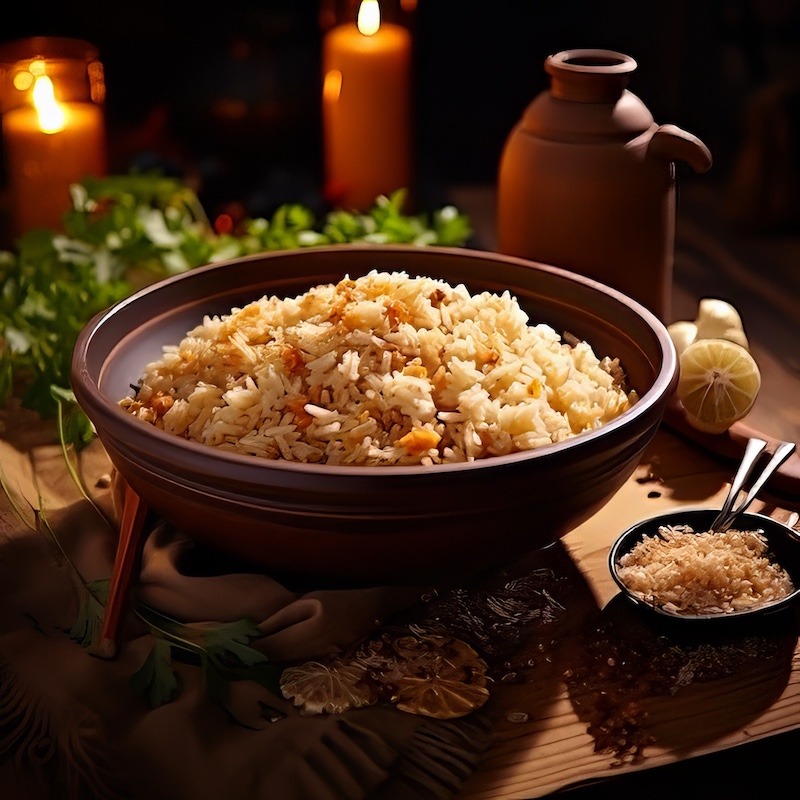
Rice Conversions & Equivalents
Rice Amounts, Yields & Servings
Quick rule: Most dry rice roughly triples in volume when cooked. Plan about ½ cup cooked rice per person as a side dish or up to 1 cup as a main dish.
| Amount Uncooked | Approximate Yield |
|---|---|
| 1 cup white rice | About 3 cups cooked |
| 1 cup brown rice | About 3 cups cooked |
| 1 cup instant rice | About 2 cups prepared |
| 1 cup wild rice | About 3½ cups cooked |
| Main-Dish Portions — 1 Cup Cooked per Person | |
| ¾ cup uncooked rice (about 140g) | Serves about 2 |
| 1 cup uncooked rice (about 185g) | Serves about 3 |
| 2 cups uncooked rice (about 370g) | Serves about 6 |
| Side-Dish Portions — ½ Cup Cooked per Person | |
| ¾ cup uncooked rice (about 140g) | Serves about 4–5 |
| 1 cup uncooked rice (about 185g) | Serves about 6 |
| 2 cups uncooked rice (about 370g) | Serves about 12 |
Dry weights are based on white long-grain rice. Other rice varieties may weigh slightly more or less per cup.
Convert dry cups, ounces, grams or pounds into cooked rice, liquid and servings.
Enter any dry amount. Results update automatically.
Conversions are approximate. Rice variety, brand, rinsing, soaking, pot size and cooking method can change the amount of liquid needed and the final yield. Check the package directions when they differ.
How Much Rice Per Person?
Plan on about ½ cup of cooked rice per person when serving it as a side dish. If rice is the base of the meal—such as a rice bowl, curry or stir-fry—allow ¾ to 1 cup cooked per person.
For most white rice, ¼ cup dry makes approximately ¾ cup cooked. That makes ¼ cup dry per person a practical starting point, although appetite and the rest of the meal will determine how much you actually need.
In our house, we usually cook extra because the leftovers go into our daughters’ lunches. I would rather have a little rice ready for the next day than come up short at dinner.
Frequently Asked Questions On Pasta and Rice Conversions
How much dry pasta do I need per person?
As a side dish, 2 oz dry per person. As a main course, 3–4 oz. A standard 1 lb box serves 4 generously as a main or 5–6 as a side.
My recipe calls for cooked pasta or cooked rice — how do I know how much dry to start with?
Divide the cooked amount by 2 for pasta, by 3 for white rice. If a recipe calls for 3 cups cooked white rice, start with 1 cup dry. If it calls for 4 cups cooked pasta, start with about 2 cups (roughly 8 oz) dry.
How much dry rice do I need per person?
For a side dish, ¼ cup dry white rice per person yields about ¾ cup cooked. For a more generous portion or when rice is the base of the dish, use ⅓ to ½ cup dry per person.
What’s the rice-to-water ratio?
1 cup rice to 2 cups liquid yields 3 cups cooked — the 1-2-3 rule. For brown rice use 1 cup rice to 2¼ cups water. For instant rice, check the package — it typically uses a 1:1 ratio.
How much liquid do I use for 1½ cups of cooked white rice?
½ cup dry white rice and 1 cup liquid. The 1-2-3 rule scales proportionally at every amount.
My recipe is in grams. How do I convert?
Dry pasta: 1 serving is 2 oz / 57g. A full pound is 454g. Dry white rice: 1 cup weighs about 180–185g dry, and about 195–200g cooked.
Does pasta shape affect how much it expands when cooked?
Yes, modestly. Long and short pasta both roughly double by weight, but tubular pasta traps water and feels slightly more voluminous by the cup. Soup pasta like orzo expands less — about ⅔ to 1 cup cooked from 2 oz dry. Egg noodles are the outlier — they stay close to 1:1 by volume.
What about arborio rice — does it convert the same way as regular rice?
Cooked like regular rice (not risotto method), use 1 cup arborio to 1½ cups liquid, yielding about 3 cups cooked. Risotto is different — you add warm stock gradually over 20–25 minutes, using 3–4 cups total per cup of rice. That’s a technique, not a conversion.
Does quinoa convert the same way as rice?
Yes — 1 cup quinoa to 2 cups liquid yields about 3 cups cooked, same as white rice. It’s done when the germ ring (a tiny white spiral) appears around each grain, usually around 15 minutes. For other grains, see the grain conversions guide.
Is package rice like Rice-a-Roni the same as instant rice?
No. Instant rice is fully pre-cooked and rehydrates in minutes at a 1:1 ratio. Rice-a-Roni uses regular long-grain rice combined with vermicelli and a seasoning packet — it cooks longer and follows roughly the same ratio as standard white rice. Always follow the package instructions.
How do I measure spaghetti without a kitchen scale?
A bundle about the diameter of a quarter is roughly 2 oz — one serving. A kitchen scale is faster and more reliable: 2 oz is 57g.
Can I cook rice in something other than water?
Yes, and it’s worth doing. Chicken or vegetable stock uses the same 1:2 ratio and adds flavor without changing the yield — especially useful for pilaf and rice side dishes where the rice needs to carry some flavor on its own.
29 Responses
If 1/4 cup uncooked rice serves 1 person, wouldn’t 1 cup uncooked rice serve 4 people (not 2 cups serve 4 people)? Just asking! 🙂
Hi Kathryn. You’re right that ¼ cup dry rice per person would mean 1 cup dry serves four people. That assumes each person receives about ¾ cup cooked. One cup dry makes approximately 3 cups cooked, so it serves three people at 1 cup each, four people at ¾ cup each, or six people at ½ cup each.
This is SO helpful! Thank you so much!
Many thanks,I’m making a rice and bean (Costa Rica)dish and didn’t want to make as much as they were asking. Glad I saw this sight
I am making a rice dish which calls for 350g of rice….I guess it would be cooked, how many cups would that be
Hi Karen. The recipe should specify whether the 350g is dry or cooked because the difference is substantial. If it means dry white rice, 350g is approximately 1⅞ cups dry and will make about 5½ to 6 cups cooked. If it means cooked rice, 350g is approximately 1¾ to 1⅘ cups cooked.
This has been so helpful. Thanks!
Thank you for your conversions!! ?
Are there different conversions for short-grain (e.g. arborio) rice?
Hi Adele. Yes. Short-grain rice generally needs less liquid than standard long-grain rice. One cup of dry white short-grain rice uses about 1½ cups of water and yields approximately 3 cups cooked. Arborio, prepared as risotto, may use up to 4 cups of stock per cup of dry rice because you add the liquid gradually.
my local barilla package recommends a 80 grams portion. which is 2,82 oz.
I must say a typical weekday dinner I ate around 3,5 oz really, when it’s the main dish.
Would one cup of uncooked quinoa yield the same amount as one cup of uncooked long grain white rice?
Hi Sally, 1 cup of quinoa cooked with 2 cups of liquid yields 3 cups of cooked quinoa. So your answer is yes. You can find conversions for grains here.
Although this may be helpful for some people, this was completely useless for me. I asked a simple question and LITERALLY nobody on the internet can answer me! This is a conversation page, and its information for me is worthless. And it’s not this site alone.
I just want to know how much of a certain thing is uncooked to cooked. It shouldn’t be this freaking hard. Never mind I’ll do it my damn self since nobody can help me. Your website is literally supposed to be about conversions, I figured you would be able to help. And I’m sorry you’re getting the brunt of this. I’m just so frustrated and your headline on Google made it appear as if you’d help. And after much searching im just going to have to waste food and time and figure it out myself.
I hope you can help other people because none of this was helpful to me.
Hi Chantel. I’m sorry the page didn’t answer the specific conversion you needed. If you tell me the ingredient, how much you have, and whether you need the dry or cooked amount, I’ll help you work backward. Conversions vary considerably between different pasta shapes and rice varieties, which is why one general formula doesn’t always work.
Thank you for all this info. I’m about to attempt cooking crawfish etouffee for 400 people for a church festival. My first question was answered here in how to figure out the rice conversions. Thank you so much.
I think Chantel was just looking for a place to complain and found it here.
Thank you again for the info.
Thank you so much for these conversions! I went to culinary school and I scoured my textbooks I saved for this information to no avail. I usually guesstimate when I’m cooking at home and am spot at times on or come really close. But I wanted something more precise for my need. My 14 year old niece has started cooking and is really enjoying it. So I am making a cookbook of recipes perfect for a cast iron skillet and I wanted to take some information and compile some “useful” charts in the book for conversions of various things as a resource and reference for her. I’m pairing this book along with her very first cast iron skillet for Christmas. I wasn’t exactly sure how to put my guesstimates into word and wanted something more precise for her and these perfect! I will make sure to credit your website under the charts I put in the book.
Thanks again!
You are welcome Liana.
In pkg rice such as rice a roni— is that instant rice???
Hi Joan. Rice-A-Roni is not instant rice. It combines regular rice, pasta and seasoning, so its liquid ratio and cooking time differ from instant rice. Follow the package directions for that specific product.
First thing that popped up when we Googled “recipe calls for 3 cups cooked rice”. Thanks for taking the time to put this together!
Good information.
My recipe calls for 1 1/2 cups of cooked white rice. How much dry rice and how much liquid.Thanks for your help. Nicki
Hi Nicki, if you look at the chart you will see 1 cup uncooked white rice yields 3 cups cooked rice so if you halve the 3 cups to 1 1/2 cup, the uncooked would be 1/2 cup. The ratio of rice to liquid is 1 to 2 so 1/2 cup of uncooked rice needs 1 cup of liquid to yield 1 1/2 cups cooked.
What about arborio rice. What’s the yield on 1 cup of uncooked arborio rice? I’m not talking about risotto where you have to use like 4 cups of water for 1 cup of arborio. If you cook arborio like you cook any other rice, what’s the yield?
Thanks
One more detail: when you cook Arborio by absorption rather than as risotto, 1 cup dry generally yields about 3 cups cooked. Use approximately 1½ cups of liquid as a starting point, but check the package because brands and methods vary.
I wish I could save this to my Pinterest so when I need it, I can find it. I have a very short memory.
I need to know how much raw rice to use instead of 1 1/2 cups raw pasta plz ?? Anyone ?? ??
Hi Mel — rice and pasta don’t swap cleanly by volume because they absorb water differently. As a rough guide: 1½ cups dry pasta cooked yields about 3 cups cooked pasta, which would take about 1 cup of dry white rice to match (yielding 3 cups cooked). If you’re substituting rice for pasta in a recipe, use equal amounts of cooked volume as your target, then work backwards from there using the dry conversion for whichever grain you’re cooking.