

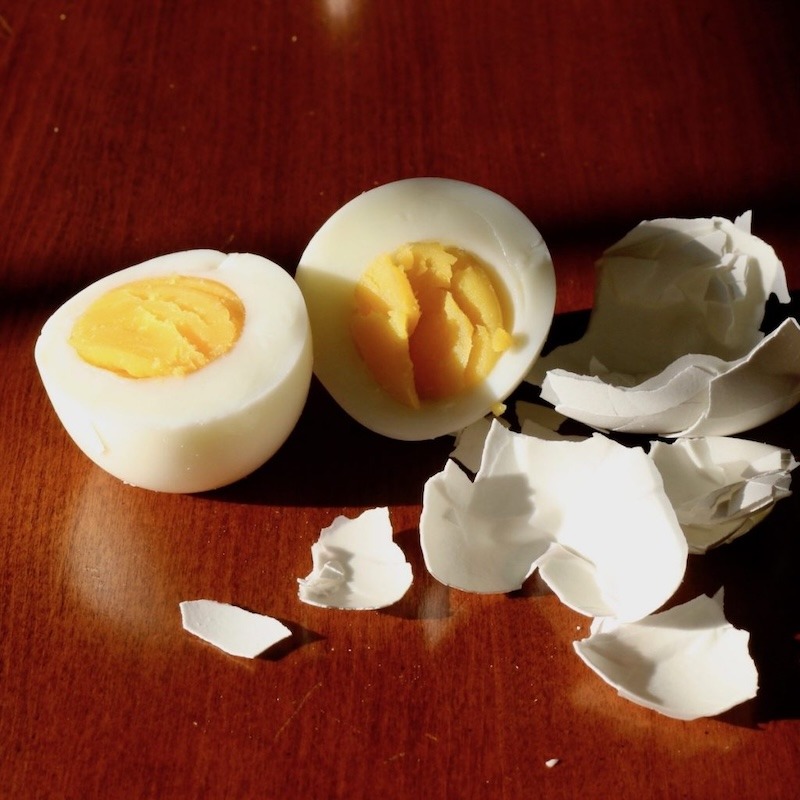
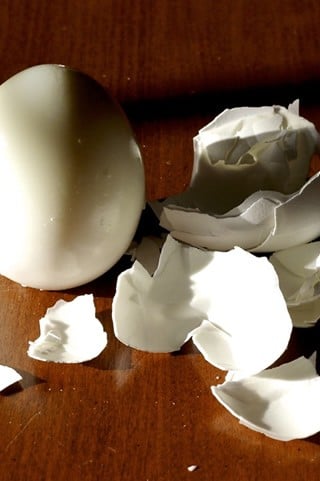
| Pre-Boiled Egg | No Pre-Boiling Egg |
|---|---|
|
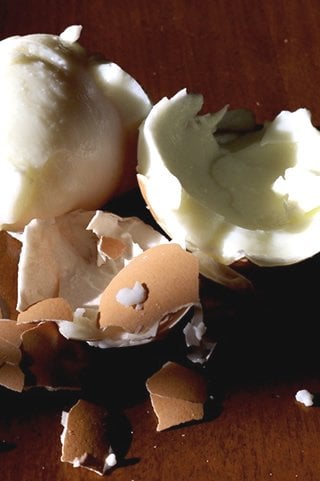
|
| Result: Clean peel, smooth surface, minimal tearing | Result: Egg sticks to shell, rough surface, frustrating to peel |
How to Sous Vide Perfect Hard Boiled Eggs
Sous vide hard-boiled eggs use precise temperature control to deliver perfectly set yolks and tender whites every single time.
Equipment
- My old hard-anodized 4 quart sauce pot
- Oven safe plastic slotted spoon
- Large stainless steel bowl for ice water
- Cambro 4.75 gallon polycarbonate food storage container for sous viding in
- Anova Sous Vide Precision Cooker
Instructions
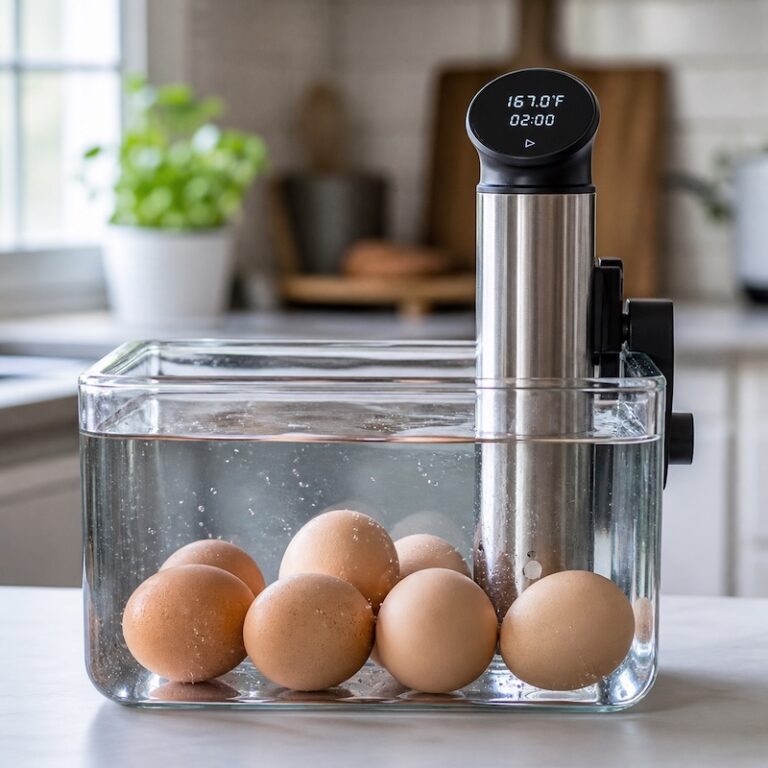
Preheat the Water Bath
- Set your sous vide machine to 167°F (75°C). Let it fully come to temperature before adding eggs.
Starting at the right temperature prevents uneven cooking.
Add the Eggs
- Gently lower eggs directly into the water. No bag needed.
Cook the Eggs
- Cook for 13–15 minutes, depending on how firm you want the yolk.
Ice Bath Immediately
- Transfer eggs to an ice bath for at least 5 minutes.
This stops cooking and improves peeling.
Peel & Serve
- Tap, roll, and peel under running water if needed. Serve immediately or store.
Start peeling from the wider end where the air pocket sits.

46 Responses
Just curious; did you try the same experiment, this time pre-boiling the brown eggs and not the white eggs? or – does it matter, in your opinion, if you use brown eggs or white – if you preboil them first?
It should not matter at all if you use brown or white eggs but I did find if I did NOT pre-boil the eggs first, they were impossible to get out of the shell.
FYI : Brown eggs are from brown hens, white eggs from white hens. That’s all there is to it.
Hi Marie Jo, I’m not sure that is totally true. I believe it has more to do with the breed, not the color of the bird. I did find some references to the color of the hens earlobes – chickens with white earlobes produce white eggs and chickens with brown earlobes produce brown eggs. You have white, yellow, black and brown chickens that lay white eggs and other breeds the same colors that produce brown eggs. There are even some breeds that produce blue-green eggs but the chickens aren’t blue or green. Interesting tidbit, once a hens starts laying eggs, the color will always be the same.
You are so right! I have black, tan, gold and white chickens and only get light brown and blue/green eggs. Still narrowing down who is laying which color. The earlobes are all white or red which doesn’t match the eggs. I think I have easter eggers AKA mutts.
and chocolate milk comes from brown cows.
This was great. I too have thought about doing a side by side study. My question would be, will it peel easily if I just wait until the egg is cooked then shock them for 15 minutes in an ice bath? Have you experimented there?
I have not Millie but it would be interesting to find out and I do need some more hard boiled eggs.
Thanks for the writeup. I will try it but instead of pre-heating the water bath, why not just use the boiled water, adding a little of the ice bath to cool it down until you hit your target temp with in instant read thermometer?
Good idea. Let me know how it works for you.
It’s so much hassle of boiling eggs for 3 minutes, use an ice bath, and then toss the eggs into a container for an hour with the circulator going. I’d say putting the method of putting eggs and water into a pan, bringing to a boil, and removing from heat to sit for 20-30 minutes is a lot more convenient. The result should be near identical in less time and with a lot less effort.
But thanks for the experiment. I appreciate that you shared your results with us.
I have tried the method you list here, but I found that my eggs cooked differently, base on the size of the egg. The larger eggs are a little underdone and the smaller eggs are a little overdone. For me, the advantage of the sous vide is that I don’t have to guess how long to boil based on egg size. This pre-boil and sous vide method is definitely extra work, but I like the consistency.
Well I bought myself and Anova Sous Vider for myself for Christmas. Mine has to be controlled by my phone? Followed their recommendations for hard cooked eggs but use your 3 min. boil. 45 min at 160 F per their recommendation a disaster! Took 3 more eggs out at 5 min intervals to 1 hour. (Local grocery had 18 eggs for $.97 so I am experimenting.) Dropped each in an ice bath for 15 min. Whites were still way too soft. Next batch at 160 F for 75 min. and will again take them out in 5 min. intervals. Have 3 nicely cooked yolks to make Caesar salad dressing with.
Will let you know how the second experiment goes. Thanks for the tips.
Yes, please let me know how you do with your eggs. Can you believe how the price of eggs have come down. A year or two ago they were so expensive.
Thanks for writing this article, very helpful! I tried your method and got great hard boiled, easy to peel eggs. I had tried the 165 degrees for 45 minutes (based on information from another webiste) and the yolks came out transparent — not what I was hoping for. 165 degrees for an hour after the 3 minute preboil produced great eggs that were easy to peel.
Good to hear about your results Sarah. Thanks for letting me know.
were the whites fully cooked and the yokes runny, based on your method? Nice write-up, thanks.
Hi Allan, these were hard boiled eggs so the yokes were not runny but with sous vide you can have your eggs any way you want them.
I have tried so many times to make a hard boiled eggs. Followed so many suggestions and never could get one to peel perfectly. I followed the 3 min boil, ice bath, sous vide for an hour at 165, ice bath… they came out perfect. It takes time, but not really too much work. Thanks so much for the suggestion.
You are very welcome Kevin.
I purchased a sous vide just before Christmas and hard cooked eggs were one of the first things I tried. Honestly I am not seeing any great difference from eggs cooked in a pot and shocked and those sous vide. I followed your method of simmering for 3 min. then sous vide them and shocking in ice water. Most peeled cleanly others did not. The white texture was finally set at a hour and 5 min. The yolks probably could have used a bit more. I am using the method of sous vide to get meat more tender and juicy. With regard to the hard cooked eggs I think I will stick to the old simmering pot method and avoid having to double cook using a traditional pot then the sous vide. Any thoughts
I’m currently on my second run thru using this method and just wanted to say thanks. I haven’t done very much sous vide at all (just got one for xmas), but these were the best hb eggs I’ve ever had. I don’t think I could get the yolk the same any other way (disclaimer – definitely not an expert at hb eggs). I’m sure there are easier ways but the extra work is totally worth it. Looking forward to some egg salad later today! Thanks again.
You are very welcome. I love how you can cook your eggs to the perfect temperature (consistancy) whether you want hard or soft boiled eggs with sous vide. I received an InstaPot for Christmas and have to say I can make hard boiled eggs that are also perfect without all the extra work and the shells come right off with no fuss.
I’ve done eggs by sous vide several times and always had great doneness but annoying peeling problems. After googling and trying several sous vide methods and additives like vinegar, baking soda, etc., I gave this method a shot to hb our eggs for Easter. The results were, in a word, perfect!
The cook was perfect with firm, melt in your mouth yolk, typical of sous vide eggs, but the peel results were amazing. This is definitely the method to go with. So good that I was told by my in-laws that they will place hard-boiled egg orders with me in the future.
Thanks Matt for letting me know.
You mention altitude playing a part in cooking the eggs, but you don’t say anything about it in the instructions. I just purchased an Avona sous vide and immediately tried to make eggs. I followed their instructions in the app, 160 for 45 minutes. They were so runny that I could barely eat them. I live in Denver, so I’m wondering if altitude played a part? I’ll try the 3 min boil ahead of time next to see if that helps.
Liz, great point and I’m guessing it has to do with altitude but it could be other factors as well including the age of the eggs but I’m not sure. Please come back and let us know your results after trying the 3 minute boil.
Altitude will affect the boiling point of water.
Sea level is 100c to boil water.
1000 ft above sea level=99c to boil water.
This is so accurate, that before altimeters, explorers would boil water to check the temperature of boiling water to see how far above sea level they were.
Does this help? Not sure, but in Denver, your water boils at 95c.
Since you are not boiling the eggs in sous vide, that may or may not change the outcome.
However, you will need to boil your eggs for an extra 5% based on your altitude before ice bath and sous vide. But that is a mere 9 seconds.
It is possible (and eggs are tricky little buggers) that high altitude eggs are different in their overall density, as eggs are “alive” even if unfertilized, and breathe. Be glad you aren’t making hard boiled eggs on Everest.
Altitude, I know for a fact, changes recipes that require any amount of heating/boiling liquid. I’ve worked in kitchens at high altitude for 5 years. At sea level water boils at 212F and at work (10,120ft) it boils at 192F
Followed your steps & directions and I was left with the most perfectly cooked hard-boiled eggs. The yolk was smooth and creamy. Never will I boil or steam an egg again!
fresh eggs will “SINK” to the bottom
Great article! I can’t wait to give it a go.
Don’t any of your egg shells break when placed in the boiling water? I have at least one broken shell every time I do it. I have even tried allowing the eggs to come to room temperature first.
If the 3-minute boil isn’t used, does the 165° temperature for one hour in the sous vide still apply?
i use a steamer basket to keep the eggs from touching the bottom. it eliminated shells breaking the pot.
Ugh! Total fail. I used brown eggs, that weren’t “old”. I followed the instructions precisely. They were all undercooked to the point that I couldn’t even cut cleanly through the egg. Three were impossible to peel without destroying them. The other 9 I peeled under running water like I usually do. I did not think they peeled any easier. Maybe this method relies on older eggs or only white eggs. It sure didn’t work for me. Now I have to start all over since I need them for a party. Wish it had worked. Lucky you if it works for you.
Excellent — great peeling and a spectacular texture. Who know such a staple had this much room for improvement! BTW, my wife loves a quick “grab & go” egg in the morning, and does not enjoy peeling an egg while suffering from caffeine deficiency. So I peel the whole batch and put them in a jar with salted water. That increases the shelf life as well as the convenience. The slight salt tasted in the egg is nice too.
I’ve had more success steaming than any other way. Full steam, 240* for 15 minutes exactly. Submerge in ice bath for 15 minutes or longer. Peel immediately or dry and store in ziplock til needed.
I found, a very long time ago, that adding a small amount of vinegar to the water in which the eggs are cooked helps in peeling the egg.
I made these today just as written and they came out 100% PERFCT! They peeled so easily! I must admit sometimes when I make them the traditional way they SOMETIMES come out perfect but not always. I will continue to use this method because it seems foolproof. Thank you!
I hav been cooking sous vide for six years and more, cooking proteins starches veggies and desserts. You want a very, very easy to peel hard boiled egg of any age, pressure cook it for six minutes, put it in cold water, then peel.
White eggs from blondes and brown eggs from darker hens. all eggs are same. the ones who mention about taste difference are just snobs to show off. When they eat either can never tell which one they eat without seeing the color of the shell.
I’m writing while my sous vide is continuing. 150° for 45 minutes was the directions. No way are these hard boiled. But your pre-boil advice is astonishing. I have hard boiled eggs for years with perfect peeling by boiling for one minute, leave undisturbed 10 minutes, ice bath. SO, can you blame me for doubting your instructions? You have been cooking COOKED eggs in your sous vide. The emperor has no clothes.
Soux Vide Easy Peel Hard Boiled Eggs Every Time (age does not matter)
Use tongs to gently lower eggs into water @ 197
Time@197 = [20 seconds] x [number of eggs]
When Time@197 expires, lower temp to 165 for 30 minutes
Transfer eggs to ice bath for 15 minutes
Bottom Line: The age of an egg does not matter.
I used 194 temp for 20 minutes and plunged in ice water til cool. Perfectly cooked, peeled like a charm. Different aged eggs don’t seem to make a difference. Lovin’ the sous vide since Christmas.
The test is flawed as far as which egg peels easier. You must use the same eggs for the test not some from one carton and some from another carton. We had our own hens and always bought eggs from the store if we were hard boiling the eggs as we found the farm fresh were much harder to peel. I tried leaving them in the fridge for a couple weeks to age but this did not seem to help so not sure what the difference was. Our farm eggs did happen to be brown and the store bought were white. With that said using the same technique store bought eggs sometime the shell slides off and sometimes it really sticks. Regardless I would like to see a test of the two cooking methods with eggs from the same carton.
I did 165 degrees for one hour (Anova), without the 3 minute boil and they were way underdone. The white was like white jelly, impossible to cut, even on my smallest egg, which was 60 grams. I have chickens and most of my eggs are jumbos, but I did have one large egg in the batch and even that one was underdone.