
How to Cut an Onion (Without Tears or Mistakes)

Mess up your onion cuts, and your entire dish pays the price. Some pieces burn while others stay raw, and suddenly your “simple sauté” turns chaotic. The good news? One smart cutting technique fixes all of it—and makes you look like you know exactly what you’re doing.

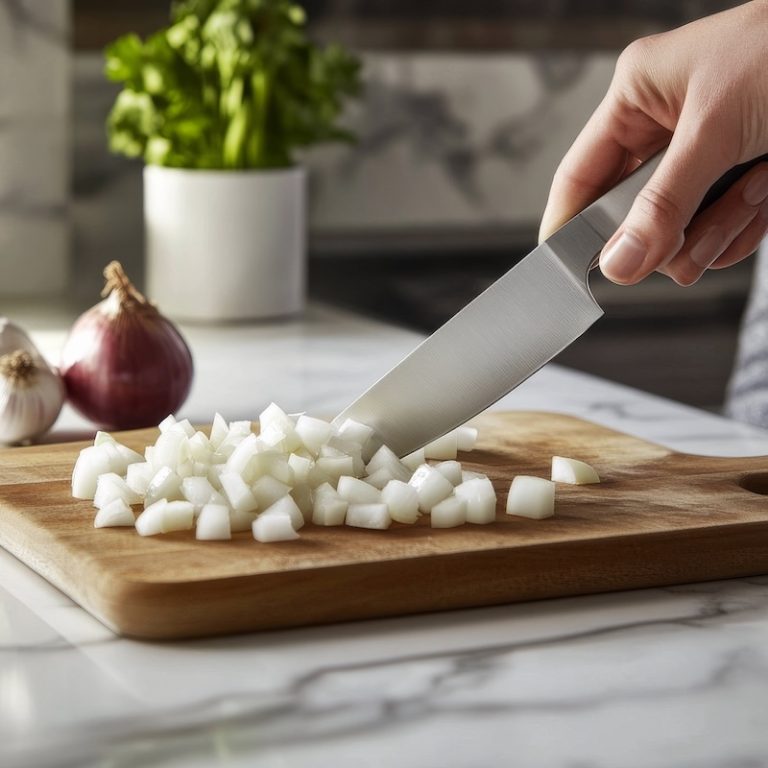
How to Dice an Onion Like a Pro (Step-by-Step Guide)

Learning how to cut an onion properly is one of the most valuable kitchen skills you can master. It affects how evenly your food cooks, how it tastes, and even how professional your dishes look.

In this guide, you’ll learn a simple, reliable method to dice onions efficiently, minimize tears, and understand why each cut matters—so you can cook with confidence, not guesswork.

Fast Answer

Cut an onion by halving it through the root, making horizontal and vertical cuts, then slicing across to create even dice that cook uniformly.

Start Here: Your Onion Game Plan

  • Who this is for: Home cooks tired of uneven onion pieces or struggling with knife control.
  • When to use it: Anytime a recipe calls for diced or chopped onions.
  • What success looks like: Even-sized pieces that cook at the same rate and enhance your dish.
  • What you’ll gain: Better flavor, texture, and confidence with your knife.

Why This Technique Works

  • Natural structure: Onions have layers, and this method works with them instead of against them.
  • Even sizing: Uniform cuts cook at the same speed, preventing burning or undercooking.
  • Root holds it together: Keeping the root intact stabilizes the onion while you cut.
  • Efficient workflow: You get clean dice with fewer random chops.

Step-by-Step Technique Guide

  • Trim and halve: Cut off the stem end, then slice through the root to halve the onion.
  • Peel: Remove the skin while keeping the root intact.
  • Horizontal cuts: Slice parallel to the cutting board (1–3 cuts depending on size).
  • Vertical cuts: Make evenly spaced cuts from top to root.
  • Final slice: Cut across to create uniform dice.
  • Watch for: Pieces should fall apart cleanly with minimal effort.

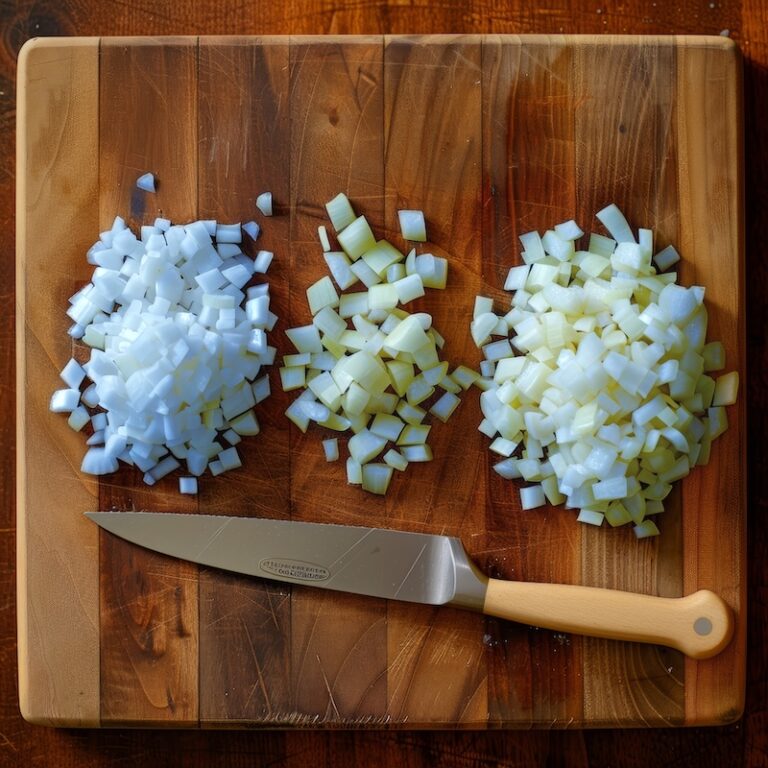
Onion Dice Sizes (What They Look Like)
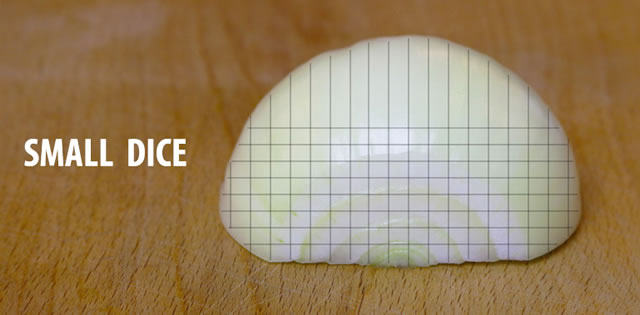
Small diced onion

Small Dice

About 1/4-inch pieces. Best for sautés, soups, and sauces where onions should melt into the dish.
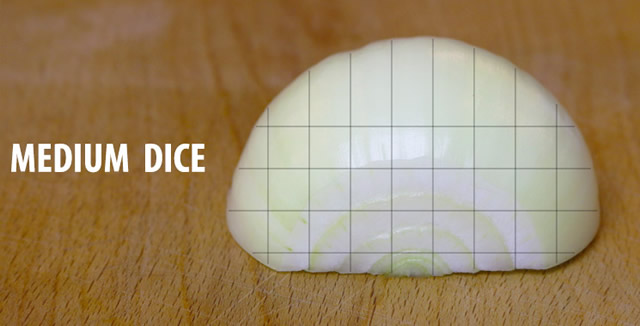
Medium diced onion

Medium Dice

About 1/2-inch pieces. A versatile size that works for most everyday cooking.
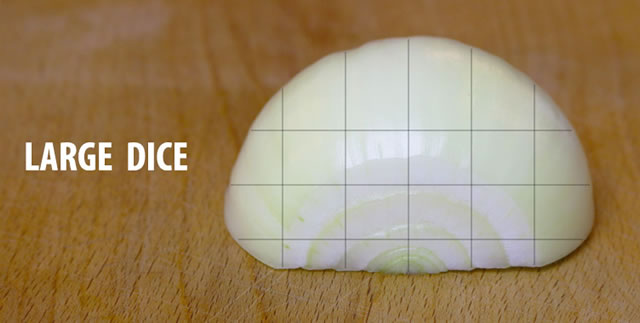
Large diced onion

Large Dice

About 3/4-inch pieces. Best when you want the onion to hold its shape and texture.

Core Concept: Control Size = Control Cooking

  • Smaller pieces: Cook faster and release more flavor quickly.
  • Larger pieces: Hold texture and cook more slowly.
  • Your job: Match the size of your cut to the cooking method and dish.
  • Think ahead: Don’t just cut—decide how the onion should behave in the pan.

Visual Cues That Tell You It’s Working

  • Even size: Pieces look consistent, not random.
  • Clean edges: Cuts are smooth, not crushed.
  • Stable onion: It doesn’t slide around while cutting.
  • Minimal waste: Only the root remains intact at the end.

What Most Cooks Get Wrong

Frustrated cook making common mistakes.
  • Cutting off the root: The onion falls apart and becomes harder to control.
  • Skipping horizontal cuts: Leads to long, uneven strips instead of dice.
  • Dull knife: Crushes the onion, releasing more irritants and juice.
  • Rushing: Results in uneven pieces and sloppy cuts.
Quick Diagnosis Strip

  • Problem: Uneven cooking → Cause: Inconsistent cuts → Fix: Slow down and space cuts evenly
  • Problem: Onion falling apart → Cause: Root removed too early → Fix: Keep root intact
  • Problem: Excess tears → Cause: Dull knife → Fix: Use a sharp blade
  • Problem: Mushy texture → Cause: Crushing instead of slicing → Fix: Clean, confident cuts

Quick Fixes & Pro Tips

  • Chill the onion: Reduces tear-inducing compounds.
  • Sharp knife: Always your best upgrade.
  • Use a stable board: Prevents slipping and improves precision.
  • Practice spacing: Consistent cuts matter more than speed.
a wooden cutting board with three piles of diced yellow onion arranged left to right

Other Ways to Dice an Onion (When to Use Them)

  • Rocking technique: Fast and great for a fine dice, but less precise. Best when speed matters more than perfect uniformity.
  • Food processor: Extremely fast, but easy to over-process. Use for soups, sauces, or bulk prep—not when texture matters.
  • Slice then dice: Simple and beginner-friendly. Works well, but pieces are often less uniform.
  • Japanese (chopstick method): Adds stability for beginners. Helpful if your knife control isn’t strong yet.
  • Onion dicer tools: Consistent results with little skill required. Trade-off is cleanup and less control over size.
  • Brunoise (fine dice): Very small, precise cuts for sauces and garnishes. Best when presentation or texture is critical.
  • Bottom line: Use the classic root-on method for most cooking. Switch techniques only when speed, volume, or precision demands it.

What’s been your biggest struggle when cutting onions—uneven pieces, tears, or just speed? Drop a comment below and let’s fix it.

3 Responses

  1. 3 stars
    Very wasteful! A huge portion of the root end is thrown away, as well as a rather large end of the blossom part.

    Better to just cut minimally on the root and blossom, peel it, and then just do vertical cuts angled toward the center axis longitudinally, then slice transversely. The onion’s layers themselves will separate and the result is consistently sized pieces with minimal waste.

    But Chef Mohr’s method is taught as gospel in the culinary schools, and Gabriel’s horn must blow before they’d consider a change from “the right way”.

  2. 5 stars
    Nice demonstration! To the “comment “ re: waste. So what, onions are cheap and plentiful. Dicing properly utilized maximum usage anyway. Further more, I thought he efficiently diced the demonstrated half anyway!

Leave a Reply

Your email address will not be published. Required fields are marked *

This site uses Akismet to reduce spam. Learn how your comment data is processed.