

Fast Answer
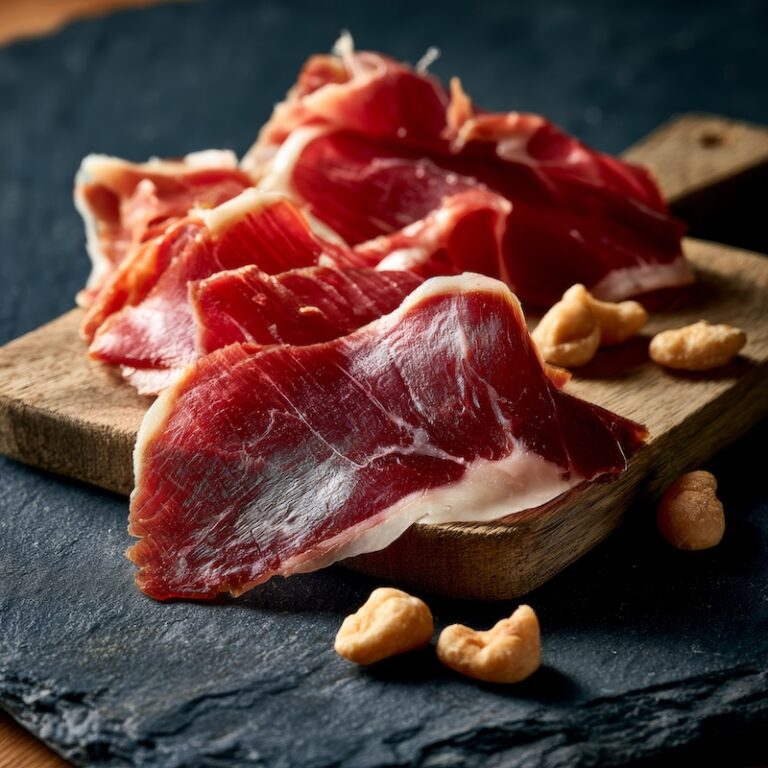
Jamón Ibérico de Bellota is the top tier of Spanish cured ham — made from free-range Iberian pigs that spend their final months eating acorns in oak forests, then aged a minimum of three years. It's the breed, the diet, and the time that justify the price.
The Day I Spent Forty Dollars on Four Slices of Ham
My friend Cheeseman Jack at the local farmer’s market is the kind of guy who always knows what’s worth trying. When he told me he’d come across some Jamón Ibérico de Bellota, I asked how expensive a cured pork product could possibly be. The answer was $185 a pound. I bought four slices.
They were extraordinary — but I’ll be honest, I wasn’t entirely sure I could have picked them out of a lineup against a good Italian prosciutto. That question sent me down a rabbit hole. What exactly goes into a ham that costs that much? The answer turns out to be more interesting than I expected.
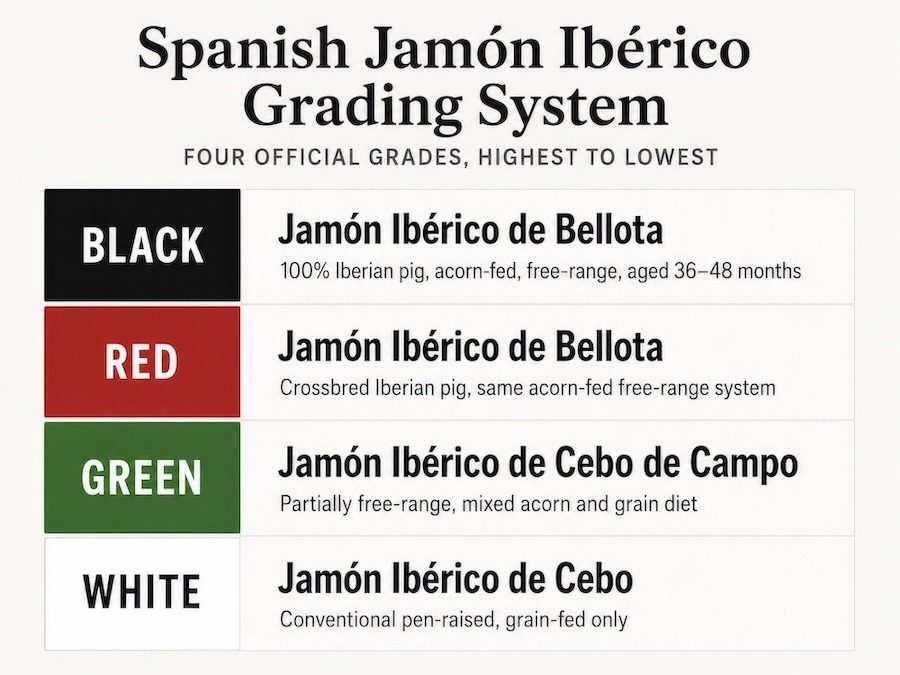
The Grading System (This Is What the Labels Actually Mean)
- Jamón Ibérico de Bellota (Black Label): 100% Iberian-breed pigs, free-range in oak forests (dehesas), acorn-fed during the montanera, aged 36–48 months. The top of the category — and the only grade that earns the "Pata Negra" designation.
- Jamón Ibérico de Bellota (Red Label): At least 50% Iberian lineage, same acorn-fed free-range system, but crossbred pigs. Excellent quality, noticeably lower price.
- Jamón Ibérico de Cebo de Campo (Green Label): Iberian pigs, partially free-range, fed a mix of acorns and grain. A middle tier — less fat marbling, less complexity.
- Jamón Ibérico de Cebo (White Label): Iberian pigs raised in conventional pens on a grain diet. No acorn feeding. The entry-level Ibérico — better than Serrano, but a different animal than Bellota.
- The practical upshot: The color of the label on the leg is the fastest way to know what you're buying. If it doesn't have a label at all, ask.
Flavor & Function
- Flavor profile: Nutty, savory, and faintly sweet — with a richness that builds as it melts on the tongue. The fat is as important as the meat: it's soft, almost silky, and carries most of the flavor. Underneath the nuttiness there's something mineral and slightly funky, in the way aged cheese has a low note you can't quite name.
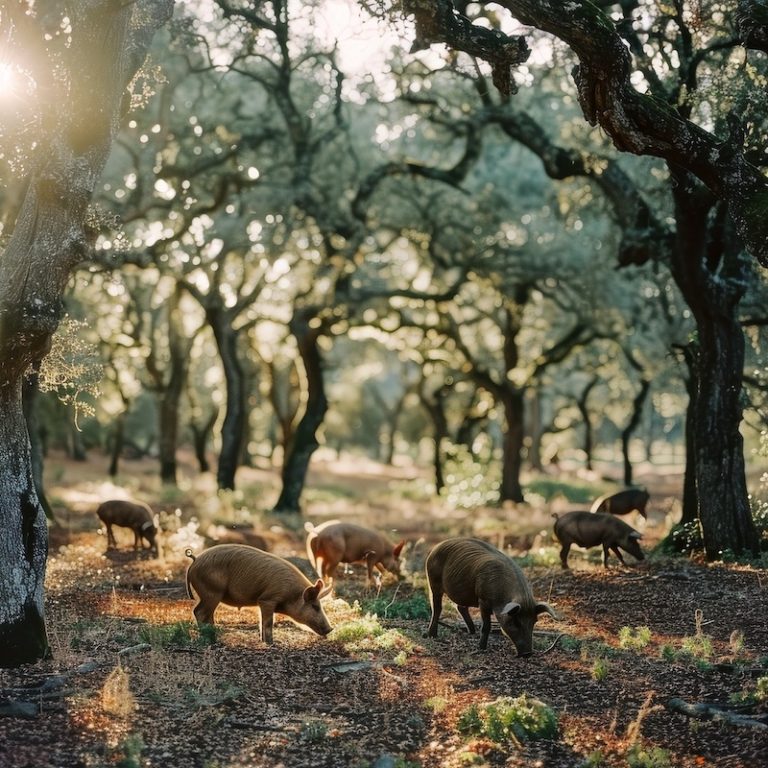
- How the acorn diet changes it: Iberian pigs convert oleic acid from acorns directly into intramuscular fat. That fat has a lower melting point than standard pork fat — which is why a slice of good Bellota seems to dissolve rather than sit on your palate. It's not a marketing claim; it's measurable chemistry.
- Role in cooking: It isn't one. Jamón Ibérico de Bellota is eaten as-is, thinly sliced at room temperature. Heat destroys the fat structure that makes it special. If you're cooking with it, you're using the wrong product — reach for a less expensive Ibérico or Serrano instead.
Think Like a Cook
- The question most people ask about Jamón Ibérico de Bellota is "is it worth the price?" That's the wrong question. The right question is "what am I actually paying for?" — because once you understand that the price reflects four-plus years of production, a specific breed of animal, a specific forest ecosystem, and a legally controlled aging process, it stops feeling like a luxury markup and starts feeling like what premium actually costs.
- Think of it like a single-malt Scotch or a small-production olive oil: you're not paying for better technology, you're paying for less efficiency and more time. The product is expensive because it can't be made faster without becoming something else.
How to Choose It
- Look for the label color first: Black label = 100% Ibérico de Bellota. Red label = crossbred Bellota. Both are genuinely excellent. If a retailer can't tell you the label classification, that's a signal.
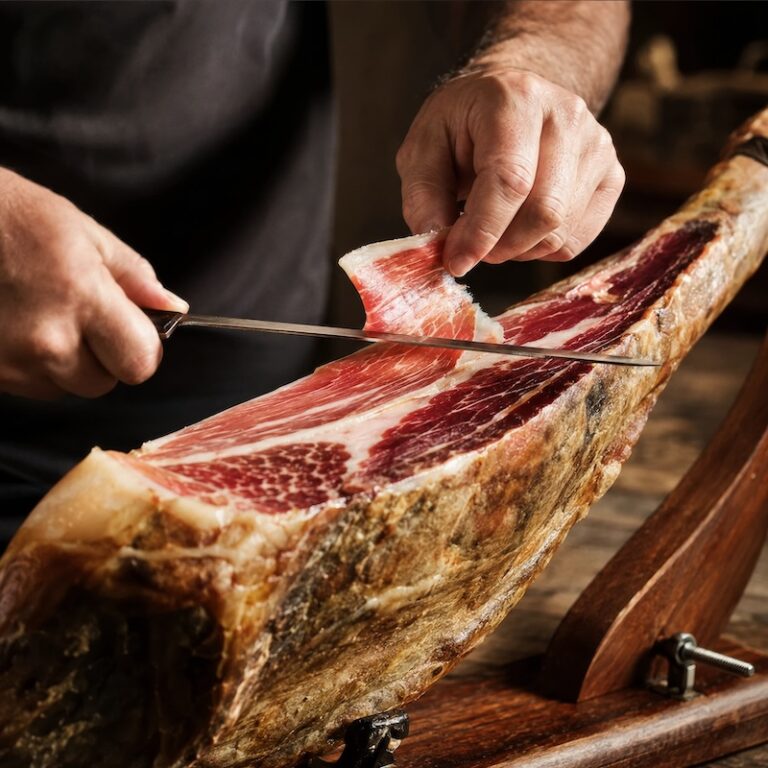
- At a counter: The fat should be ivory-white to pale yellow, not stark white or gray. The meat should be deep ruby — not brown, not pink. Ask when the leg was opened; once cut, it starts to oxidize.
- Pre-sliced and packaged: Look for a slicing date and buy as fresh as possible. The slices should be translucent, not opaque. Avoid anything that looks dry or has darkened edges.
- Regional origin: Jabugo (Huelva), Guijuelo (Salamanca), and Los Pedroches are the most respected producing regions. It's not required information, but it's worth knowing — much like wine appellations, the terroir of the dehesa affects the final flavor.
How to Serve It
- Temperature matters more than anything: Serve at room temperature — pull it from refrigeration at least 20–30 minutes before eating. Cold fat is rigid fat, and rigid fat is not what you paid for.
- Thickness: Slices should be translucent — thin enough to see through, but not shredded. If you're buying from a counter, ask for it sliced to order.
- What to serve alongside: Good bread (plain, not sourdough-assertive), a drizzle of high-quality olive oil if you like, maybe a few Marcona almonds. The ham is the point — don't compete with it.
- Wine pairing: Fino or Manzanilla sherry is the traditional match and remains the best one. A young Rioja works. Avoid anything heavy or tannic enough to overwhelm the fat.
- What not to do: Don't cook with it, don't refrigerate and re-serve multiple times, don't wrap it in melon, don't pair it with strong cheese on the same board. This is not a charcuterie component — it's the main event.
Jamón Ibérico de Bellota vs. Prosciutto — An Honest Comparison
- The fair comparison: A top-grade Bellota against a San Daniele or Prosciutto di Parma of equal quality. At that level, they're different expressions of the same idea — salt, time, and a specific breed of pig — not competitors on a quality ranking.
- Where they differ: Prosciutto is milder, sweeter, and more delicate. Bellota is nuttier, more complex, and has a deeper umami foundation. The fat in prosciutto is richer and more buttery; Bellota fat is softer and carries more savory character.
- The honest answer to "which is better": It depends on what you want. Prosciutto disappears into a dish. Bellota demands your full attention. Neither is wrong; they're for different moments.
- What reader JORGE pointed out in the comments: Prosciutto tastes like the cheapest kind of Serrano ham to someone who grew up eating good Spanish ham. That's worth sitting with — it says as much about reference point as it does about quality.
What Most Cooks Get Wrong
- Buying it for cooking: Jamón Ibérico de Bellota at the stove is like using a vintage Burgundy in a braise. Technically fine, practically a waste. If a recipe calls for Spanish ham, use Serrano or a lower-grade Ibérico.
- Serving it cold: Straight from the refrigerator, the fat is firm and the flavor is muted. The difference between cold and room-temperature Bellota is not subtle — it's significant enough to make an expensive purchase feel disappointing.
- Confusing "Ibérico" with "Bellota": "Ibérico" is a breed designation. "Bellota" is a production method. A ham can be labeled Ibérico without being Bellota — and many are. The word Ibérico alone tells you very little about what's in the package.
- Assuming "Pata Negra" is a grade: It means "black hoof" and refers to the characteristic dark hooves of 100% Iberian pigs. It's a useful visual marker, but it's not an official regulatory grade — look for the label color system instead.
The Good Fat — Why the Oleic Acid Story Is Real
- What happens in the dehesa: Acorns are high in oleic acid — the same monounsaturated fat that makes olive oil good for you. Iberian pigs eating a heavy acorn diet during the montanera convert that oleic acid into intramuscular fat at a remarkably high rate.
- What the research shows: Studies have found that Jamón Ibérico de Bellota has a fatty acid profile closer to olive oil than to conventional pork — with oleic acid accounting for more than half of its total fat content. That fat profile has been shown to reduce LDL cholesterol.
- The caveat: It's still a cured meat with significant sodium and saturated fat alongside the oleic acid. "Healthier than expected" is not the same as "health food." But the underlying chemistry is real, not marketing.
Where to Buy It in the United States
- Specialty retailers: Whole Foods carries it in some markets. Spanish specialty importers (La Tienda, Despaña, Ibérico Club) are reliable online sources with proper cold-chain shipping.
- Price range: Expect $80–$120 per pound for sliced red-label Bellota; $150–$250 per pound for 100% black-label. Whole legs are more economical per pound but require proper storage and commitment.
- What to look for on labeling: "100% Ibérico de Bellota" or "Jamón Ibérico de Bellota" with a black or red tag. If the label only says "Ibérico" without specifying Bellota, you're looking at a lower grade.
- USDA regulations: All imported Jamón Ibérico de Bellota is subject to USDA inspection. The product that reaches US consumers is the same product sold in Spain — the import process doesn't compromise quality.
Storage & Shelf Life
- Whole leg: Store in a cool, dry place at room temperature, cut-side down or covered with the removed fat cap and a clean cloth. Use within a few weeks once started. Do not refrigerate a whole leg — it damages the fat.
- Pre-sliced and packaged: Refrigerate and use within the date on the package — typically within a few days of opening. Once opened, the slices oxidize quickly.
- How to tell when it's past its prime: The fat turns gray or develops an off smell. The meat oxidizes to brown at the edges. At that point, the complexity is gone even if it's technically safe to eat.
Worth the Upgrade?
- Worth it: When you're serving it as the focus — a small plate with bread and wine, a special occasion, or when you want to understand what the category actually tastes like at its best. The black-label upgrade over red-label is worth it once; after that, red-label gives you 90% of the experience at 60–70% of the price.
- Not worth it: If you're adding it to a charcuterie board where it'll be eaten alongside strong cheeses and pickles, or if you're cooking with it. In those contexts, a good Serrano or lower-grade Ibérico performs identically and costs a fraction of the price.
Explore More on This Topic
- Chabichou du Poitou — the cheese Cheeseman Jack recommended the same day he handed me my four slices of Bellota.
- Braised Sage Pork Chops — if you want to cook with Spanish ham, this is the kind of dish where a good Serrano earns its place.
- How to Bake a Ham — a completely different animal, but worth understanding if cured and whole-leg ham is your thing.
- Pork Osso Buco — what to cook when you want serious pork flavor without the $185-a-pound price tag.
- Roast Pork with Rosemary and Garlic — straightforward, reliable, and a good reminder that great pork doesn't require a dehesa.
Frequently Asked Questions About Jamón Ibérico de Bellota
What is the difference between Jamón Ibérico and Jamón Ibérico de Bellota?
“Jamón Ibérico” tells you the ham comes from Iberian-breed pigs. “Bellota” tells you those pigs were free-range and acorn-fed during the final fattening period. A ham can be labeled Ibérico without being Bellota — the word alone doesn’t tell you the feeding method or quality tier. Always look for the full designation and the label color.
What does “Pata Negra” mean?
“Pata Negra” means black hoof — a physical characteristic of purebred Iberian pigs. It’s used informally to refer to the highest grade of Bellota ham, but it’s not part of the official regulatory grading system. The four-color label system (black, red, green, white) is the reliable way to identify what you’re buying.
How is Jamón Ibérico de Bellota different from prosciutto?
Both are salt-cured, aged hind legs from specific pig breeds — but the flavor profiles are distinct. Prosciutto is milder and sweeter; Bellota is nuttier, more savory, and more complex. The fat in Bellota has a lower melting point due to its oleic acid content, which gives it a softer texture on the palate. They’re different products, not grades of the same thing.
Why does Jamón Ibérico de Bellota cost so much?
The production timeline is long and inefficient by design. The pigs take years to raise, the acorn-feeding period is seasonal and can’t be accelerated, and the aging runs 36–48 months minimum. There’s no way to compress that timeline without producing a different product. The price reflects actual time and inputs, not just branding.
How should Jamón Ibérico de Bellota be served?
At room temperature, sliced thin, with minimal accompaniment. The fat needs to be soft enough to melt — cold ham from the refrigerator is a lesser version of itself. A 20–30 minute rest before eating is not optional if you’re going to appreciate what you paid for.
Can you cook with Jamón Ibérico de Bellota?
Technically yes. Practically, no. Heat disrupts the fat structure that makes it special, and the complexity you paid for becomes background noise in a hot pan. For cooking, use Serrano ham or a lower-grade Ibérico — they perform better in heat applications and cost significantly less.
Is Jamón Ibérico de Bellota actually healthier than other cured meats?
Its fatty acid profile is unusually high in oleic acid — the same monounsaturated fat in olive oil — which has been shown to reduce LDL cholesterol. Studies have found oleic acid can account for over half the total fat content in Bellota ham. That said, it’s still a cured meat with meaningful sodium and some saturated fat. “Less bad than expected” is accurate; “health food” is not.
Where can I buy Jamón Ibérico de Bellota in the US?
Online importers like La Tienda and Despaña are the most reliable sources. Some Whole Foods carry it. Expect $80–$120 per pound for sliced red-label; $150–$250 for 100% black-label. Look for the full “Jamón Ibérico de Bellota” designation on the label — not just “Ibérico.”
5 Responses
I was surprised to hear about ultra-premium hogs being fed grain, considering all the current discussion of the benefits of grass feeding. So I went to look up whether acorns are technically a grain, or a nut. I can’t really find a definitive answer, but I *did* find this amazing article about the history of human consumption of acorns: http://www.motherearthnews.com/Modern-Homesteading/1984-09-01/Acorns-The-Grain-That-Grows-on-Trees.aspx
Now I want to check my neighborhood for oak trees and keep an eye out this fall.
Hi Drew and thanks for the link to this interesting article. Who Knew? I really like your site and will be spending more time on it and letting my readers know about what you are doing at http://blog.cooklikeyourgrandmother.com/
Great writing! – RG
HI, THE IBERIO IS MUCH BETTER THAN PROSCIUTTO, PROSCIUTTO TASTES LIKE THE CHEAPEST KIND OF SERRANO HAM, NOTHING TO COMPARE TO THE SPANISH SERRANO, BELLOTA , ALSO THERE ARE DIFFERENT TYPES DEPENDING OF THE REGION, TERUEL , GUIJUELO, OR BLACK LEG 5JS FROM SANCHEZ ROMERO CARVAJAL WHICH IS THE MOST EXPENSIVE….. BUT ALL TASTE EXCELLENT …..ALSO NO LEG TASTES THE SAME IS KIND OF LIKE WINE….
Best Jamon Iberico in Spain is 7 Bellotas and now buy online straight from the source in Guijuelo
7bellotas.com
The price is totally worth it. It takes years of raising the animals, feeding the acorns / bellotas and then curing the meat. Aussies can source their supply at Spanish Deli.