


Classic Chicken Broth Recipe
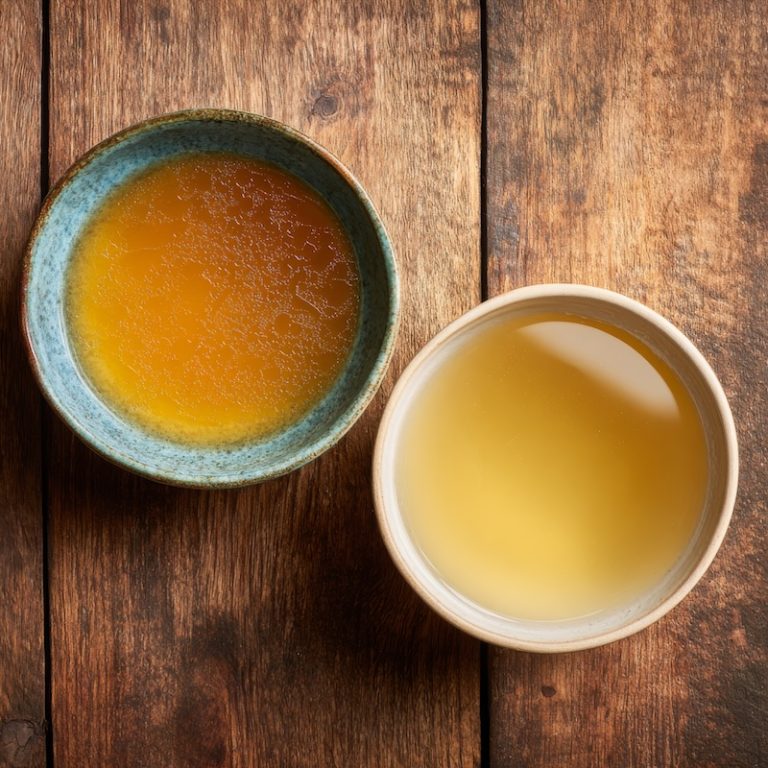
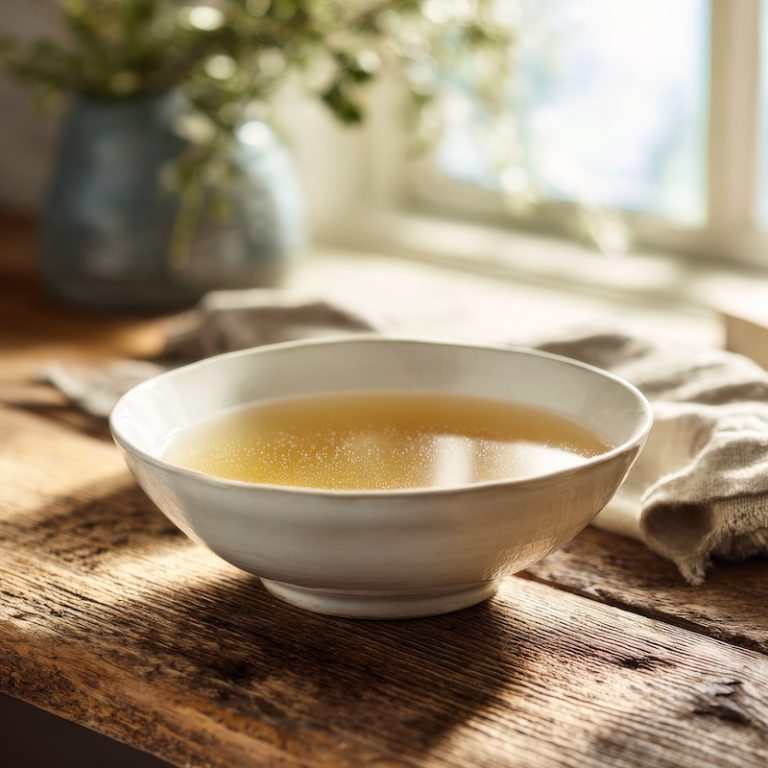
A clear, flavorful chicken broth made from meat, aromatics, and gentle simmering. Light enough for soups and sipping, yet rich enough to anchor everyday cooking.
Servings: 9 cups
Calories: 14kcal
Equipment
- stock pot
Ingredients
Instructions
Start with Cold Water
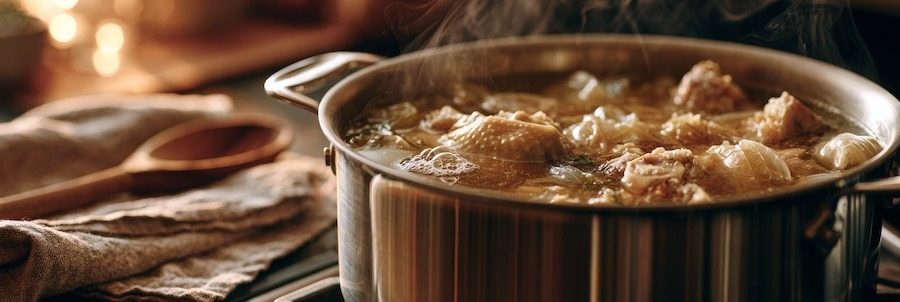
- Place the chicken in a large stockpot and add the cold water. Starting cold helps draw flavor gently from the meat as the liquid heats.
Add Aromatics
- Add the onion, carrots, celery, garlic, bay leaf, and peppercorns. Keep the vegetables large so they flavor the broth without breaking down and clouding it.
Bring to a Gentle Simmer
- Set the pot over medium heat and slowly bring it to a bare simmer. Do not let it boil. You should see only an occasional bubble breaking the surface.Tip: Boiling emulsifies fats and proteins, making the broth cloudy.
Skim the Surface
- As the broth begins to simmer, foam and impurities will rise to the top. Skim these off with a spoon for a cleaner-tasting broth.
Simmer Gently
- Lower the heat and simmer uncovered for 1½ to 2 hours. Keep the broth at a quiet simmer, not a rolling boil.
Strain the Broth
- Remove the pot from the heat. Strain the broth through a fine-mesh strainer into a clean container. Discard solids.
Season to Taste
- Add salt gradually, tasting as you go. Broth should be pleasantly seasoned but not salty, especially if it will be reduced later.
Cool & Store
- Let the broth cool slightly, then refrigerate or freeze.
Notes
Helpful Tips for Better Broth
Use meat-forward chicken partsBroth relies on meat for flavor. Backs, wings, and legs are ideal. Keep it simple
Too many herbs or spices overpower the broth and limit its versatility. Salt at the end
Salting early can make the broth too salty if it reduces. For extra clarity
Avoid stirring once the broth starts simmering.
Nutrition
Calories: 14kcal | Carbohydrates: 3g | Protein: 0.4g | Fat: 0.1g | Saturated Fat: 0.01g | Polyunsaturated Fat: 0.02g | Monounsaturated Fat: 0.004g | Sodium: 11mg | Potassium: 74mg | Fiber: 1g | Sugar: 1g | Vitamin A: 2270IU | Vitamin C: 2mg | Calcium: 10mg | Iron: 0.1mg




76 Responses
Hi, I just found your blog while reading some instructions from a recipe on another website. I LOVE your explanation about broth and stock. Makes perfect sense to me. I was also captivated by your explanation for deglazing and for making reductions sauces. I have just begun to experience the WOW factor of reductions. I didn’t realize I had already done that..that’s what makes my cream gravy for Southern style chicken fried steak taste so incredible! I learned how to cook this from my mother. I’ve never seen a recipe that describes making it the way my mother and grandmother made it in our small Texas town.Anyway, my husband adores Italian food. They use a lot of techniques you describe so I’m learning lots of new stuff very quickly.Your blog is a God-send! I blog too and have a homemaking blog called, Comin’ Home. I will be referencing you in the future I can assure you! Your explanations are so helpful!
Thanks, Donna Rodgers Willis, Tx.
You are very welcome Donna – RG
That is why everything made with chicken stock taste better, I always wondered now I know.
I kind of disagree with you. I believe that stock is a spiced product of individually boiled meat,bones or vegetables; when they are put together to make a meal it becomes broth. For instance, when u want to cook melon soup with chicken, you first of all boil the chicken and add some spices. When this is done, it is stock at this stage, but when you add the vegetables and the melon and some additional spices to taste it becomes broth. Thanks
Hi Angelica, like I say in the post, “Understand that the distinctions are very murky. I am trying to clarify the distinction based on my research and what some of my chef friends have told me. ”
So I’m fine that you disagree.
Based on your definition above, I would call it “soup” and not broth when you add the vegetables and melon and spices to the stock that you made but it’s fine with me if you call it broth. I’m sure some will disagree, but I think of broth as a liquid with nothing in it. If you simmered vegetables or chicken meat with or without bones and then strained all the vegetables and chicken out, you would be left with a broth that could be served on its own or added to a soup or sauce. – RG
Thanks for the clarification on broth vs. stock. So, what do you do with the gelatin extracted from the bones? I’m always confused about this. Do you add it to a broth to give it body? Thanks!
Hi Renee, the gelatin is extracted from the bones when you are making stock but it does not separate out. It is part of the stock. For example, if you make a classic chicken stock, reduce it by half and stick it in the refrigerator, the next day it will be gelatinous. But if you heat up that wonderful gelatinous ingredient, it becomes liquid again. You can use it to make sauces, add it to soups or braises for additional flavor. – RG
Try microwaving chicken, approximately 12-20 minutes for a leg-quarter seasoned, reserving the excess-‘juice’ after eating the chicken, scraping off the ‘lard’ after storing in the refrigerator–delicious and can be added-to with water and thinned, butter added to make soup and frozen easily to de-frost, again in the microwave. Makes for an easy meal later; Try salt, pepper, red pepper, garlic powder, olive oil, lemon juice and oregano and at times, a touch of chili powder.
QUIT YELLING AT US!!
I fixed it Don. Now lower your voice please. 🙂
Chicken Stock doesn`t have any carrots, because carrots will kill the clarity of the stock. A Chicken stock is white or brown. You can use carrots just for the brown one.
Both are easy and tasty recipes to use for stew, pasta, and more!
Love the article! People ask me the same thing all the time – I’m going to link to you instead of rewriting the same answers Love your recipe – it is similar to my basic one. My Favorite recipe though, which can be found at my blog includes chicken feet, necks and backs- we have found them to be an incredible source of flavor and they add a nourishing ooomph to the stock…or broth…whatever you prefer to call it.
what if i boil chicken parts in water and then simmer. after taking out the chicken can i still use the water to make a gravy?
My understanding is both are made by boiling chicken parts but chicken broth has been clarified, all meat and fat have been removed. So if you are making chicken soup use stock, if you are making a dish that will be reduced then use broth.
In my experience, stock and broth are different in only one meaningful way, cooking temperature. Both use waste bits of meat, bone, veg or anything else you like the flavour of and water. As you heat the water, it takes on the flavours of the ingredients you use, whatever they may be. the difference is that broth starts cold and stays around 150 f (65 c) to 180 f (80 c) for a long, long, loooong time. stock is made by bringing the temp above 195 f (85 c) at which point the fats and proteins break down and make the stock “murky”. As evidence, open a can of stock and a can of broth and you’ll see through the broth, and the stock will be cloudy.
Stocks are traditionally used for hearty soups, demis, or glazes because they have a higher fat content and are a little richer. broths are better used as a flavourful substitute for water in any dish that calls for water. try making bread with stock
As for using bones/meat in stock; stock gets murky because the proteins and fats break down. veg has way less of this, so isn’t thought of when making a stock. good veg stocks can be made with nuts or particularly fatty veg like avocado or olives.
hope it helps
Agree with your post. 100% best answer.I f you want a nice clear soup for egg bow or noodles, use broth, if you are cooking with it to add to a dish for flavored liquid use stock.
Agree with your post. 100% best answer.
Love the idea of using nuts in veg stock! I’ll try that.
Here are the correct (just kidding) definitions of broth and stock according to my Great Great Granny from Scotland. Broth contains oats and barley. Stock does not.
Wow. Just like any important issue in life, there are many, many “correct” ways to go about it – depending on your experience!
I love to learn about regional cooking and gather up all the tips and stories, and then create something all my own based on what I learn and my own tastes. I love to read all these posts. Nothing is sacred, though, in cooking. Traditions are often embellished, a snip of an herb here, an additional garlic clove there.
Great way of putting it Kate – RG
I’ve yet to see a dish where it would matter much which you used, whatever way you define them. The taste difference would be minimal, likely indistinguishable, among those other minor variations we all usually make to set recipes anyway.
I have several recipes that call for chicken stock – and a recipe for chicken stock comes with them, but I really don’t care to make anything with the word “carcass” in it! Can I substitute store-bought chicken broth in the recipes? Thanks!
Hi Helen, of course you can use store bought chicken broth for most recipes but will they be as good as using homemade chicken stock or chicken broth? That’s a personal preference. There are often times I don’t have time to make chicken stock or don’t have any in my freezer and use a commercial brand. The trick is to find a good brand that is low in salt and has lots of flavor. – RG
I have an easy and simple explanation that defines the true difference and why its important.
Chicken broth is made from the meat of the chicken
Chicken stock is made from the chickens bones.
Because the stock is made from the bones it has gelatine in it and it will thicken.
Because the broth contains no gelatine it stays watery.
Thats it aside from that taste is pretty much the same.
Best explanation by far
Many thanks.
I have just discovered that Chicken feet make the best stock. I live in Mexico where they cost about 12 pesos per kilo. That about 50 cents per pound so it’s cheap. They are easy to find here and very fresh. It gave me the creeps at first but I got over that after the first time. Then I feed the feet to my neighbors dogs. They love me now! lol
I was just freaking out because my broth/stock turned out very dark…according to the comments above it was because I put carrots in from the beginning…I was in a hurry I guess.
So if a recipe calls for chicken stock can you use chicken broth instead? Do they sell chicken stock in a grocery store?
Swanson has “cooking stocks” now, in addition to their broths. They come in cylindrical cardboard containers, rather than cans or the rectangular cardboard that the broths come in. They have lower-sodium (or is “No Salt Added”…?) versions, too, which I always go for…
Yes: Almost all stores carry chicken stock, I personally use broth and can’t taste much difference. Your guests will never know. Try it, you might love it.
So, if I am making gravy, do I want to add stock or broth?
What about risotto? Should I use broth or stock? I am thinking broth for this one. Thanks much.
Beth, you usually want stock for gravy and broth for risotto for the reasons above.
Do you have to use chicken broth in butternut soup or can you use something else as a replacement?
Sinead, chicken stock would be a fine replacement or you may even want to try vegetable broth. – RG
If making a BROTH, is the meat still edible after 2-3 hours of cooking? Thanks.
Judy, sure, I use it in chicken soup all the time. – RG
Thanks a lot that was what I was wondering. I couldn’t imagine throwing out all that good chicken. Glad to know it can be used and I wouldn’t toss those vegetables out either. I’d find use for them to or spice then up a bit more and then eat them up to.
David,
I think you nailed it. Thanks.
Hi. Can these 2 recipes be frozen for use at a later stage?
The answer I’ve received when I asked the same question is that Broth has no meat in it; it is clear liquid whereas stock have meat minimal pieces. I hope this clear the debate.
Josy, I don’t think that is true. I have made and purchased lots of stocks and I have never seen any meat in them. Every recipe I’ve ever seen for making homemade stock has you strain all the solids from the liquids. – RG
I use chicken and beef broth all the time for soups. Today, I decided to read the labels in re nutritional value – surprise! None at all. Sodium and coloring plus other things – nothing for nourishment. The labels are very misleading. Better to just get chicken or beef and put them in your soups. I’m pretty angry right now.
From what i understand stock is made from carcasses and bones which has a richer taste and feel to it (accompanied by vegetables and herbs and seasoning). Stock is made from more meat than flavorful bones, necks and spines. The difference in culinary terms is the mouth’s chemical reaction to flavors known as the ‘mouthfeel’.
I always thought stock was clear (made with or without bones) and broth was the finished soup (with barley or vegetables, meat, etc. in it)
I’m really confused now!!
The recipe is very good, but I would suggest soaking the meat and bone in cold water for half an hour before cooking to extract the flavor from it.
Then Simmer the meat and bone for 3-4 hours, THEN add the vegetables and whatever spices you need, and continue simmering for another hour.
This is done to prevent the unsavory taste of overcooked vegetables.
Good tips for fine tuning it, Jonathan!
But which recipe is it… stock or broth???
It IS murky! I always just assumed that stock was veggies and bones, while broth would be veggies, bones (with or without some meat attached) and herbs/spices (including salt). Which is why broth is good to have all on its own, while stock is the basis for what will become soup or what have you. But either way, homemade is way awesome!
Brook, you are so correct. Homemade is “way awesome.”
One question I don’t see addressed is how to skim the fat from stock. Usually, when making a broth, refrigerating overnight caused most of the fat to rise to the surface and solidify, making it easy to remove. I understand now why the liquid becomes gelatinous – I didn’t understand the chemistry of adding more bones. When that happens, though, removing the fat from the surface is more difficult as not as much of it comes to the surface. I imagine there’s as much, if not more, fat. Is there a way to remove it, or is that part of what contributes to the richness and mouth feel?
Hi Maria, I’m not sure I understand your question. Are you asking if there is a better way to remove the fat or if you don’t have to add the bones. If you are asking about the bones, yes, they do contribute to the richness and the mouth feel of the stock.
I think the question is, “How to separate fat from gelatin?”
Your explanation for preparing the stock and broth is very clear… But what happens to the actual meat after preparing the broth..as the broth recipe is the liquid itself…I should eat the meat separate?
Great question uche and I’ll have to fix the post to include this. The stock and the broth should both be strained to remove the meat, bones, and vegetables. There will be no flavor in any of them after cooking for 2 to 3 hours.
Is it okay to use a Stock when making a Stir Fry sauce?
Cheers
Mike
Sure Mike, I see chicken stock used all the time when preparing stir fry.
I’ll let y’all in on what we like to do round ours. Get 3 turkeys, 6 chickens and put them all, whole, into this big old catering pot leftover from Nam, then I throw in 2lbs butter, 500g salt, cover with water and let fly with the gas. The lid is on – repeat – THE LID IS ON – so it’s pressure all the way, keep checking the water isn’t getting low. 8 hours later take out the carcasses and either throw em to the dogs or dive in yourself, then reduce that whole pot of stock for another hour until it’s real dark. Pour this over some ribs and BANG – houston, we have got ourselves some Ribs. RG, I know your gonna want to publish this recipe, I don’t mind a bit, it is the BEST there is, you need photos of me, the fam and the dogs tucking in? Just say the word. Nothing like a pooch playing with a turkey’s snood to brighten up the day.
Over and out
Sgt. Buck Fast McDonald.
Thanks Sgt. McDonald for this illustrative stock recipe and I’m not sure I’ve ever seen a “pooch playing with a turkey’s snood” but I’ll take your word for it that it brightens up the day.
I sure love your description about making stock…throwing the carcass to the dogs (which might choke them to death…but not your dogs!), then pouring the stock over the ribs. Are you by any chance related to the Duck Dynasty clan?
I enjoyed your explanation of the difference between broth and stock. If I had known the difference, I would never have clicked on the link to find the answer, and your answer satisfies me completely. While we lived in Belize, I learned a way to make Chicken Broth with more body. You have to strain the broth well and pick through the meat carefully to avoid bone shards, but the broth produced is excellent. They, like some have mentioned before me, use the neck and feet as well as the usual whole chicken. But they break all the large bones before frying the chicken till the outside is well browned. This allows the bones to add more flavor to the stock. After frying the chicken they proceed as you instructed for broth.
Hi JD, what you are describing is the difference between a brown chicken stock (roasted bones) and white chicken stock. The brown chicken stock definitely has more flavor but is not always called for in some recipes. Thanks for sharing.
The first ingredient listed on my canned chicken broth is chicken stock. The rest of the ingredients are vegetables, seasonings, preservatives, etc. So, chicken broth seems to be primarily chicken stock, with additional flavoring.
Thank you for your explanation. Do you recommend “better than bouillon organic chicken base.” As chicken broth I believe it is made by southeastern mills, inc it comes in 8 oz glass jar. I have used this for soups and it is very flavorful
Hi Roxana, lately I have been making chicken stock from the bones of leftover roasted chickens and freezing it. When I do use a commercial product, it is often More Than Gourmet, Glace de Poulet Gold or something we pick up at Trader Joe’s but I hear good things about Better Than Bouillon and you are again confirming this. I’ll order some online and give it a try.
Hi there, interesting website which I’ve only just discovered! Thank you!
I usually make chicken stock/broth? (still confused!) whenever I have enough chicken carcass & bones (from roasted and/or boiled chicken with some flesh on) stored in the freezer.
I use it for risotto.
I do not use vegetables in the boil, only the chicken, some salt & white pepper. I strain it once, let it cool a bit and store it overnight in the fridge. The next day, I skim all that yellow fat away and I have a beautiful jelly, not translucent, because there are still very tiny particles of flesh in there. When this reduces, it gives a very rich chicken flavor to the risotto.
No bouillon cube will ever beat my chicken stock!!
I’m from the low country of South Carolina ,Horry County. We have a dish here called “chicken bog”, made by boiling a whole chicken, using the stock to make a chicken, sauage, and rice dish usually for large crowds. There are many variations, from plain to complex,using many of the above suggestions; chicken feet,extra wings,lightly sauteing the aronomic veggies, etc. You’all should Google it and look at some of the different types. I promise you will love one of them.
Ugh. Now I’m even more confused!! I have a recipe for my Vitamix for garden pea soup (with ham and carrots added toward the end). It calls for chicken or vegetable broth. I have those plus chicken and vegetable stock. It’s the first time making this and I don’t know which I should use!
Jan, personally, I think chicken stock gives more flavor to most soup recipe compared to vegetable broth so that’s what I would use unless you are preparing it for a vegetarian. Saying that, there may be some soups (and I’m not sure which) that chicken stock would overpower the flavor of the soup and you want to go with a milder tasting veggie stock. Now you may like to try both and see which one you prefer. Make half a batch with chicken stock and half a batch with vegetable stock and do a taste testing with your family or some friends. This way you can TASTE the difference.
I read all the comments about my question and I think it’s about every individual to know what’s better and the difference between the broth and stock. I like both but I think stock its healthier.
Re chicken broth vs chicken broth. Can’t you use half stock and half broth in a recipe and have the best of both worlds?
I agree. Use them both and get the best of both. Worth a try anyways.
Why not just add bones to the broth and cook it so we have… stoth? or… brock? lol Thought I could compliments a bit more! You’re welcome. lol
I’m confused – when making stock you throw away the meat and vegetables? Why? Couldn’t you repurposed these into another dish? Like Chicken noodle soup? Or at least the chicken for another meal? I’m confused as to why you would spend all that money on chicken and veggies just to throw them away after boiling. Store broth/stock would be so much easier and cheaper then. I thought the whole pupose of homemade was healthier and less cost. It might be healthier to make your own, but definitely doesn’t seem like less cost.
Hi Debbie, great question. The simple answer is because most of the flavor and nutrients from the chicken and vegetables will be transferred to the broth when making the stock. Yes, you will have a bunch of veggies but they will be flavorless. When I make chicken stock at home from a previously roasted chicken, I remove most of the meat as possible and reserve. I then make the stock as described and then if I want to make chicken and vegetable soup, I add fresh vegetables back into the stock along with the reserved chicken. Then I can taste the flavor of the chicken and vegetables and the vegetable won’t be a soggy mess. Store bought broth/stock is not cheaper when you compare actual costs and most brands are not healthier than what you can prepare at home. Just compare ingredients. Finally, making stock at home is a great time to use up all those veggies sitting in the refrigerator waiting to be tossed.
I have always been lead to believe that a stock is just the bones boiled with with and bay leave and it becomes a broth when you use it to make your soups by adding your veggies and meat
Just ridiculous that the culinary schools and associations don’t man up and declare a standard ! I enjoyed this article and had my questions answered, THEN I went to Swanson’s web page and they say just the opposite of what is written here ! So if I buy Swanson’s Stock or Broth its products are opposite of this article, is also true with other brands or do they agree with this article? campbells.com/swanson/whats-fresh/broth-vs-stock/
I will lose the argument about how stock should be made according to the French Laundry or the various culinary institutes that train chefs for 5 star restaurants. But I’m just a Hillbilly, and make stuff that that saves money and tastes really good.
First, I believe bones and vegetables must be roasted first. Not braised or boiled—-roasted. That’s where the gel extracts, roasty and full flavored, to be added to the long term simmer. I also collect the gel that collects at the bottom of the pan that holds the leftover roast before it is de-boned.
From experience, an 8-hour simmered stock can be used as a far superior broth as long as salt is added. A 24-hour simmered stock, clarified twice, can be frozen to better flavor 1-hour broths. Personally, I will make an 8-hour stock from bones from 1 chicken. If I have of collection of bones, I’ll make a large content stock that can be frozen in cheap ice trays for months, to use in various ways.
Tonite, I will make a Mushroom Risotto with a recent 8-hour stock, used as broth. Our Oaks provide mushrooms above ground certain certain times of the year . We are very lucky for that.
The “correct way” of making stock is a culinary scam, if one wants to be to a television star on TV.
Just makes what is good.