


Brown Stock Recipe
How to make brown stock for all your favorite soups, stews and sauces.
Servings: 1 gallon
Equipment
- Large Stock Pot
Ingredients
- 4 pounds veal marrow bones sawed into 2-inch pieces
- 3 pounds beef marrow bones sawed into 2-inch pieces
- 8 ounces tomato paste
- 2 cups onions chopped
- 1 cups carrot chopped
- 1 cups celery chopped
- 3 cups dry red wine
- 1 bouquet garni
- salt and pepper to taste
- 8 quarts water
Instructions
- Preheat the oven to 450° F. Place the bones in a roasting pan and roast for 1 hour.
- Remove the bones from the oven and brush with the tomato paste. In a mixing bowl, combine the onions, carrots, and celery together.
- Lay the vegetables over the bones and return to the oven. Roast for 30 minutes.
- Remove from the oven and drain off any fat. Place the roasting pan on the stove and deglaze the pan with the red wine, using a wooden spoon, scraping the bottom of the pan for browned particles.
- Put everything into a large stockpot. Add the bouquet garni and season with salt.
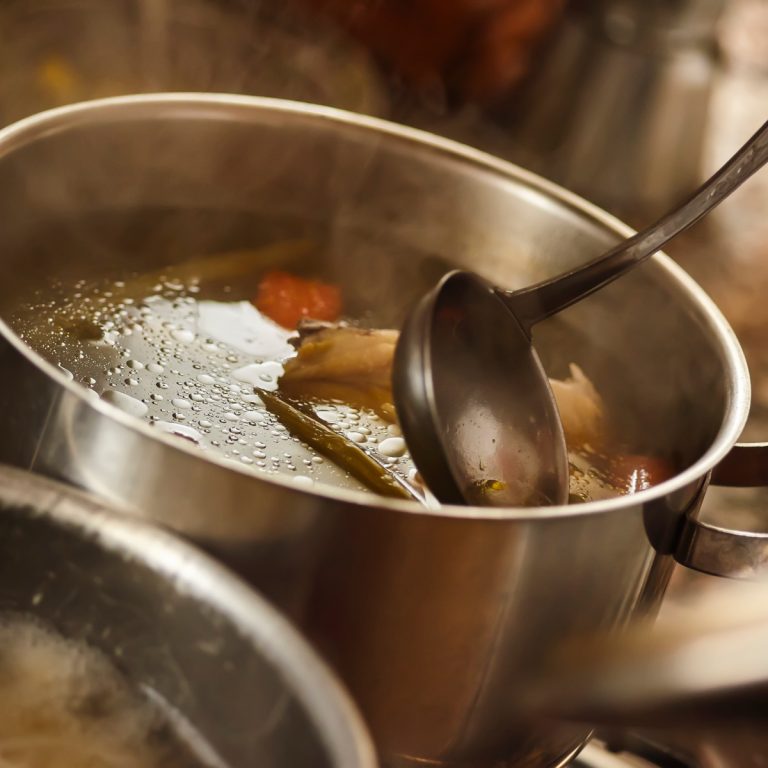
- Add the water. Bring the liquid up to a boil and reduce to a simmer. Simmer the stock for 4 hours, skimming regularly.
- Remove from the heat and strain through a China cap or tightly meshed strainer.




12 Responses
great stuff, but pot shape is for fat removal, if you want faster evaporation wider pots educe faster as they have more surface area to the air. I notice no bacon in the recipe. Isn’t the classice beef product made with it?
But do not take anything I post as a bad review, this is a great page. Simple producing a very fine product. Going o the store now, to get the bones!!!
Wow this was a great and easy explanation for an answer I have been looking for for some time now. Thank you so much. Sauces are a great way to finish off a dish and I have gotten bored of making easy creme sauces for my meat.
I tried several red wine sauces that revolve around a simple wine and stock reduction after deglazing the pan, but I never get it to the consistency it is in the restaurants. The other day I added some left over gravy to thicken up my wine sauce, not very classy, I know, but it did make the resulting red wine sauce thicker. I look forward to carrying out these instructions to make a better Demi Glace for a better sauce.
Can you give me any ideas oh how I could best preserve the Demi glace? When I make chicken stock, I jar it while it’s piping hot and it keeps in the fridge for about a week. Is there any way to increase this storage time? I don’t have a freezer.
Maitri, freezing would be the best solution but I would try reducing as much as you can until you get a very thick gelatinous consistency. I’m not a food scientist, but it makes sense to me the more reduced, the longer it will last in the refrigerator. How long? I have no idea. There are some commercial products on the market with amazing shelf life that over restaurant quality results without the hours involved with making a demi glace from scratch. good luck and let me know how it turns out.
I am not a chef and just trying to get a grasp on the demi-glace thing.
I fail to see how demi-glace will taste differently than the brown sauce. You take brown sauce, dilute it with stock and reduce it by half. Won’t it look and taste pretty much like brown sauce, with a little more stock in it?
Alain, it will taste like brown sauce but an incredibly flavorful, concentrated brown sauce. If you tasted a classically prepared demi glace, you might not like the taste of it. It may be too overpowering for your personal tastes, but when you use it to prepare a sauce, wow, the flavors explode in your mouth. Without having to make a demi glace from scratch, try using a chicken stock. Take a cup of chicken stock and reduce it by half and then compare the taste of the reduced chicken stock to regular chicken stock to see if you can taste the difference. Yes, the reduction will taste like chicken stock but a much stronger chicken stock. Will it taste good on its own? Probably not but try making a reduction sauce with it and you’ll be wowed by the results. Let me know.
Your blog is immensely helpful. I have a question about the brown sauce.
Do you use unsalted cooking butter for this? Our regular butter is salted and hence I am wondering. Also I assume that the sauce will last weeks in the refrigerator and months in the freezer?
Koel, thanks for your comments. We generally have unsalted butter in the house but I have made this sauce with both and taste for seasonings at the end. You are cooking it down so generally I would recommend unsalted. Not being a food nutritionist, I can’t guarantee it will last for weeks in the refrigerator. I guess it depends on how well you seal it and the temperature of your fridge but in our house, I can’t see it lasting that long anyway. I guess you could freeze it, but I don’t. We typically use it up with our meal or with leftovers the next day.
In a great many of your preparation directions, you mention that if one would rather not totally make the sauces from scratch, but instead purchase some of the finished products commercially (There are some affordable commercial products now available for you culinary pleasures”). However there is absolutely no mention of these products anywhere in your on-line publications. So my question is: What am I supposed to think? What can I do? If I don’t wish to spend hours making demi-glace, or even brown stock, where are your references listed?
Hi John, when I first read you question I was confused because on almost every one of my posts that include stock reductions for making sauces, I have included links from Amazon with some of my favorite commercial products that I use in my own cooking. One of the reasons I link to Amazon is because I have found they have the largest selection of products and some of the best prices I have found on the internet. Another reason is because I am an affiliate of Amazon and earn a small percentage for sales I generate from my website to help defray the cost of hosting my site.
After thinking about it for a couple of minutes, I realize you must have an ad blocker on your browser to keep these Amazon ads from showing up and therefore, not able to see some of my suggestions. I realize now, I need to write a new post reviewing all my favorites and what I like and don’t like about each. I’ll get to work on that but in the meantime, here are a few of the products I have found available. Custom Culinary Whisk and Serve Demi Glace, Savory Choice Beef Demi Glace, Minor’s Sauce Demi Glace, Bonewerks Culinarte Demi Glace de Veau Elite, and More Than Gourmet Demi Glace Gold. Thanks for bringing this to my attention.
Two items:
1. At step #4, as we “Remove from the oven and drain off any fat.” shouldn’t we also remove all the vegetables & bones at this time before ‘deglazing with red wine?’
2. Here in Phoenix AZ, I could find no butcher, grocery store (not even WholeFoods), nowhere that sold veal bones. One butcher sold veal, meat on the bone for $18.99 a lb. Anyway, I used all beef accordingly…
I’ve used all of them and think Savory Choice is the best. It is unsalted ( unlike More Than Gourmet’s ) so it gives you an unseasoned Demi that it really restaurant quality. You can season whatever you make of it after you do so. It’s also fluid so you can proportion it as you like and envelope packaged so you can reseal. The “tub” versions are more difficult to preserve and are usually a thick near solid gel. .
But let me comment on “restaurant quality”. There’s a million restaurants out there. Some not so good, some good and some top notch. Their Demi and stocks parallel their place on that scale.. The cost and effort that goes into stock and glace making is way off center if all you want is something to cook with. Making it is done to satisfy a desire. You do that to achieve that. If you just want to use it you buy a good quality prepared product. You list some that are above what just about anyone could make at home.
Richard, thanks for sharing your thoughts on Savory Choice and “restaurant quality”. So true, I have been to restaurants that prepare from scratch and it is incredible but I’ve also been to restaurants using inferior commercial demi glace and it is such a let down. I can’t understand why they would serve a nice steak and put on an inferior sauce.