
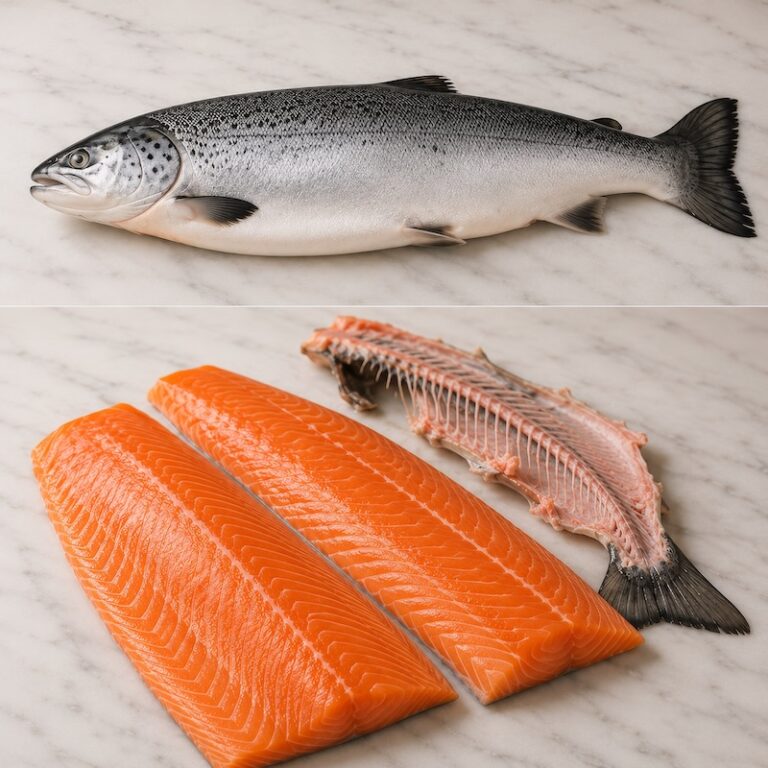

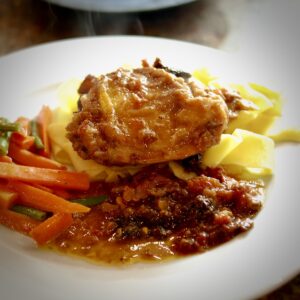
At a restaurant where you pick your fish from an iced cooler and pay by the pound, I picked Dover sole — one of the lowest-yielding fish there is. Expensive lesson. This page is the result.
Fast Answer
Whole fish yields run from about 30% (flounder, Dover sole) to over 70% (salmon, monkfish, swordfish) of the total weight in edible fillet. Find your species in the chart below.
Many Fillets Will a Whole Fish Yield?
This chart covers yield percentages for 17 common species, from catfish to wahoo, so you know roughly how much fillet a whole fish will actually give you. Yields vary by size, season, and who’s doing the cutting — treat these as solid planning numbers, not guarantees.
Fish Fillet Yields
| Fish | Starting Form | Fillet Type | Approx. Yield % |
|---|---|---|---|
| Catfish | Headed and gutted | Skin-on fillet | 45–55% |
| Cod | Headed and gutted | Skin-on fillet | 45–50% |
| Fluke/Flounder | Whole fish | Skinless fillet | 30–40% |
| Grouper | Head-on, gutted | Skinless fillet | 40–45% |
| Halibut | Headed and gutted | Skin-on fillet | 48–52% |
| Mahi-Mahi | Headed and gutted | Skin-on fillet | 50–55% |
| Monkfish | Tail | Skinless fillet | 70–75% |
| Salmon | Head-on, gutted | Skin-on fillet | 68–72% |
| Sea Bass | Headed and gutted | Skin-on fillet | 35–40% |
| Skate | Wings | Skinless fillet | 35–40% |
| Snapper | Head-on, gutted | Skin-on fillet | 42–45% |
| Swordfish | Headless bullets | Center cut loins | 65–70% |
| Tilapia | Headed and gutted | Skin-on fillet | 35–40% |
| Trout | Whole fish | Skin-on fillet | 55–60% |
| Tuna | Headless bullets | Untrimmed loins | 60–65% |
| Wahoo | Headed and gutted | Skin-on fillet | 50–55% |
| Wild Striped Bass | Whole fish | Skin-on fillet | 35–40% |
Fish Calculator
Usable fillet
—
lbs of edible fish
Total cost
—
for the whole fish
Real cost per lb
—
of edible fillet
Whole fish to buy
—
lbs needed
Fillet you'll get
—
lbs of edible fish
Yield breakdown
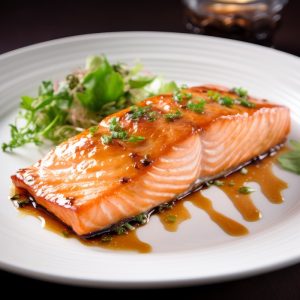
Salmon — Great Yield
A salmon with its head on but gutted yields 68–72% skin-on fillet.
If you buy a whole salmon head-on and gutted, the fillets cut off the body run about 70% of the total weight — a 10-pound sockeye yields roughly 7 pounds of edible fillet, a good buy at typical market prices. Compare that to one of my favorites, fluke or flounder, which doesn’t fare nearly as well. Salmon, for what it’s worth, wasn’t even on the by-the-pound menu at the restaurant that started all this.
Quick reference:
- 5 lb whole salmon (head-on, gutted) → ~3.5 lb fillet
- 10 lb whole salmon (head-on, gutted) → ~7 lb fillet — at $12/lb whole, that’s about $17/lb of fillet
- 20 lb whole salmon (head-on, gutted) → ~14 lb fillet
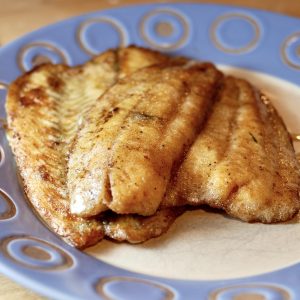
Flounder — Not So Good Yield
A whole flounder yields only 30–40% skinless fillet.
That’s not a great ratio of edible fillet to whole fish, and a big reason flounder can feel like a poor value even when the per-pound price looks reasonable. Flounder’s been running expensive lately because of fishing limits — I’ve seen fillets at $25 a pound. I still don’t know what a fish store itself pays for the whole fish, and I’d like to find out.
Quick reference:
- 2 lb whole flounder → ~0.7 lb fillet
- 4 lb whole flounder → ~1.4 lb fillet — at $25/lb fillet price, that’s about $35 for the whole fish
- 6 lb whole flounder → ~2.1 lb fillet
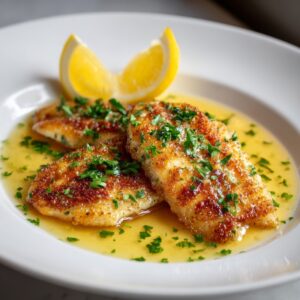
Dover Sole — Low Yield Really Expensive
A 2-pound Dover sole yields about 10 ounces of skin-off fillet — roughly 30%.
Skin-on, Dover sole runs closer to 50%, but the skin is thick and heavy, and since it’s almost never served skin-on, that 30% is what you’re actually paying for. At $49 a pound for the whole fish, the real math is $49 ÷ 0.30 = $163 per pound of what lands on your plate — the restaurant’s recommended 2 pounds for two people came out to a $98 purchase and about 5 ounces of uncooked fillet per person. I’ll be honest, that gave me sticker shock even on someone else’s dime. I later found Dover sole fillets at a reputable Seattle market for $7.99/lb — even tripling that for local pricing, it’s still $139 a pound less than the restaurant charged. If I want Dover sole, I’ll make it myself.
Quick reference:
- 1 lb whole Dover sole → ~5 oz skin-off fillet
- 2 lb whole Dover sole → ~10 oz skin-off fillet
- 4 lb whole Dover sole → ~1.2 lb skin-off fillet
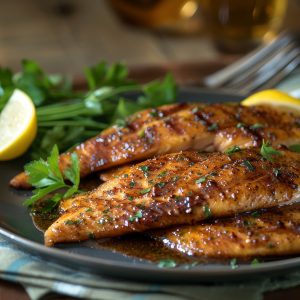
Tilapia
A whole tilapia round yields 35–40% skin-off fillet.
I got interested in tilapia because it’s one of the least expensive fish on the market — mild, farmed, and forgiving, which is probably why it turns up in so many everyday dinners. At around $10 a pound for boneless, skin-off fillet, it’s a genuinely economical choice despite the modest yield, and its mild flavor is forgiving enough to take on whatever sauce or seasoning you throw at it.
Quick reference:
- 1 lb whole tilapia → ~0.4 lb fillet
- 2 lb whole tilapia → ~0.8 lb fillet
- 3 lb whole tilapia → ~1.2 lb fillet
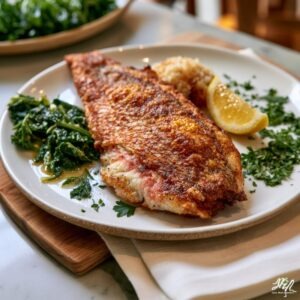
Red Snapper
A whole red snapper yields 42–45% skin-off fillet; head-on and gutted, it’s closer to 38%.
One of the most popular fish around, and worth noting the yield drops once the head’s already off — a good thing to check when you’re comparing whole-fish prices at different stages of cleaning. Snapper holds up well on the grill or when whole-roasted, skin-on, which is how I’d cook it given the choice.
Quick reference:
- 2 lb whole red snapper → ~0.9 lb fillet
- 3 lb whole red snapper → ~1.3 lb fillet
- 5 lb whole red snapper → ~2.2 lb fillet
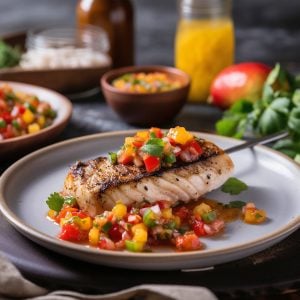
Mahi Mahi
Mahi Mahi, headed and gutted, yields 50–55% skin-on fillet.
A very popular fish, and one of the better yields on this list once it’s already been headed and gutted for you. The flesh is firm enough to hold up on the grill without falling apart, which is probably why it shows up on so many restaurant menus grilled simply with citrus and not much else.
Quick reference:
- 2 lb whole mahi mahi (H&G) → ~1.1 lb fillet
- 4 lb whole mahi mahi (H&G) → ~2.1 lb fillet
- 6 lb whole mahi mahi (H&G) → ~3.2 lb fillet
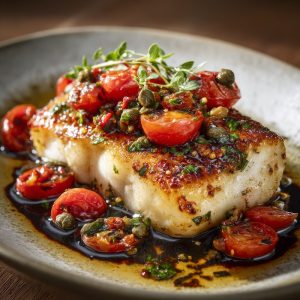
Chilean Sea Bass
A whole Chilean sea bass yields 50–55% skin-off fillet; headed and gutted, yields average closer to 70%.
One of my favorite fish to eat, but incredibly expensive and seriously overfished — worth knowing exactly what you’re paying for given the price. The flesh is rich and buttery enough that it barely needs more than a sear and a squeeze of lemon, which is part of why restaurants charge what they do for it.
Quick reference:
- 2 lb whole Chilean sea bass (H&G) → ~1.4 lb fillet
- 4 lb whole Chilean sea bass (H&G) → ~2.8 lb fillet
- 6 lb whole Chilean sea bass (H&G) → ~4.2 lb fillet
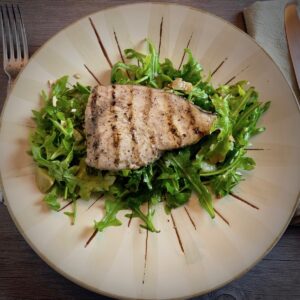
Swordfish
A head-off, gutted swordfish yields 65–70% fillet with skin on and bloodline in — the highest yield on this page.
This is how swordfish is usually sold at the market, bloodline intact — yield drops to about 64% once it’s processed skin-off with the bloodline removed. It’s dense and meaty enough to grill like a steak, which is exactly how I usually cook it.
Quick reference:
- 5 lb whole swordfish (head-off, gutted) → ~3.4 lb fillet
- 10 lb whole swordfish (head-off, gutted) → ~6.8 lb fillet
- 20 lb whole swordfish (head-off, gutted) → ~13.6 lb fillet
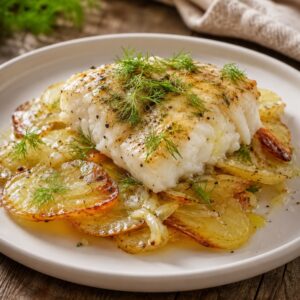
Atlantic Cod
Cod, headed and gutted, yields about 45–50% skin-on fillet.
Cod is almost always sold already filleted at the counter, so the whole-fish math mostly matters if you’re butchering it yourself or want the frame for stock. It’s a thick, dense fish, and pin bones are worth checking for even on a “cleaned” fillet.
Quick reference:
- 1 lb whole cod (H&G) → ~0.45–0.5 lb fillet
- 2 lb whole cod (H&G) → ~0.9–1 lb fillet
- 4 lb whole cod (H&G) → ~1.8–2 lb fillet
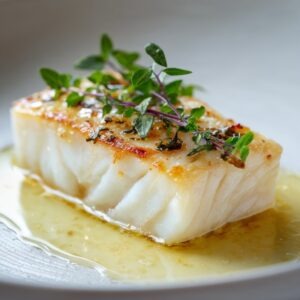
Halibut
Halibut, headed and gutted, yields about 48–52% skin-on fillet.
Whole halibut can run huge — 20 pounds or more — which is why most home cooks only ever see it as steaks or pre-cut fillets. At this yield, buying whole isn’t automatically the better deal; do the per-pound math against fillet pricing before assuming it is.
Quick reference:
- 5 lb whole halibut (H&G) → ~2.5 lb fillet
- 10 lb whole halibut (H&G) → ~5 lb fillet
- 20 lb whole halibut (H&G) → ~10 lb fillet

Halibut
Whole trout yields about 55–60% skin-on fillet — one of the better ratios on this list.
Trout is small enough that it’s often easier to roast or grill it whole and pull the bones after cooking than to fillet it raw. Worth considering before you reach for a boning knife.
Quick reference:
- 1 lb whole trout → ~0.55–0.6 lb fillet
- 2 lb whole trout → ~1.1–1.2 lb fillet
Whole Fish: How Much to Buy Per Person
Before you can use the yield chart below, it helps to know how much edible fish you actually need. As a general rule, plan on 6 to 8 ounces of cooked fish per person for a main course — that’s roughly 8 to 10 ounces of raw fillet to account for moisture lost during cooking.
But if you’re starting with a whole fish, you need to work backward through the yield to figure out how much to buy. Here’s a simple table for the most common situations:
| Fish | Yield % | Whole Fish Needed (1 serving) | Whole Fish Needed (4 servings) |
| Salmon (head-on, gutted) | 70% | ~0.9 lbs | ~3.5 lbs |
| Trout (whole) | 58% | ~1.1 lbs | ~4.3 lbs |
| Mahi-Mahi (H&G) | 52% | ~1.2 lbs | ~4.8 lbs |
| Snapper (head-on, gutted) | 44% | ~1.4 lbs | ~5.7 lbs |
| Cod (H&G) | 48% | ~1.3 lbs | ~5.2 lbs |
| Flounder/Fluke (whole) | 35% | ~1.8 lbs | ~7.1 lbs |
| Tilapia (H&G) | 38% | ~1.6 lbs | ~6.6 lbs |
| Sea Bass (H&G) | 38% | ~1.6 lbs | ~6.6 lbs |
Based on a 8 oz raw fillet per person. H&G = headed and gutted.
The Quick Formula
If you know the yield percentage and how many people you’re feeding, the math is straightforward:
Whole fish to buy = (Servings × 8 oz) ÷ Yield %
Example: Feeding 4 people with flounder (35% yield): (4 × 8 oz) ÷ 0.35 = 91 oz ÷ 0.35 = about 7.1 lbs of whole flounder
That’s a lot of fish — which is exactly why flounder and other low-yield species can feel like poor value even when the per-pound price looks reasonable. More on that below.
Estimated Mark Ups By Fish Type
| Fish | Retail Markup | Restaurant Markup |
|---|---|---|
| Salmon | 70–120% | 200–300% |
| Snapper (whole) | 80–120% | 250–350% |
| Mahi-Mahi | 100–150% | 250–300% |
| Monkfish (tail) | 80–100% | 200–250% |
| Cod | 100–150% | 200–300% |
| Grouper | 100–150% | 250–350% |
| Halibut | 120–180% | 300–400% |
| Tuna (bullet) | 400–800%* | 900–1300%* |
| Swordfish | 120–150% | 250–350% |
| Fluke/Flounder | 100–150% | 250–350% |
| Skate (wings) | 80–100% | 200–300% |
| Striped Bass | 100–150% | 250–350% |
| Trout | 80–120% | 200–300% |
| Tilapia | 100–150% | 200–300% |
| Sea Bass | 100–150% | 250–400% |
| Wahoo | 100–150% | 250–350% |
| Catfish | 70–120% | 200–300% |
| Chilean Sea Bass | 100–150% (retail) | 250–400%+ |
Notes:
Retail Markup = (Retail – Wholesale) ÷ Wholesale × 100%
Restaurant Markup includes not just ingredient cost but also labor, prep, plating, and waste factor.
*Tuna markups are extreme due to very low wholesale cost of unprocessed bullets vs. high-end retail/sashimi pricing.
Frequently Asked Questions About Fish Yields
How much fillet do you get from a whole salmon? About 70% if it’s head-on and gutted — a 10-pound salmon yields roughly 7 pounds of fillet. Reader-reported yields in the comments below run lower in practice, so treat 70% as an upper-end estimate.
Why does flounder cost so much per pound if the whole fish is cheap? Because yield is only 30–40%, so the real cost per pound of edible fillet runs two to three times the whole-fish price.
How much fish should I buy per person? Plan on 8 to 10 ounces of raw fillet, or 6 to 8 ounces once cooked, per person for a main course.
Does Dover sole really yield that little? Yes — skin-off yield is around 30%, which is why it’s one of the most expensive fish to order by the pound at a restaurant.
Is skin-on or skin-off yield higher? Skin-on. Removing the skin typically drops yield by another 3–5%.
Why don’t my real-world yields match the percentages in the chart? Size, season, and who’s doing the cutting all move the number — reader-reported salmon yields in the comments have run anywhere from 40% to 75% on the same “70%” fish.
What’s the difference between H&G and whole round yield? H&G (headed and gutted) yield percentages are higher than whole round, since the head and guts — a good chunk of total weight — are already removed before you weigh it.
Is it cheaper to buy whole fish or pre-cut fillets? For high-yield fish like salmon or swordfish, whole is usually cheaper. For low-yield fish like flounder or Dover sole, pre-cut fillets are often the better deal — do the per-pound math before deciding.
9 Responses
This is great! I’m doing a series of three Tasting Michigan History events this spring and summer. The first one is the recreation of a 1908 banquet in Benton Harbor, Michigan. The other two are 1937 and 1959. I was literally looking for fish amounts per person to go to the market and came across your blog. Thank you So Much! Great info. I love your style. I’ll be back. Ellie
what they call “dover sole” in the west coast isnt the dover sole (scientific name: solea solea) from europe
Having just returned from Salmon fishing I weighed my 2 fillets off my male silver. Each fillet weighed a little over a pound … I estimated the live wt of the salmon to be 7-8 lbs. Gutting the fish would lose no more than 1 lb and gilling it is another 1/2 lb. My 2 lbs of fillet was way less than the 75% estimate for a 5 to 5.5 lb fish. My experience says a 10 lb whole salmon might yield 4 lbs of fillets
I have a commercial fin fish license.
I get: Black Drum $1-$2 per pound whole, Flounder – $4.50 per pound whole
We get 50% skinless filet for our flounders. Good article
Great.
my experience with salmon head on gutted you get 75 percent useable meat. you get more meat depending how yu cut the fish.
Thank you James.
Great article and insightful commentary. Thanks for sharing!
I have the data to be very much useful. I am interested in forming a Fishing company in Tanzania to fish in Indian ocean. Thus, these types of data is helpful.