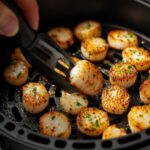
Fast Answer
Air fry sea scallops at 400°F for 6–8 minutes, flipping once halfway through. Pat them completely dry first, and use dry-packed scallops — not wet-packed — or the moisture will prevent any browning at all.
Air Fryer Scallops — Getting the Sear Right Starts Before You Cook
The air fryer surprised me with scallops. I went in skeptical — my oldest daughter bought one for my wife Meg and me a few years ago as a Christmas gift, and I’d been quietly doubtful. But the circulating heat does something useful here: it draws surface moisture away from the scallop as it cooks through. The result isn’t quite a cast-iron sear. It’s closer than you’d expect, though — and considerably less drama.
What determines whether it actually works isn’t the air fryer. It’s the scallop.
Start Here: What You're Actually Trying to Do
- The goal: A scallop with a lightly caramelized exterior and an interior that's just turned opaque — tender, not rubbery, not translucent.
- The obstacle: Scallops contain a lot of water. If you don't manage that moisture, you get steaming instead of browning — and a gray, soft result instead of a golden one.
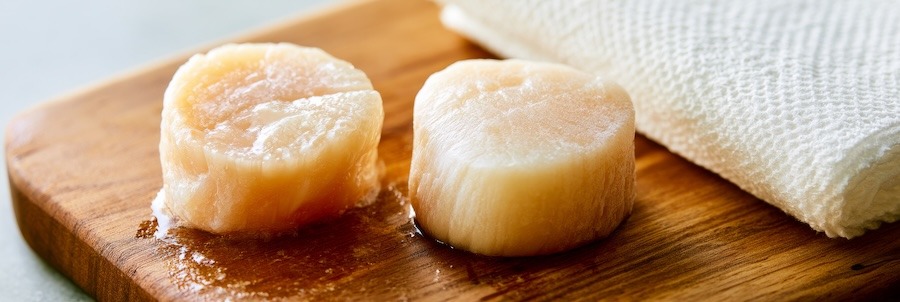
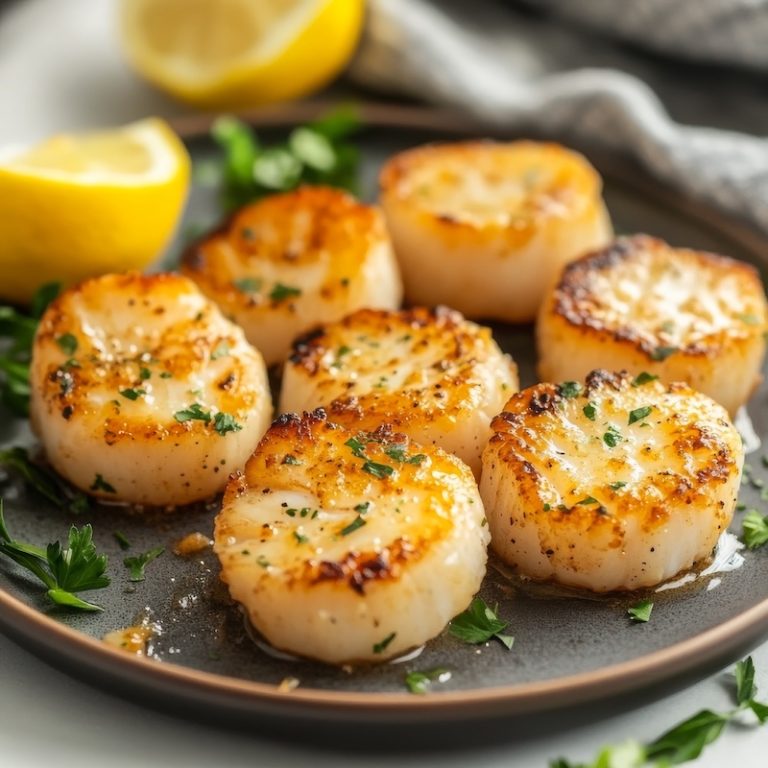
- What success looks like: A pale golden crust on the flat faces, an opaque white interior, and a texture that gives slight resistance before yielding. Not bouncy. Not mushy.
- Who this is for: Anyone who has overcooked scallops on the stovetop and wants a more forgiving method — or anyone cooking a small batch (under a pound) where a large pan would work against you.
Why the Air Fryer Works for Scallops
- Circulating hot air: The fan-driven heat surrounds the scallop on all sides simultaneously, which means the exterior firms and browns while the interior cooks through — without the narrow window you get with a screaming-hot pan.
- Moisture management: The moving air carries surface moisture away from the scallop as it cooks, which is why patting them dry first is not optional — you're giving the air fryer something to work with.
- Forgiving timing: A scallop in a cast iron pan goes from perfect to overcooked in about 30 seconds. The air fryer's even heat gives you more room to pull them at the right moment.
- What it can't do: Replicate the deep mahogany crust of a properly seared scallop in butter. The Maillard reaction needs sustained direct contact with a very hot surface. You'll get color in the air fryer — just not the same color.
Think Like a Cook: The Real Variable Is the Scallop Itself
- Every scallop recipe assumes you have a good scallop. Most don't say so. The difference between a dry scallop and a wet-packed scallop isn't a matter of preference — it determines whether browning is even possible.
- Wet-packed scallops are soaked in a sodium tripolyphosphate solution to extend shelf life and add water weight. They release that water when heat hits them. You're essentially steaming them in their own liquid before the surface can brown.
- Dry scallops have no added solution. They're perishable and usually more expensive, but they behave the way a scallop should — they sear, they brown, they caramelize at the edges.
- Day boat scallops (like the ones from Mystic) are harvested and sold same-day, never frozen, never treated. They're rare and worth finding when you can.
- Once you understand this, you stop wondering why your scallops turned out gray and wet. The technique wasn't the problem.
Air Fryer Scallops
Equipment
- Air Fryer
Ingredients
- 1 pound sea scallops preferably dry scallops
- 1 tablespoon olive oil
- salt & pepper to taste
- 1 teaspoon garlic powder
- 1 lemon zested and juiced
- 2 tablespoons unsalted butter melted
- 1 tablespoon fresh parsley chopped (optional)
Instructions
Preheat the Air Fryer
- Preheat your air fryer to 400°F (200°C) for about 3 minutes.
Prep the Scallops
- Pat the scallops dry with a paper towel to remove any excess moisture.
- Toss the scallops with olive oil, garlic powder, salt, and pepper in a bowl to evenly coat them.
Cook the Scallops
- Arrange the scallops in a single layer in the air fryer basket, ensuring they don’t touch.
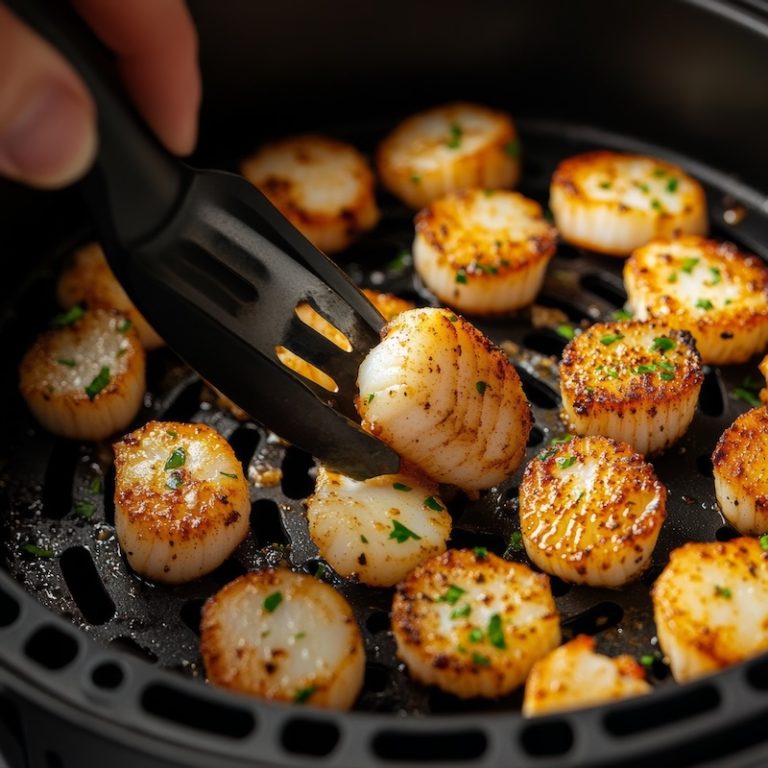
- Air fry for 6-8 minutes, flipping halfway through, until the scallops are golden brown on the outside and opaque in the center.
Make the Lemon Garlic Butter Sauce
- While the scallops are cooking, whisk together the melted butter, lemon juice, and lemon zest in a small bowl. If desired, add fresh parsley.
- Serve
- Once the scallops are cooked, remove them from the air fryer and drizzle the lemon garlic butter sauce over them.
- Garnish with extra lemon zest and parsley for a pop of color, and serve immediately.
Notes
Step-by-Step: Air Fryer Scallops
- Step 1 — Choose the right scallop: Buy dry-packed sea scallops. If the label doesn't say "dry," ask. Wet-packed scallops have a slightly milky, wet appearance; dry scallops look matte and firm. If they smell strongly of the sea before cooking, that's fine. If they smell of chemicals, pass.
- Step 2 — Dry them completely: Remove the side muscle (the small rectangular tag on the side — it's tougher than the rest), then press each scallop between paper towels for a full 30 seconds. They should look matte, not glistening. This is the most important step in the recipe.
- Step 3 — Season simply: Toss with olive oil, salt, pepper, and garlic powder. Don't marinate. Acid and prolonged moisture undo the drying you just did.
- Step 4 — Preheat the air fryer: 400°F for 3 minutes. You want the basket hot before the scallops go in — they should sizzle faintly when they make contact.
- Step 5 — Single layer, no touching: Arrange scallops flat-side down in a single layer with a small gap between each. If they're touching, they'll steam each other. Work in batches if needed.
- Step 6 — Cook 6–8 minutes, flip once: At 3–4 minutes, flip with tongs. Look for a pale gold color on the cooked face — not deep brown, but not colorless either. After flipping, the second side cooks faster.
- Step 7 — Check for doneness: The scallop should be opaque all the way through with just a faint translucency at the very center when you pull them — carryover heat will finish it. If you wait until it's completely opaque in the fryer, it's already overcooked. Press gently with a finger: it should feel slightly firm but still give. Rubbery means it's gone too far.
- Step 8 — Sauce and serve immediately: Drizzle the lemon-butter sauce over the scallops the moment they come out. Scallops don't hold — serve them right away.
What Most Cooks Get Wrong
- Skipping the dry step: Patting scallops dry sounds obvious, but most people do a quick pass with one sheet of paper towel and call it done. You need real pressure and real time — 30 seconds per scallop. Moisture on the surface is the enemy of color.
- Buying wet-packed without knowing it: Most supermarket scallops are wet-packed, and the label often won't say so clearly. If you're at a fish counter, ask directly. If you're at a grocery store with pre-packaged scallops, look for any mention of "solution" or "water added" in the ingredients.
- Crowding the basket: The air fryer works by circulating hot, dry air. Pack the basket and the air can't move, the moisture can't escape, and you're back to steaming. This is especially easy to do when you're cooking a full pound — just do two batches.
- Waiting until they look fully cooked: Scallops continue cooking after they leave the heat. By the time they look done under direct heat, they're overdone on the plate. Pull them when there's still a faint give in the center.
- Using frozen scallops without fully thawing and drying: Frozen scallops carry significant residual moisture even after thawing. Thaw overnight in the refrigerator, then dry aggressively before cooking.
What Went Wrong — and Why
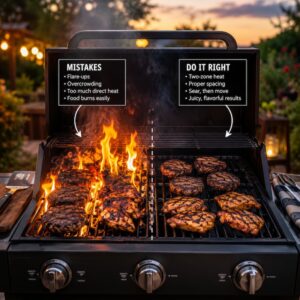
- Scallops are gray and wet, no browning at all → Wet-packed scallops releasing their added water → Next time, buy dry-packed; this batch is already lost
- Scallops are rubbery and tough → Overcooked → Pull them 30–60 seconds earlier; the interior should still have slight give when they leave the air fryer
- Scallops are translucent and raw-looking in the center → Undercooked, or the scallops were too large for the timing → Add 1–2 minutes and check again; larger scallops (U/10 size) may need closer to 9–10 minutes
- Scallops stuck to the basket → Not enough oil, or basket wasn't preheated → Coat the scallops thoroughly in oil before cooking; preheat the basket before adding them
- Uneven cooking — some done, some not → Scallops of very different sizes in the same batch → Sort by size and cook similarly-sized scallops together
- No color at all on the surface → Scallops weren't fully dry, or fryer wasn't preheated → Both matter; address both on the next batch
Control the Variables
- Temperature (400°F is the target): Lower than 380°F and you lose surface browning; the scallops cook through before the exterior caramelizes. Higher than 410°F and the outside toughens before the center catches up. 400°F is the functional sweet spot for sea scallops of standard size.
- Time (6–8 minutes for most): U/20 scallops (smaller) need 5–6 minutes. U/10 scallops (larger, restaurant-style) need 8–10 minutes. Bay scallops are smaller still — 4–5 minutes, and watch them closely.
- Moisture level: The single most impactful variable. The drier the scallop surface going in, the more browning you'll get coming out. Fully within your control — and almost entirely a function of how thoroughly you dry them in Step 2.
- Basket crowding: Leave at least a half-inch between scallops. Less than that and the air circulation degrades enough to matter. If you're cooking more than 3/4 pound, plan on two batches.
- Fat type: Olive oil works; melted butter applied before cooking will burn at 400°F. Brush butter on after they come out of the fryer — this is how you get both the browning and the richness.
- Scallop size (the variable you can control at the market): Larger scallops are more forgiving — they have more mass to buffer against overcooking. If you can find U/10s (under 10 per pound), buy them.
When to Use the Air Fryer for Scallops — and When Not To
- Use it when: You're cooking one to two servings and a large skillet would work against you (too much surface area, heat dissipates, scallops steam). The air fryer is well-sized for small batches.
- Use it when: You want less stovetop drama — no spatter, no smoke, no watching a screaming-hot pan while butter browns.
- Use it when: You're new to scallops and want a more forgiving window to work with. The air fryer gives you a few extra seconds of margin.
- Skip it when: You have exceptional scallops — day boat, just-caught — and a well-seasoned cast iron pan. That combination produces a crust the air fryer can't match. Don't waste a great scallop on a method that's primarily about convenience.
- Skip it when: You're cooking more than 1.5 pounds. The batching required means the first scallops are cold before the last ones are done.
- Skip it when: The recipe calls for scallops in a sauce. The air fryer browns and dries — the opposite of what you need for a braise or a cream sauce finish.
Apply It to Real Food
- Sea scallops (U/10–U/20): The primary use case. 400°F, 6–8 minutes. Dry them completely, leave space in the basket, and don't walk away in the last two minutes.
- Bay scallops: Much smaller — about the size of a marble. They cook fast (4–5 minutes at 400°F) and overcook faster. Better suited to a quick sauté, but if you're using the air fryer, watch them from the 3-minute mark and pull at the first sign of firmness.
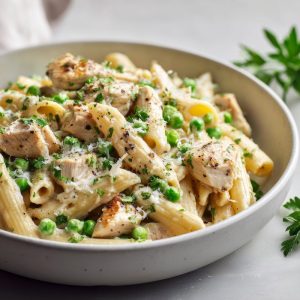
- Scallops over pasta: Cook the pasta and sauce first, then air fry the scallops and add them at the last moment. Scallops don't hold in a sauce — they go on top, not in.
- Scallops with a crumb crust: Press a thin layer of seasoned panko onto the flat face before cooking. The air fryer handles this better than the stovetop — the crust sets and browns without the scallop moving around.
- Frozen scallops: Thaw overnight in the refrigerator, not at room temperature. Once thawed, dry them more aggressively than you would fresh scallops — they'll have more residual moisture. Add 1–2 minutes to the cooking time and check early.
Explore More About Scallops
- Dry-packed vs. wet-packed scallops — What the label means, why it matters, and how to tell the difference at the fish counter.
- How to Cook Scallops — The stovetop method: why scallops stick, why they stay pale, and how to get a proper sear in a pan.
- Sea Scallops with Tomato Ginger Vinaigrette — A recipe that shows what scallops can do when paired with something bright and acidic.
- Pan Fried Scallops with Bacon and Grapefruit — Salt, fat, and citrus — a combination that works better than it has any right to.
- Olive Oil — Which type to use for high-heat cooking and why it matters for searing.
- Butter — Why you finish with butter rather than cook in it — and what happens when you get that backwards.
Frequently Asked Questions About Air Fryer Scallops
Q: Do I need to flip scallops in the air fryer?
Yes. Flip once at the halfway point — around 3–4 minutes. The flat faces need direct contact with the hot basket to brown; without flipping, one side stays pale. The flip also helps you check how the browning is progressing.
Q: What size scallops work best in the air fryer?
U/10 to U/20 sea scallops — that’s 10 to 20 scallops per pound, which puts them in the “large” to “jumbo” range. Larger scallops give you more margin before overcooking. Bay scallops are too small for most air fryers to handle well — the timing window is too narrow.
Q: Can I use frozen scallops?
Yes, but thaw them completely first — overnight in the refrigerator is the right way to do it. Never cook from frozen; the exterior will toughen before the center thaws. After thawing, dry them more aggressively than you would fresh scallops. Add 1–2 minutes to the cook time and start checking early.
Q: What’s the difference between dry and wet scallops, and does it matter here?
It matters more than anything else on this page. Wet-packed scallops are treated with a sodium tripolyphosphate solution that adds water weight and extends shelf life. When heat hits them, they release that water — and instead of browning, they steam. Dry scallops have no added solution; they behave the way scallops are supposed to. If the label doesn’t say “dry,” ask your fishmonger. If you can’t find dry scallops, soak wet-packed ones in salted water for 30 minutes, then rinse and dry thoroughly — it doesn’t fully fix the problem, but it helps.
Q: How do I know when scallops are done?
Pull them when the center still has the faintest translucency — carryover heat finishes the job. Pressing gently with a finger is more useful than visual cues alone: a done scallop feels slightly firm but still yields; an overcooked one feels bouncy and resistant. Once you’ve overcooked a scallop or two, you learn to pull them early.
Q: Can I cook scallops in the air fryer without oil?
Technically yes; practically, no. Without oil, the scallops will stick to the basket, the surface moisture won’t distribute evenly, and you’ll get blotchy browning at best. A tablespoon of olive oil for a pound of scallops is minimal — don’t skip it.
Q: What should I serve with air fryer scallops?
Scallops are rich despite their size, so pair them with something that doesn’t compete. Risotto, pasta with a simple butter or cream sauce, or roasted vegetables all work. The lemon-butter sauce in the recipe below is light enough to let the scallop come through.
Q: Can I reheat leftover scallops in the air fryer?
You can, but you’re going to lose something. Scallops are best the moment they come off heat. If you must reheat, use 300°F for 2–3 minutes — low and slow is better than fast and hot. Accept that the texture will be softer than fresh.