
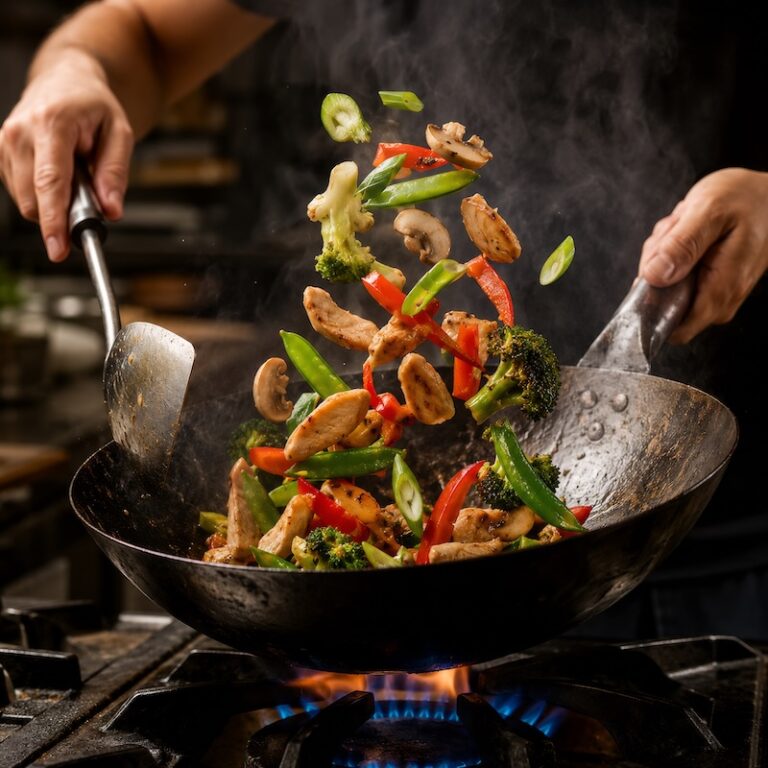
Fast Answer
Stir frying means cooking small, uniform pieces of food in a very hot pan with a small amount of oil, moving constantly. The goal is browning and caramelization — not steaming. The most common reason home stir fry fails is insufficient heat and overcrowding, both of which drop the pan temperature and turn what should be a fry into a steam. Everything else — sequence, oil, sauce timing — follows from understanding that one thing.
How to Stir Fry at Home: Technique, Heat, and What Goes Wrong
The technique is simple on paper: hot pan, high heat, fast movement, small pieces. In practice, most home stir fry ends up soggy, grey, and nothing like what comes out of a restaurant wok.
The reasons come down to three things — the heat problem, the crowding problem, the mise en place problem — plus two techniques most Western home cooks have never heard of: velveting and wok hei.
Start Here: What Stir Frying Actually Is
- The definition that matters: Stir frying is a dry-heat technique using a small amount of very hot oil to cook small, uniform pieces of food quickly through direct contact with a hot surface. The food browns, caramelizes, and picks up char. It does not steam. The moment it steams, it has stopped being a stir fry.
- This technique is for you if: Your stir fry comes out soggy. The vegetables are grey instead of bright. The protein is cooked through but has no browning. The dish tastes flat. All of these are the same problem — insufficient heat — and they're all fixable.
- What success looks like: Vegetables that are bright, crisp-tender, and lightly charred at the edges. Protein that's seared on the outside and just cooked through. A sauce that coats everything rather than pooling in the bottom. And an elusive quality called wok hei — a smoky, slightly charred depth of flavor that is the signature of good stir fry.
- What you need: A wok or a large heavy skillet. A high-smoke-point oil. Ingredients prepped and ready before you turn on the heat. Everything else is technique.
Why Stir Frying Works: The Science Behind the Wok
- The Maillard Reaction at speed: Stir frying is one of the fastest applications of the Maillard reaction in cooking. High heat — 400°F to 600°F at the wok surface — triggers the browning of proteins and sugars almost instantly. This produces the complex, roasted flavor that makes stir fry taste like more than the sum of its ingredients. Lower heat produces grey, steamed food with none of that complexity.
- Why the wok shape matters: A wok's curved, sloped sides concentrate heat at the bottom while keeping the sides cooler. Food tossed up the sides cools briefly before coming back down into the hot zone — which gives the cook control over doneness without removing food from the pan. A flat skillet has no cool zone. Everything in contact with the surface is at the same temperature, which makes precise control harder.
- Wok hei — what it is and why you can't fully replicate it at home: Wok hei — literally "breath of the wok" — is the smoky, slightly charred, almost caramelized quality that defines restaurant stir fry. It comes from extremely high heat (commercial burners run 6 to 10 times hotter than a home stove) vaporizing oil and creating a brief flambé effect that chars the food's surface. You can approximate it at home but you can't fully replicate it. The honest answer is: know what you're working with and optimize for it rather than chasing something your equipment can't produce.
- Why moisture is the enemy: Water boils at 212°F. Any moisture in the pan — from wet vegetables, crowded food, or a cold protein — instantly drops the pan temperature below browning threshold and produces steam instead of sear. Every technique decision in stir frying — dry ingredients, small batches, high heat — is about keeping moisture from winning.
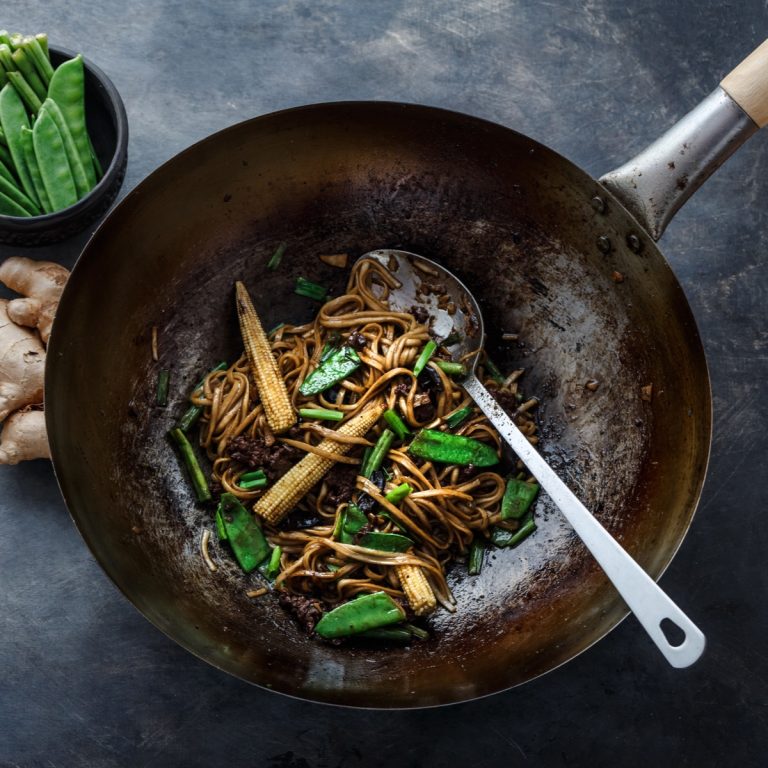
Stir Fry Cooking Order — and Why Each Step Matters
- Oil (peanut, avocado, grapeseed, or canola): Goes in first to create a hot, even cooking surface. High-smoke-point oils handle stir fry temperatures without burning or turning bitter. Never use toasted sesame oil here — it's a finish, not a cooking oil.
- Aromatics (garlic, ginger, onions, scallions): Go in immediately after the oil is hot. Heat releases their essential oils and builds the flavor foundation for the entire dish. Move them constantly — they burn in 30 seconds at stir fry heat. Have the next ingredient ready to go in immediately.
- Protein (chicken, beef, tofu, shrimp): Goes in next in a single layer. Searing first builds browning and flavor. Remove at 80% cooked — it finishes when it returns to the pan with the sauce. Don't leave it in while the vegetables cook or it overcooks.
- Hard or dense vegetables (carrots, broccoli, bell peppers, cauliflower): Go in after the protein is removed. These take longer to cook — adding them early gives them time to become crisp-tender without overcooking everything else.
- Quick-cooking vegetables (snow peas, baby corn, zucchini, mushrooms): Go in 2 minutes after the dense vegetables. They cook fast — adding them too early turns them mushy before the rest of the dish is ready.
- Soft greens (spinach, bok choy, baby kale, watercress): Go in last among the vegetables — 30 seconds is usually enough. Any longer and they lose color, texture, and nutrients. Bok choy is the exception — separate stems from leaves and add the stems 2 minutes before the leaves.
- Sauce (soy, oyster sauce, hoisin, chili paste, rice vinegar): Goes in after the protein returns to the pan. Pour it around the edge of the wok rather than directly onto the food — the hot metal caramelizes it slightly before it hits the ingredients. Toss everything together for 30 to 60 seconds until the sauce coats and reduces. See Asian Sauces for combinations that work.
- Finishing touches (fresh herbs, nuts, sesame seeds, scallion greens): Go on at the plate, not in the wok. These add aroma, texture, and visual contrast — cooking them kills all three.
Try this order with the Chicken and Broccoli Stir Fry recipe — then experiment with different proteins, aromatics, and vegetables to build your own.
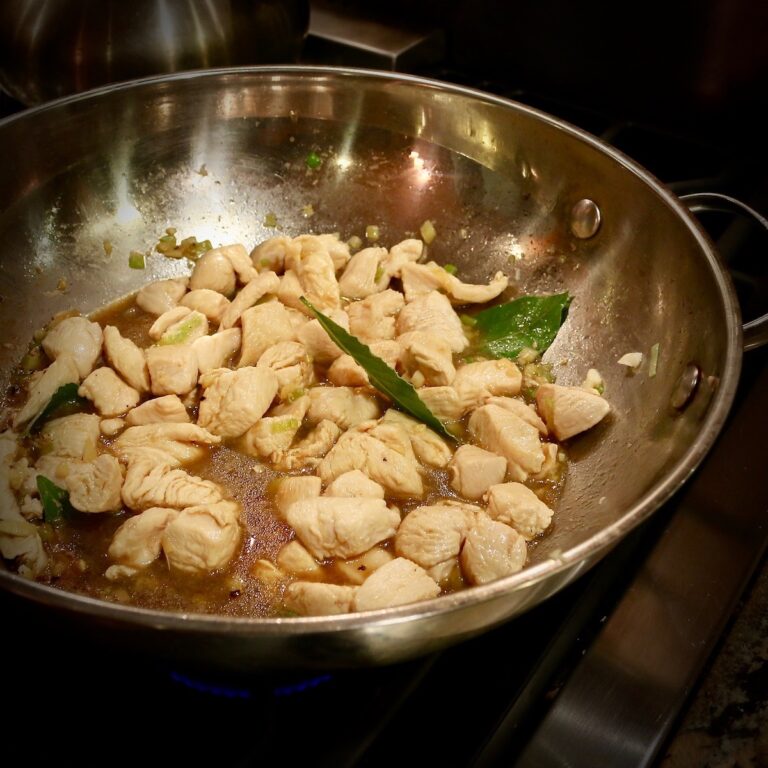
Best Oils for Stir Frying
- Peanut oil (~450°F smoke point): The traditional choice for stir frying. Light, neutral flavor with a subtle nuttiness that doesn't compete with the dish. Handles high heat reliably and is what most Chinese restaurant kitchens use.
- Avocado oil (~520°F smoke point): The highest smoke point of any common cooking oil. Completely neutral flavor. Ideal for the hottest stir frying — particularly when searing protein first at maximum heat.
- Grapeseed oil (~420°F smoke point): Clean, neutral taste that lets the aromatics and sauce come through without interference. A reliable everyday option that's widely available.
- Sunflower oil (~440°F smoke point): Light, mild, and affordable. Works well for everyday stir frying without any strong flavor contribution.
- Canola oil (~400°F smoke point): The budget-friendly workhorse. Smoke point is on the lower end for stir frying — use it at slightly lower heat or in a well-ventilated kitchen.
- Toasted sesame oil (~350°F smoke point): Not a cooking oil. Its smoke point is too low for stir fry heat and it burns quickly, turning bitter. Use it as a finishing drizzle at the plate — a few drops over the finished dish adds the nutty sesame aroma that makes a stir fry smell like a restaurant. It belongs at the end, not the beginning.
The rule: if it's going into a screaming hot wok, use peanut, avocado, or grapeseed. If it's going on the finished dish, sesame oil is one of the best finishing touches in the kitchen.
Equipment: What You Need and Why It Actually Matters
- The wok — and why the shape is the point: A wok's curved, sloped sides aren't just for tossing food dramatically. They create a temperature gradient that gives you control. The bottom of the wok runs at 500°F or higher — that's your searing zone. The sides are cooler. A cook who understands this uses the sides to rest ingredients between tosses, slowing their cooking without removing them from the pan. A flat skillet has no cool zone. Everything in contact with the surface is at the same temperature, which means less control and faster overcooking.
- Carbon steel — the right material for the right reasons: Carbon steel is the professional choice for stir frying. It heats fast, responds to temperature changes quickly, and develops a natural nonstick patina over time through seasoning. Unlike cast iron it's light enough to toss food with one hand. Unlike stainless it doesn't require perfect technique to prevent sticking once it's properly seasoned. A 14-inch carbon steel wok is the single best investment a serious home stir fry cook can make.
- Seasoning a new carbon steel wok — the step most people skip: A new carbon steel wok is coated in a factory oil that needs to be burned off before use. Scrub it with soap and hot water — the only time soap is acceptable on carbon steel — then dry it completely over high heat. Add a thin layer of high-smoke-point oil, heat until it just begins to smoke, wipe it out, and repeat three or four times. The pan will darken and develop a patina. That patina is the seasoning — it's what creates the nonstick surface and prevents rust. Without this step, food sticks and the wok performs poorly. With it, the pan improves every time you cook in it.
- Cast iron — good heat retention, slow response: Cast iron holds heat longer than carbon steel — useful for keeping a consistent temperature through multiple batches. The tradeoff is weight and response time. Cast iron is slow to heat up and slow to cool down, which makes precise heat management harder. It works for stir frying but it's not the ideal tool. If cast iron is what you have, preheat it longer and cook in smaller batches to compensate for the slower temperature recovery.
- Stainless steel — works with the right technique: Ivan, a reader and experienced Chinese home cook, asked in our comments why his All-Clad stainless stir fry pan stuck so badly. The answer is technique, not the pan. Stainless steel requires the pan to be properly preheated before oil goes in — heat the dry pan for 2 to 3 minutes over high heat before adding oil. The metal expands slightly and closes the microscopic pores that cause sticking. Add oil, let it heat until shimmering, then add food. Done correctly, stainless performs well. Done cold, it sticks to everything.
- Nonstick — don't use it for stir frying: Nonstick coatings degrade above 450°F and release fumes that are harmful to humans and lethal to birds. Stir frying requires temperatures well above that threshold. This is a genuine safety issue, not a performance preference. Keep the nonstick pan for eggs and delicate fish. Use carbon steel, cast iron, or stainless for anything that requires high heat.
- The skillet substitute — honest about the tradeoffs: A large heavy-bottomed skillet — 12 inches or larger — is a workable substitute for a wok. You lose the cool zone and the ability to toss food, which means more careful batch management and less margin for error on timing. Compensate by cooking in even smaller batches than you would in a wok, keeping the heat at maximum throughout, and using a spatula to move food rather than tossing. The results are good. They're just not quite the same.
- The tool nobody mentions — the wok spatula: A wok spatula is a long-handled, angled metal spatula designed specifically for the curved surface of a wok. Using a flat Western spatula in a round wok is awkward — the angle is wrong and you can't get under the food cleanly. A wok spatula costs under $10, works with the shape of the pan rather than against it, and makes the constant movement of stir frying noticeably easier. If you're cooking in a wok regularly and don't have one, get one.
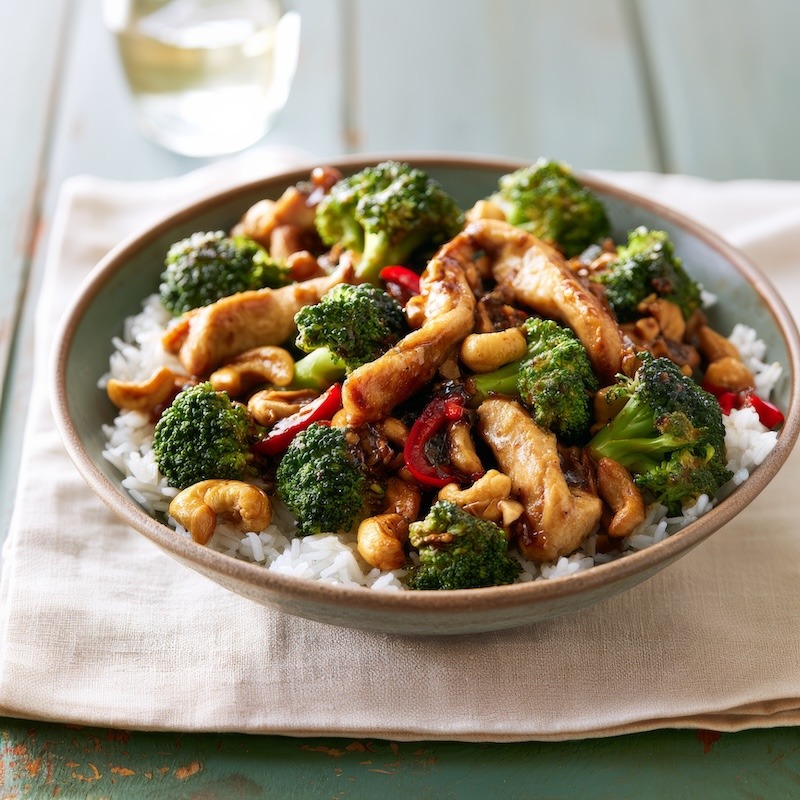
Think Like a Cook: The One Idea That Changes Everything
- Stir frying is a race against moisture and temperature drop. Every ingredient you add to the pan carries moisture and drops the temperature. Your job as the cook is to manage that race — using high enough heat, small enough batches, and dry enough ingredients that the pan recovers its temperature faster than the moisture can accumulate. Once you understand that stir frying is fundamentally about heat management rather than ingredient management, everything else makes sense: why you prep everything first, why you cook in batches, why you dry ingredients before they go in, why you add sauce at the end. Every one of those decisions is about keeping the pan hot enough to fry rather than steam.
- This same logic applies to sautéing, pan roasting, and grilling. Any high-heat dry technique is a race against moisture. Stir frying is just the fastest version of that race.
Step-by-Step: How to Stir Fry Properly
- Step 1 — Mise en place first, always: This is non-negotiable in stir frying more than almost any other technique. The cook time for an entire stir fry is 5 to 8 minutes. There is no time to chop anything once the wok is hot. Everything — protein sliced, vegetables cut, aromatics minced, sauce mixed, garnishes ready — goes into individual bowls before the burner goes on. This is how restaurant kitchens cook every single service. It's the difference between controlled and chaotic.
- Step 2 — Cut to uniform size: Uniform pieces cook at the same rate. A thin slice of chicken and a thick one will not be done at the same time. The knife work here is genuinely important — not for appearance, but for even cooking. Thin slices of protein (¼ inch or less) cook in 60 to 90 seconds. Cut accordingly. See knife skills for the specific cuts that work best.
- Step 3 — Dry everything: Pat proteins dry with paper towels. Wash vegetables well in advance and let them dry completely, or spin them dry. Wet ingredients immediately drop the pan temperature and steam instead of fry. This is the step most home cooks skip and the one that causes most stir fry disappointments.
- Step 4 — Heat the pan until it's genuinely hot: Place the wok or skillet over maximum heat for 2 to 3 minutes before adding oil. The pan should be hot enough that a drop of water evaporates instantly on contact. Add a high-smoke-point oil and let it heat until it shimmers and just begins to smoke slightly. This is your signal — not a timer.
- Step 5 — Cook protein first, in batches: Add protein in a single layer — never pile it. Let it sear without moving for 30 to 60 seconds before stirring. A proper sear requires sustained contact with the hot surface. Remove the protein when it's about 80% cooked — it will finish when it goes back in with the sauce. Set it aside. Wipe out any accumulated moisture if needed.
- Step 6 — Aromatics: Add a small amount of fresh oil if the pan looks dry. Add garlic, ginger, and any aromatics. Move them constantly — they burn in seconds at this heat. 20 to 30 seconds maximum. This is where the flavor base of the dish is built.
- Step 7 — Vegetables in stages: Dense vegetables — carrots, broccoli, bell peppers — go in first. Toss and cook 2 to 3 minutes. Quick-cooking vegetables — snap peas, mushrooms, zucchini — go in next. Soft greens — bok choy, spinach — go in last, 30 seconds before the sauce. Each addition drops the pan temperature — keep the heat at maximum throughout.
- Step 8 — Return the protein, add the sauce: Return the cooked protein to the pan. Pour the sauce around the edges of the wok rather than directly onto the food — the hot wok surface caramelizes the sauce slightly before it hits the food, which adds depth. Toss everything together for 30 to 60 seconds until the sauce coats and reduces slightly.
- Step 9 — Finish and serve immediately: A drizzle of toasted sesame oil, fresh scallions, sesame seeds, or crushed peanuts go on at the plate, not in the wok. Stir fry waits for no one — serve immediately. Every minute it sits, moisture accumulates and the crispness you worked for disappears.
Visual Cues: What to Look and Listen For
- Loud sizzle when food hits the pan → pan is hot enough → proceed. Quiet or no sizzle → pan is too cool → remove food and heat longer before continuing.
- Protein releases steam and starts to brown at the edges within 60 seconds → Maillard reaction is happening → good. Grey color with no browning → steaming, not frying → pan too cool or food too wet.
- Vegetables turn vivid and bright → cell structure has relaxed from heat → this is the signal to check for crispness. Dull, grey, or darkening color → overcooked or steaming → remove immediately.
- Light charring at the edges of vegetables and protein → approaching wok hei territory → this is what you want. Don't panic at small char marks; they're flavor.
- Sauce reduces and clings to the food rather than pooling → correct heat and timing → done. Sauce sits in a pool at the bottom → added too early or too much liquid → toss on high heat to reduce.
- Smoke coming from the wok → pan is at stir fry temperature → normal and expected. Acrid black smoke → oil burning → reduce heat slightly or add food immediately to drop the temperature.
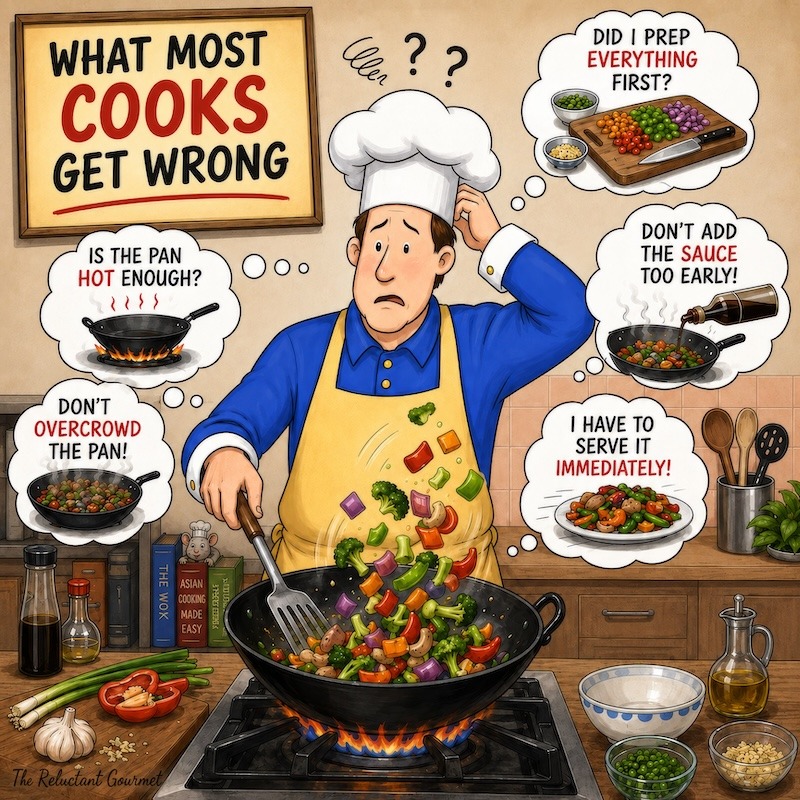
What Most Cooks Get Wrong: The Seven Stir Fry Mistakes
- Mistake 1 — The pan isn't hot enough: This is the root cause of most stir fry failures. A pan that isn't screaming hot produces steam, not sear. Home cooks are often nervous about high heat — the smoke, the noise, the speed. But high heat is the technique. Without it, you're making a vegetable sauté, not a stir fry. Heat the pan for a full 2 to 3 minutes before anything goes in.
- Mistake 2 — Overcrowding the pan: Adding too much food at once drops the pan temperature immediately. The food sits in its own steam, moisture accumulates, and browning becomes impossible. Cook in batches. Two properly cooked batches are faster and better than one crowded, soggy batch.
- Mistake 3 — Wet ingredients: Water in the pan vaporizes at 212°F and creates steam. Dry ingredients sear. This is the whole game. Pat proteins dry. Dry vegetables thoroughly after washing. Never add ingredients straight from the sink.
- Mistake 4 — Skipping mise en place: Starting to chop while the wok is heating is how you end up with burnt garlic and overcooked protein. Everything must be prepped, portioned, and within arm's reach before the burner goes on. There are no timeouts in stir frying.
- Mistake 5 — Adding sauce too early: Sauce contains liquid. Liquid drops the temperature and creates steam. Add the sauce in the last 60 seconds, when everything is cooked and the pan is still ripping hot. Pour it around the edges so the wok surface caramelizes it slightly before it hits the food.
- Mistake 6 — Cooking everything together: Different ingredients cook at different speeds. Protein goes first, comes out, goes back in at the end. Dense vegetables before quick-cooking ones. Soft greens last. Ignoring this sequence produces some things overcooked and others raw in the same dish.
- Mistake 7 — Letting it sit before serving: Stir fry continues to cook from residual heat after it leaves the wok. Every minute it sits, moisture accumulates from the vegetables and the crisp texture that took all that heat to achieve softens and disappears. Serve immediately. Always.
Quick Diagnosis: What Went Wrong and How to Fix It
- Vegetables grey and soggy → pan too cool or too crowded → cook in smaller batches over maximum heat; dry vegetables thoroughly before cooking.
- Protein chewy and grey, no browning → pan not hot enough, or protein was wet → pat dry aggressively; heat pan longer before adding oil; cook in a single layer without stirring for the first 60 seconds.
- Everything tastes bland → sauce added too early and got lost, or not enough aromatics → add sauce at the very end over high heat; build a stronger aromatic base with garlic, ginger, and scallion.
- Sauce pools at the bottom instead of coating → too much liquid in the sauce, or added before the pan was hot enough → reduce sauce quantity; add over high heat at the very end and toss aggressively to coat.
- Garlic or ginger burnt and bitter → cooked too long at too high a temperature → aromatics need 20 to 30 seconds maximum at stir fry heat; move them constantly; have the next ingredient ready to go in immediately.
- Uneven cooking — some pieces done, others raw → uneven cut sizes → uniform thickness is more important than any other prep decision; ¼ inch slices cook in 60 to 90 seconds.
- Too much smoke, setting off alarms → oil past its smoke point → use a higher smoke-point oil (peanut, avocado, grapeseed); turn on ventilation before you start; some smoke is normal and expected at proper stir fry heat.
Quick Fixes and Tips Worth Knowing
- The smoke problem — Ivan's question answered properly: A reader named Ivan — a Chinese home cook — raised this exact issue in our comments years ago. He was preheating his wok dry, adding peanut oil, seeing smoke, and panicking. Here's the real answer: some smoke when oil hits a very hot wok is normal and expected. The oil is at the right temperature. Add the food immediately and the temperature will drop slightly. The smoke will reduce. If the smoke is acrid and black, the oil has gone past its smoke point — reduce heat slightly next time. But a wisp of smoke from peanut oil in a hot wok is not a problem. It's a sign you're at the right temperature.
- Velveting — the technique that makes restaurant chicken taste different: Chinese restaurants tenderize protein before stir frying using a technique called velveting. Thinly sliced chicken, beef, or pork is tossed in a mixture of egg white, cornstarch, and a small amount of oil, then briefly blanched in water or oil before stir frying. The cornstarch coating protects the protein from the intense heat, keeping it silky and tender rather than tough. This is why restaurant stir fry chicken has a completely different texture from home stir fry chicken. It's not the wok. It's the prep.
- Approximating wok hei on a home stove: You can't fully replicate restaurant wok hei at home, but you can get closer. Use a carbon steel wok, not nonstick. Get the pan as hot as your stove allows — maximum heat, preheated for 3 full minutes. Cook in very small batches. Tilt the pan occasionally to let the oil pool and briefly ignite — this creates a momentary high-heat burst. Don't crowd the pan. The goal is to work with your equipment's limits, not pretend they don't exist.
- The sauce trick: Mix your stir fry sauce before you start cooking and keep it beside the stove. Never measure at the wok — the timing is too tight. Pour the sauce around the edge of the wok rather than directly onto the food. The hot metal surface caramelizes the sauce in the half-second before it reaches the food. Small thing, real difference.
- If it went soggy: You can't un-steam food. But you can rescue a soggy stir fry by spreading it onto a very hot sheet pan in a 450°F oven for 5 minutes — the dry oven heat drives off some moisture and restores some crispness. Not perfect, but better than serving it as is.
Control the Variables: How to Adapt This Technique
- Heat level: Maximum heat throughout. This is not adjustable downward without fundamentally changing what you're cooking. If your stove can't get hot enough, cook in smaller batches and move faster to compensate.
- Batch size: The single most controllable variable for home cooks. Smaller batches = higher effective heat = better browning. As a rule: never fill the wok more than one-third full at any time.
- Cut size: Thinner = faster cook = more surface area for browning = better result. ¼ inch slices for protein. Similar sizing for vegetables. Partial freezing (20 minutes in the freezer) makes thin slicing of protein much easier.
- Oil quantity: Enough to coat the wok surface — usually 1 to 2 tablespoons. More oil produces a greasier result without improving browning. The oil is a medium for heat transfer, not a cooking fat in the French sense.
- Sauce quantity: Less than you think. Too much liquid defeats the purpose of the technique. A good stir fry sauce should coat, not flood. Start with 3 to 4 tablespoons for a two-person dish and adjust from there.
- Protein type: Chicken breast and pork benefit most from velveting. Beef and lamb are more forgiving at high heat. Shrimp cook in 90 seconds and need to come out the moment they curl into a C shape. Tofu needs to be pressed completely dry and can be pre-fried for better texture.
- Wok vs. skillet: A carbon steel wok is better for the technique. A large heavy skillet is a workable substitute — use stainless steel or cast iron, never nonstick at these temperatures. The key difference is the sloped sides; without them you lose the cool zone and the ability to toss food.
When to Use Stir Frying — and When Not To
- Use it for: Small, uniform pieces of tender protein — chicken breast, beef strips, shrimp, pork, tofu. Quick-cooking vegetables — broccoli, bell peppers, snap peas, bok choy, mushrooms, zucchini. Noodles and fried rice. Any dish where you want high heat, fast cooking, and a lightly charred, caramelized result.
- Use it when: You have everything prepped and ready before you start. You're cooking for two to three people — not a crowd. You have a powerful enough burner and good ventilation. You're not in a hurry to manage the process — stir frying is fast but it requires full attention.
- Don't use it for large quantities: Stir frying for six people means six batches or a completely soggy result. For larger groups, roast the protein and vegetables separately at high heat and combine at the end. Same flavor logic, more practical execution.
- Don't use it for tough cuts: Chuck, brisket, short ribs — cuts with connective tissue need low, slow, moist heat. Stir frying at high heat toughens them further. Braising is the right technique for those cuts.
- Don't use it for delicate fish: Thin fish fillets fall apart under the constant movement of stir frying. Steam, poach, or pan roast fish instead. Shrimp and scallops are the exception — they're sturdy enough to handle the technique.
- Don't use it if your mise en place isn't ready: Starting to stir fry without everything prepped is how you end up with burnt aromatics and overcooked protein. If you're not ready, turn off the heat and finish prepping first.
Apply It: Stir Frying Across Different Proteins and Vegetables
- Chicken breast: Slice thin against the grain — ¼ inch maximum. Velvet if you have time (egg white, cornstarch, small amount of oil, 30 minutes in the fridge). Cook in a single layer for 60 to 90 seconds without stirring. Remove at 80% done. The texture difference between velveted and non-velveted chicken in a stir fry is significant. See Chicken and Broccoli Stir Fry for a full recipe.
- Beef strips: Partially freeze for 20 minutes before slicing — you'll get much thinner, more even cuts. Slice against the grain. High heat, single layer, 60 seconds per side for medium. Beef can take more char than chicken without drying out — lean into it.
- Shrimp: Peel, devein, pat completely dry. 60 to 90 seconds over maximum heat. Done when they curl into a loose C shape. A tight O shape means overcooked. Shrimp cook faster than you think and stop for nothing.
- Tofu: Press for at least 30 minutes to remove moisture. Cut into cubes. For best results, pan-fry the tofu separately in plenty of oil until golden on all sides before adding to the stir fry. This pre-frying step gives tofu a skin that holds up to tossing and actually absorbs sauce rather than falling apart.
- Broccoli: Cut into small, even florets. Blanch briefly in boiling water (1 minute) then dry thoroughly before stir frying — this pre-cooks the dense stalks so they finish at the same time as the tender tops. Otherwise the florets char before the stalks are tender.
- Bok choy: Separate leaves from stems. Stems go in 2 minutes before the leaves — they're denser and need more time. Leaves wilt in 30 seconds. One of the fastest and best stir fry vegetables once you understand the two-part timing.
Stir Fry Cheat Sheet
- Prep everything before you start: Protein sliced · vegetables cut · aromatics minced · sauce mixed · garnishes ready. No exceptions.
- Cut size: ¼ inch or thinner for protein. Uniform size for vegetables. Partially freeze protein 20 min for easier thin slicing.
- Dry everything: Pat protein dry. Dry vegetables completely. Wet = steam = soggy.
- Heat: Maximum heat, always. Preheat pan 2–3 minutes before adding oil. Oil shimmers and just begins to smoke = ready.
- Batch size: Never more than one-third full. Cook in batches rather than crowding.
- Cooking order: Oil → aromatics (20–30 sec) → protein (remove at 80% done) → dense vegetables → quick vegetables → soft greens → return protein → sauce around edges → toss → garnish → serve.
- Sauce: Mix before cooking. Add in last 60 seconds. Pour around the wok edge, not directly on food. Less than you think — 3–4 tbsp for 2 people.
- Velveting (optional but worth it): Toss sliced protein in egg white + cornstarch + a little oil. Refrigerate 30 min. Blanch briefly before stir frying. Changes the texture completely.
- Serve immediately: Every minute it sits, it gets soggier. Stir fry waits for no one.
- Best oils: Peanut (~450°F) · Avocado (~520°F) · Grapeseed (~420°F) · Canola (~400°F). Toasted sesame oil is a finish, not a cooking oil.
Explore More on This Topic
- Knife Skills — the single most important prep decision in stir frying. Uniform cuts are what make everything cook at the same rate.
- Chicken and Broccoli Stir Fry — the technique applied to one of the most popular stir fry combinations. A good place to put everything on this page into practice.
- Sautéing Technique — the closest relative to stir frying. Understanding both tells you when to reach for which one.
- Braising — what to do with the tough cuts that stir frying can't fix. Low, slow, and moist heat instead of high, fast, and dry.
- Asian Sauces — the flavor logic behind stir fry sauces. Salty, sweet, sour, and umami in balance — and how to build that yourself.
- Frying Techniques Overview — how sautéing, pan frying, and stir frying relate to each other and when each one is the right tool.
- Mise en Place — the prep discipline that makes stir frying possible. If there's one technique post that pairs with this one, it's this.
- How to Season Properly — because a well-executed stir fry with flat seasoning is still a disappointment. Get this right and everything else clicks.
Frequently Asked Questions about Stir Fry
Why does my stir fry always end up soggy? Almost always one of two things — the pan wasn’t hot enough, or you put too much food in at once. Both cause the pan temperature to drop below the browning threshold and the food steams in its own moisture instead of frying. The fix is maximum heat and smaller batches. If you have to cook three batches instead of one to get it right, three batches is the right answer.
Do I need a wok or can I use a regular pan? You can use a large heavy skillet — stainless steel or cast iron — and get good results. What you can’t use is a thin pan (hot spots and warping) or nonstick at high heat (the coating degrades above 450°F and releases fumes). The wok’s advantage is the sloped sides that give you a cool zone and the ability to toss food. A flat skillet works but requires more careful batch management.
What is velveting and do I actually need to do it? Velveting is a Chinese restaurant technique where thinly sliced protein is coated in egg white, cornstarch, and a small amount of oil before cooking. It creates a thin protective coating that insulates the meat from the intense heat, keeping it silky and tender rather than tough and dry. You don’t need to do it — stir fry works without it — but if you’ve ever wondered why restaurant chicken has a completely different texture from home stir fry chicken, this is why. It takes 30 minutes of inactive time and makes a significant difference.
What’s the best oil for stir frying? Peanut oil is the traditional choice — neutral flavor, high smoke point around 450°F, and it handles the heat well. Avocado oil has an even higher smoke point around 520°F and works beautifully. Grapeseed and canola are solid everyday options. Toasted sesame oil has a low smoke point and burns quickly — use it as a finishing drizzle at the plate, never as a cooking oil. Coconut oil, as one of our readers suggested, also works reasonably well and produces less acrid smoke when it starts to go — though its flavor comes through in delicate dishes.
How do I get that smoky restaurant flavor at home? That flavor is wok hei — the breath of the wok — and it comes from extremely high heat vaporizing oil and creating a brief flambé effect that chars the food’s surface. Commercial burners run 6 to 10 times hotter than a home stove, so you can’t fully replicate it. You can get closer by using a carbon steel wok preheated as hot as your stove allows, cooking in very small batches, and occasionally tilting the pan so the oil briefly contacts the flame. But the honest answer is that home stir fry and restaurant stir fry are different things. Knowing that helps you optimize for what you can achieve rather than chasing something your equipment can’t produce.
Can I prep stir fry ingredients ahead of time? Yes — and you should. Slice the protein, cut the vegetables, mix the sauce, and mince the aromatics up to 24 hours ahead. Keep everything in separate containers in the fridge. Pull them out 20 minutes before cooking so the protein isn’t ice cold when it hits the pan. Do not combine them ahead of time — once cut, different ingredients stored together transfer moisture and flavors you don’t want.
How much sauce should I use? Less than you think. A good stir fry sauce should coat the food, not flood it. For a two-person dish, 3 to 4 tablespoons of sauce is usually right. If the sauce pools in the bottom of the wok rather than clinging to the food, there’s too much liquid — either reduce the quantity next time or let it reduce longer in the wok before serving.
Can I stir fry frozen vegetables? Technically yes, but the results are inferior. Frozen vegetables release water as they thaw in the hot pan — which is exactly what you’re trying to avoid. If you must use frozen, thaw and dry them thoroughly first, or blanch, shock, and dry them before stir frying. Fresh vegetables are significantly better for this technique.
3 Responses
I study your entire section of saute and fry; these 2 techniques are more frequent used in my daily cooking. I am a chinese so i do lots stir fry dish; somehow, i am kind of hesitate to stir fry a lot (but only one dish per meal as the maximum) because of stir fry produce lots smook.
After I read the saute and fry article, i added more knowledge about these 2 technique and try to use these mix knowledge to apply on stir fry. Smoke still brother me. Please see my following step and understanding are correct.
Pre-heat wok (with no oil) until it can evaporate immediately as i sprinkel few drops of water. Now the wok temp is at least 212 f, i add fat (use peanut oil for stir fry); as soon as i add oil, the wok smoke; in order to reduce smoke, i put my ingredients into the wok. I think the pernut oil is not reach proper temp for stir fry; however, the smoke made me too nervous to wait until oil in convective condition.
I am using the tradition wok bought from Chinese supermarket; I am not quite sure the material (for sure not spun steel, which I am in searching). I also have a All-clad tri-ply stainless steel stir fry pan; but have’t apply above mentioned method on it because I used it to stir fry and end up with headache because of it is so sticky.
Please give me advice to make proper adjustments from my mentioned steps.
Thank you very much!!
P.S. Love this website and article; they are very useful to expand my culinary knowledge and keep myself improving ^__^
Ivan — good news first: your instinct that the peanut oil “hasn’t reached proper temp” is actually backwards. The smoke is usually the sign you’re at temp, not that you’re short of it.
Here’s what’s happening. You’re preheating the wok until water flash-evaporates, which puts the surface well above 212°F — probably closer to 350°F+ at the hottest spot, right where the flame hits. Peanut oil’s smoke point is around 450°F, so when it hits that one concentrated hot zone, it can start smoking there almost instantly — even though the oil as a whole hasn’t had time to heat evenly across the pan yet. You’re reading that localized smoke as “too hot, abort,” and dumping food in before the oil’s actually shimmering and evenly heated. That’s the part to fix, not the preheating.
Try this instead: add the oil, then immediately swirl or tilt the wok to spread it across the surface — that alone calms a lot of the initial smoke because you’re not leaving oil pooled on the single hottest spot. Give it 5 to 10 seconds. A light wisp or thin haze at that point is normal and expected — that’s your green light. What you’re actually watching for as a stop signal is smoke that turns continuous, grey-black, and acrid-smelling. That means the oil’s gone past its smoke point, not just approaching it. Wisp = go. Acrid and black = back off.
On the wok itself — “not spun steel” doesn’t necessarily mean it’s not carbon steel. Most traditional woks sold at Chinese supermarkets are carbon steel, just made by stamping or hammering rather than spinning. Cheap way to check: a magnet will stick to carbon steel and won’t stick to aluminum. I’d bet on carbon steel, in which case the pan isn’t your problem — the timing is.
On the All-Clad sticking on you: that’s a completely different animal from the wok and needs its own sequence. Preheat that pan dry, empty, over high heat for a full 2 to 3 minutes before oil goes anywhere near it. Then add the oil and wait until it shimmers — same “don’t rush it” principle as the wok, just with the extra step of getting the bare pan hot first. If you’re carrying the wok’s “get food in fast before it smokes too much” instinct over to the stainless pan, that’s almost certainly what’s sticking on you.
Try the swirl-and-wait approach next time and see if the smoke settles into something more predictable. Let me know how it goes.
Hi Ivan! I stir fry a lot and have found that my favorite oil is coconut oil (organic virgin coconut oil to be specific). It has a fairly high smoking point, and if it does smoke, it doesn’t smell as bad as peanut/vegetable oil (plus it is better for you). I add the oil to the wok when I turn the heat on so I can watch for when the oil begins to ripple…that’s how I know it’s hot enough. Approaching it this way should eliminate the smoke problem every time!