
Fast Answer
Terroir is the French term for the environmental conditions — soil, climate, sunlight, topography — that shape both food and wine in a given region. Because local foods and local wines evolved side by side over centuries, they tend to work together naturally on the table. Understanding terroir is more useful than memorizing pairing rules, because it explains not just what to pair but why it works — and lets you make confident decisions when a dish or bottle falls outside any list you've memorized.
Why Local Food and Local Wine Taste Better Together
The standard wine-pairing advice — red with meat, white with fish — isn’t exactly wrong. It’s just incomplete. It tells you what to do without explaining why, which means it breaks down the moment your dish doesn’t fit the template.
The more useful framework is terroir: the idea that foods and wines from the same place were shaped by the same geography, climate, and cooking traditions. That’s why they work together. Everything else follows from that.
Start Here: What Terroir Actually Means
- Terroir is a French word with no clean English equivalent. It refers to the complete environmental fingerprint of a place — soil composition, climate, sunlight hours, rainfall, topography, and even the wild plants growing nearby. Everything that makes one vineyard different from the next.
- It applies to food as much as wine. The same climate that shapes a Burgundy vineyard shapes the mustard, mushrooms, and Charolais cattle in the same region. That's why Burgundy wine works with Burgundy food — they carry the same environmental signature.
- Old World winemakers lead with terroir. European wines are typically named for their region (Burgundy, Rioja, Chablis) rather than their grape, because the place is considered the defining characteristic. New World wines more often lead with the grape variety because the terroir is less established as a selling point.
- You don't need to understand terroir scientifically to use it. The practical version is simple: when you're unsure what wine to open, reach for something from the same country or region as the cuisine you're cooking. The pairing almost always works because it evolved that way.
Why Terroir Explains More Than Pairing Rules
- Rules tell you what. Terroir tells you why. "Red wine with red meat" is a rule. Understanding that robust proteins need robust tannins — and that both developed in the same cool-climate terroir — is the reason behind the rule. The reason travels to new situations. The rule doesn't.
- Regional logic covers dishes that rules miss entirely. What wine with Moroccan lamb tagine? What wine with Japanese ramen? Pairing charts rarely go there. But the terroir principle points you toward North African reds for the tagine and a dry, mineral sake or lager for the ramen — because those pairings evolved together.
- It explains why some technically "wrong" pairings work. A light Pinot Noir with salmon is technically a red-with-fish pairing — and it's excellent. Why? Because both Pinot Noir and salmon share a delicate, earthy, slightly fatty character. The match is about weight and texture, which terroir shaped, not about color.
- It gives you permission to trust your instincts. If you're cooking a dish that feels Italian — olive oil, garlic, tomato, herbs — and you reach for an Italian red, you're applying terroir logic instinctively. You're probably right.
Regional Terroir Pairings: What Grows Together Goes Together
- Northern Italy (Piedmont, Tuscany). Sangiovese, Nebbiolo, and Barbera evolved alongside olive oil, tomatoes, cured meats, aged cheeses, and rich meat braises. Italian reds have the acidity to match tomato and the tannin to suit braised proteins — not by design but by centuries of co-evolution.
- Southern France (Provence, Rhône). Grenache, Syrah, and Mourvèdre grew up alongside lavender, herbs, olive oil, lamb, and ratatouille. The garrigue — the wild-herb scrubland of the region — leaves its mark on both the wine and the food. Côtes du Rhône with Provençal lamb is a regional pairing that works before you even think about it.
- Spain (Rioja, Galicia). Tempranillo and the ocean-influenced whites of Galicia (Albariño) each evolved beside very different food traditions. Rioja with grilled lamb and Manchego. Albariño with grilled seafood and clams. The geographical divide between the inland and coastal cuisines is encoded in the wine.
- Alsace (France/Germany border). One of the most instructive terroir cases — Alsatian cuisine is essentially German (choucroute, pork, sauerkraut, rich braises) but the wines are French in style. The result is a unique set of pairings: Gewurztraminer with choucroute, dry Riesling with pork, Pinot Blanc with almost everything. The food and wine evolved in the same cultural and geographical space.
- Coastal regions everywhere. Wine-growing regions near coastlines — Muscadet in the Loire, Albariño in Galicia, Vermentino in Sardinia, Assyrtiko in Santorini — share a saline minerality that mirrors the briny freshness of local seafood. This is terroir made literal: the sea shapes the vine, and both meet the ocean's harvest on the plate.
- The New World challenge. California, Australia, Argentina, and New Zealand produce excellent wines without centuries of culinary terroir. The practical workaround: pair by weight and flavor profile rather than geography. A California Pinot Noir behaves like a Burgundy in terms of weight and earthy character — apply the same food logic.
What Most Pairing Advice Gets Wrong
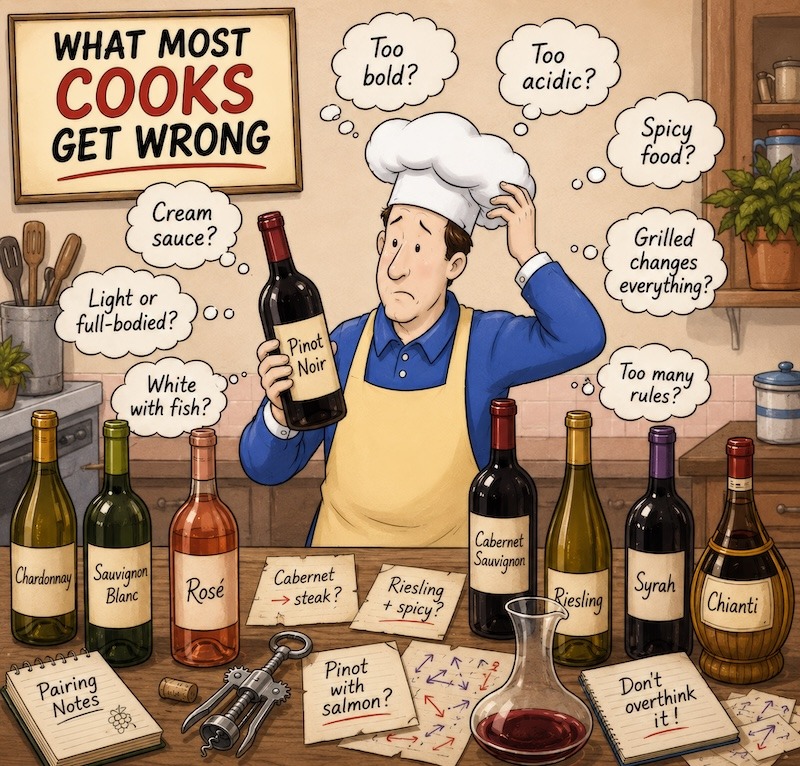
- Color is the least useful variable. "Red with meat, white with fish" survives because it's memorable, not because it's reliably true. A delicate Pinot Noir outperforms a heavy Chardonnay with salmon. Color is a rough proxy for weight — and weight is what actually matters.
- The cooking method changes everything. A poached chicken breast is a different pairing problem than a braised chicken in red wine. The same protein prepared differently can need completely different wines.
- The sauce is often the real variable. A cream sauce calls for a wine with enough acidity to cut the fat. A tomato-based sauce needs a wine with enough acidity to match it. The protein is secondary to the sauce when it comes to pairing decisions.
- Sweetness is a dial, not a switch. The rule is that the wine should never be sweeter than the dish — not that sweet wines are bad. Many savory dishes with caramelized or fruit-based elements pair beautifully with a wine that has a touch of residual sweetness.
- Vinaigrette is a genuine problem. This is one rule without exceptions: the acidity in a vinaigrette deadens the palate and makes wine taste metallic and flat. If you're serving wine with a salad course, use a creamy dressing. If you want vinaigrette, save the wine for the main course.
Sweetness: The Most Misunderstood Variable
- The core rule: wine should never be sweeter than the dish. A dry wine alongside a sweet dessert tastes sharp, thin, and slightly bitter — the wine's acidity has nothing sweet to balance against. The dessert wins and the wine loses.
- Dry wines with savory food. Most savory cooking calls for dry wine — no residual sugar. Seared proteins, roasted vegetables, pasta, and cheese all suit dry wines without exception.
- Off-dry wines with spice and salt. A touch of residual sweetness moderates chili heat and balances salty food. Off-dry Riesling with spicy Thai food or German sausage works for this exact reason.
- Sweet wines with rich desserts. Sauternes with crème brûlée, Port with dark chocolate, Moscato with fruit tarts. The sweetness in the wine matches and meets the sweetness in the dish.
- Sparkling wine breaks the rule. The carbonation and acidity in Champagne and other sparkling wines reset the palate regardless of sweetness level. Sparkling wines work across almost any course — including dessert, where a demi-sec Champagne can outperform many dedicated dessert wines.
Practical Tips Worth Keeping
- Cook with the wine you plan to drink. If you're adding wine to a braise or pan sauce, use the same bottle — or at least the same grape. The flavors integrate across the dish and the glass in a way that makes both better.
- Read the tasting notes before you cook. If a bottle describes apple and spice notes, think pork with apple. If it's described as herbal, add fresh herbs to the dish. The wine and the food build toward each other.
- When given wine as a gift, don't feel obligated to serve it that night. The wine someone brought may not match what you've cooked. Put it away for a meal where it fits. Serve a wine you know goes with the food.
- Go to tastings. Most wine shops offer free tastings on weekend afternoons. Trader Joe's, Total Wine, and BevMo all do them regularly. Knowing what you like — light and fruity vs. bold and spicy — is the fastest way to shop for wine with confidence.
- At the end of every rule: drink what you like. Technical pairing is useful. But a wine you love with a dish you love will always beat a technically correct pairing you approach with anxiety. The goal is a good dinner, not a passing grade.
A Personal Note: Santa Barbara County
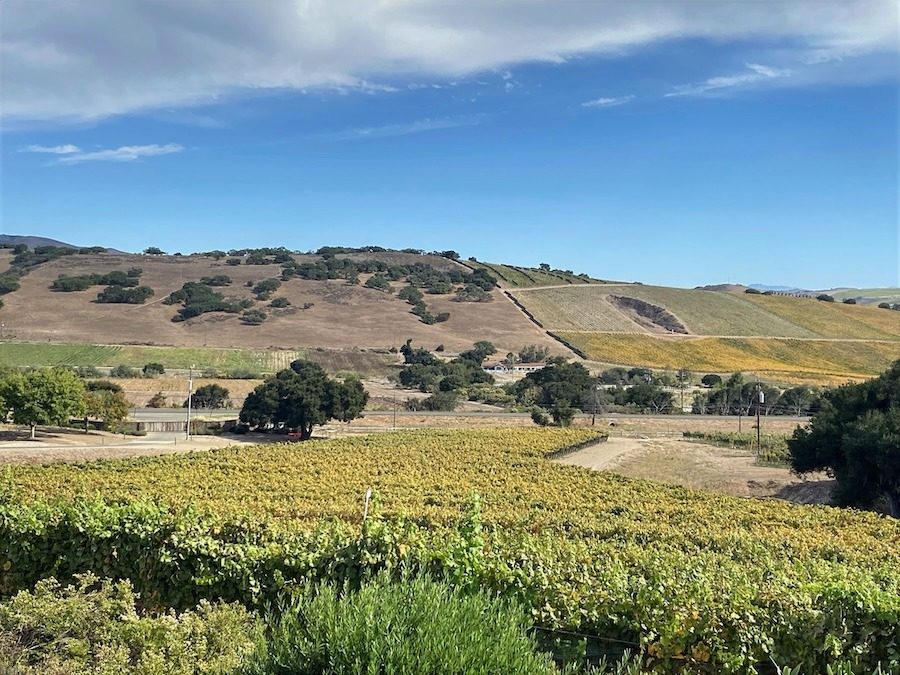
I've had the chance to visit Santa Barbara County wine country — the Santa Ynez Valley, Los Olivos, and the Santa Rita Hills — and it's one of the clearest examples of terroir I've encountered outside of Europe. The geography there is unusual: the mountain ranges run east-west instead of the typical north-south orientation of most California coastal ranges, which means the valleys funnel cold Pacific air directly inland every afternoon. The result is a cool-climate growing region sitting inside sunny Southern California, which makes no intuitive sense until you stand in a vineyard at three in the afternoon and feel the fog rolling in.
That climate produces Pinot Noir and Chardonnay with a restraint and acidity you don't expect from California. The wines taste more like Burgundy than Napa — earthy, mineral, with enough acidity to work with food rather than overpower it. And the food culture around Los Olivos and Solvang reflects it: locally raised lamb, olive oil, cheese, farmers market vegetables. The same principle that makes Burgundy wine work with Burgundy food is quietly at work in a California valley most people have only seen in Sideways.
If you get the chance to visit, go. Walk the Foxen Canyon Wine Trail. The connection between the land and what ends up in the glass is as obvious there as anywhere I've been — and it makes the terroir concept feel less like wine-world jargon and more like something you can actually taste.
Frequently Asked Questions
Q: What is terroir in simple terms? Terroir is everything about a place that shapes the character of what grows there — soil type, climate, rainfall, sunlight hours, altitude, and the surrounding plant life. In wine, terroir is why a Pinot Noir from Burgundy tastes different from a Pinot Noir from Oregon, even though they’re the same grape. In food pairing, terroir is why regional cuisines and wines tend to pair naturally — they developed under the same environmental and cultural conditions.
Q: Why do Italian wines work so well with Italian food? Because they co-evolved. Italian reds — particularly Sangiovese and Barbera — have high natural acidity that pairs well with olive oil, tomatoes, and cured meats, which are also acidic or fat-forward. The wines aren’t just stylistically compatible with the food; they developed in a culinary culture where that food was always on the table. The pairing isn’t a coincidence. It’s centuries of terroir in action.
Q: What does “what grows together goes together” actually mean? It means that before global shipping and international wine markets, people ate local food and drank local wine. The two evolved together in response to the same climate, soil, and cooking culture. The phrase is a shortcut to the terroir principle: if you’re uncertain what wine to open, start with something from the same region as the cuisine you’re cooking. It works more often than any pairing chart.
Q: Why doesn’t wine work with vinaigrette? The acidity in vinegar — specifically acetic acid — is more aggressive than the natural fruit acids in wine. When the two meet on the palate, the vinegar suppresses your perception of the wine’s flavors, making it taste metallic, flat, and slightly bitter. This is chemistry, not preference — it happens with nearly every wine. The fix is to use a creamy dressing with wine, or to serve the salad before the wine is poured.
Q: What is the difference between Old World and New World wine? Old World refers to the traditional wine-producing countries of Europe — France, Italy, Spain, Germany, Portugal, and others. Old World wines tend to be named for their region of origin (Burgundy, Rioja, Chablis) and are typically more restrained in fruit with higher acidity and earthiness. New World refers to wine-producing countries outside Europe — the US, Australia, Argentina, New Zealand, South Africa, and Chile. New World wines are typically labeled by grape variety and tend toward riper fruit with more body and alcohol. For pairing purposes, match by weight and flavor profile regardless of origin.
Q: Should the wine always be drier than the food? Yes, as a general rule. Wine should never be sweeter than the dish it accompanies — the sweetness in the food will make the wine taste thin and sharp. The exception is off-dry wines paired with spicy or salty food, where a touch of residual sweetness provides balance. And sparkling wine largely ignores this rule — the carbonation and acidity create their own balance.
Q: Is it really okay to just drink what I like? Yes. Technical pairing improves the experience when you’re cooking something specific and have choices. But the difference between a well-paired wine and a wine you simply enjoy drinking is usually smaller than the pairing advice industry would have you believe. The most important rule is that dinner should be pleasurable, not anxiety-producing. Know the principles, apply them when they’re useful, and trust your own palate.
Q: How do I learn more about what wines I actually like? Go to tastings. Most wine shops offer free tastings on weekend afternoons. Total Wine, BevMo, and Trader Joe’s all run them regularly. Tell the person running the tasting what you think you like — light and fruity, or bold and spicy, or dry and mineral — and let them suggest bottles. Your palate develops faster through tasting than through reading.
Explore More on This Topic
- Wine Pairing Made Easy — The practical tools for applying these principles, including an interactive pairing helper, a sortable grape reference table, and a printable checklist.
- Food and Wine Pairing Helper — Use the interactive tool to apply terroir logic to your specific dish — choose your protein, sauce, cooking method, and flavor profile and get ranked wine suggestions.
- Classic Food Pairings Guide — The same contrast, harmony, and bridging logic that applies to food pairings — an interactive ingredient finder covering herbs, proteins, cheeses, and more.
- Burgundy Sauce — A red wine pan sauce that demonstrates terroir logic in practice — Pinot Noir from the same region as the sauce's origins, reduced with shallots and demi-glace.
- Veal Marsala — A dish where the wine in the sauce points toward the wine in the glass — the clearest example of cooking with and drinking the same bottle.
- Chicken Marsala — The same terroir logic applied to a weeknight dish — a pan sauce built from Marsala wine that works as both cooking liquid and table wine.
6 Responses
Since I’m an ole “rednek”, I don’t know that much about wine or what wine goes with what foo.. I do have some red and some white that I use in cooking. I do sometimes think about just what would be a good wine to go with a bowl of Texas type chili or a pot of Cajun red beans and rice, or maybe some southern beef tips over rice. What would go good with turnip greens and smothered pork chops?
Hi LADawg, so much has to do with personal taste but here are some wine suggestions I might try.
Texas Chili – Shiraz or Malbec
Beans & Rice – Zinfandel
Pork Chops – Pinot Noir
Those do sound like a good choice for the first two, but so does a cold Old Milwaukee Beer with the first two, Then maybe a glass of unsweetened ice tea with the pork chops.
I can’t remember the last time I enjoyed a cold frosty Old Milwaukee but beer is a great choice. Unsweetened ice tea goes with anything if you are not indulging in an adult beverage. – RG
Hi,
I wish people would stop saying things like this:
“While I find that, in general, red wines are more complex than white wines, the rule doesn’t always hold”
Have you ever tried an aged Loire Valley Chenin Blanc? White Burgundy? Amontillado/Palo Cortado/Oloroso Sherry? Grand Cru Alsace Gewurztraminer or Pinot Gris? Bottle aged Riesling (Alsatian, Australian, German or NZ)? Canadian White blends (ie Stratus)? Sauternes? Jurancon?
All these wines are terrifically complex. Yes, the average $5 Pinot Grigio isn’t complex, but neither is the average $5 Cabernet Sauvignon.
People need to experiment more with whites. They are more flexible with food and there are loads of different styles from dry, off-dry, acidic, dessert, fat and oily, sparkling, etc. I like reds as much as the next person, but this ignorance about whites has to stop.
Some suggestions – try the ones I mentioned above, and some general pairing info:
Cream sauce – oaked Chardonnay
Asian food (spicy) – Off dry Riesling (German or New Zealand)
Pork, turkey or any fatty white meat – Dry Riesling (Alsace or Australian)
Foie Gras or pate – Sauternes or Jurancon
soft cheeses such as Brie, etc – white wines such as Champagne, Chardonnay, anything from Alsace, Riesling, etc.
Excellent points Tim and thank you for sharing. I will be checking out your blog to read more about wines and maybe you would be interested in contributing something for my readers.
I agree that there are great examples of both red and white complex wines on the market and you certainly offered some great choices of complex whites but I think the addition of tannins in red wine generally make them more complex than most whites purchased by consumers. People I know don’t purchase or for that matter cellar their red wines to a peak age for drinking so I can’t see them cellaring their whites. But you bring up a great question – are those tannins adding complexity or a flavor component? I think complexity but that’s just my opinion. – RG
Simplified:
-Full bodied wines with full flavor foods
-Lighter bodied wines with lighter foods
-High acid whites with shellfish
-White wine with poultry and white fish
-Red wines with red sauce dishes and red meat (generally)
One of the best pairings I ever had made absolutely no sense and did not apply to any of the common rules… Why was it good? Because I took my favorite bottle of wine and paired it with my favorite dish.. And it was great!
Thanks for some good pairing tipss especially your last one. Could not agree more. Good looking web site, do you ship to PA? – RG
Enjoyed your blog and found it very informative. Pairing of wines has always been a stumbling block for me. Thanks for making some excellent points.
You are very welcome Deana and I hope to have a lot more information on wine pairing in the future plus some interviews with experts. – RG
Hello! Almost everyone cooks with wine or pairs food with wine–almost always tasty results? How about food and beer? It’s a slow moving concept although it’s catching on. Beer (specifically a Porter) makes a great marinade and a nice tenderizer of a roast. Any experience, recipes, or thoughts on this?
Hi Nathan, there are lots of sites talking about food and beer plus the food magazines are getting into it. I went to a chef’s table dinner a few weeks ago where every dish was paired with a beer made by local Philadelphia breweries. I don’t have that many recipes that use beer although have you seen Bert’s Barbecue Ribs? It uses a bottle of beer in the process and the results are fantastic. I’ll start working on some posts using beer and see if I can find some information about pairing beer and food. Thanks for the suggestion. – RG