
Ever wonder why your steak looks perfect on the outside but refuses to cooperate on the inside? Grill temperature is usually the hidden culprit. “Hot” isn’t a single setting; it’s a spectrum that affects how food cooks, browns, and finishes. Understanding those heat zones turns guesswork into control, so you can finally cook with confidence instead of crossing your fingers at the grill.
Grill Temperatures Explained: From Low Heat to Searing Hot
Grill temperature isn’t just a number—it’s what determines how your food cooks, browns, and finishes. Understanding heat levels turns guesswork into control.
🔥 Texture
Too hot and food burns outside before cooking inside. Too low and it dries out before it develops a proper crust.
🥩 Flavor
The right heat creates caramelization—the rich, browned surface that gives grilled food its signature taste.
⏱️ Timing
Different foods need different heat levels. Matching temperature to the food keeps everything juicy and evenly cooked.
💡 Bottom Line: When you understand grill temperature, you stop reacting to the fire—and start controlling it.
Grill heat isn’t one setting—it’s a range. Use this quick guide to match the right temperature to what you’re cooking.
🔥 Low Heat
225–275°F
Best for slow cooking, ribs, and smoking. Keeps food tender without drying it out.
🌡️ Medium-Low
275–325°F
Great for thicker cuts like chicken thighs and pork that need steady, gentle heat.
🍔 Medium
325–375°F
Ideal for everyday grilling—burgers, sausages, and chicken breasts.
🥩 Medium-High
375–450°F
Perfect for steaks and chops when you want a good sear without burning.
🔥 High Heat
450–600°F
Best for fast searing, building crust, and high-heat grilling like pizza.
💡 Tip: Preheat your grill for at least 10–15 minutes to reach and stabilize these temperature ranges.
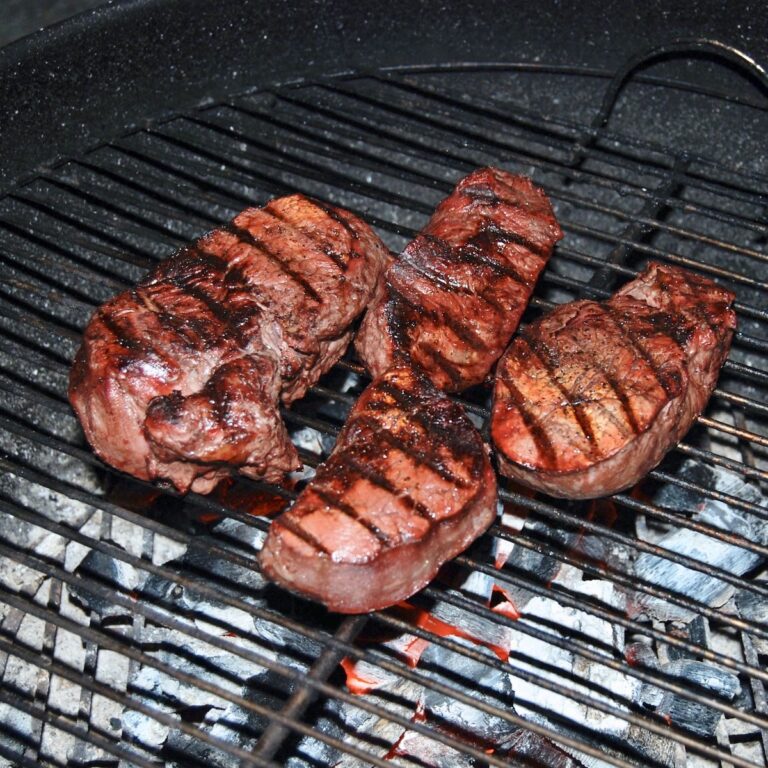
No thermometer? No problem. Hold your hand about 5 inches above the grill grate and count how long you can keep it there.
🔥 Very High Heat
2 seconds
Intense heat for fast searing and building a crust on steaks.
🥩 Medium-High
3–4 seconds
Ideal for steaks, chops, and foods that need strong direct heat.
🍔 Medium
5–6 seconds
Great for burgers, chicken, and most everyday grilling.
🌡️ Low Heat
7–8 seconds
Gentle heat for slow cooking and keeping food from drying out.
⚠️ Note: This method is only an estimate. For accuracy and consistency, use a grill thermometer whenever possible.
Great grilling isn’t about guessing—it’s about controlling heat. Once you understand how to manage your grill, you can cook anything with confidence.
🔥 Create Heat Zones
Set up high and low heat areas. On gas grills, use different burners. On charcoal, bank coals to one side. This lets you sear, then finish cooking gently.
🔄 Control Airflow
On charcoal grills, vents control oxygen—and oxygen controls heat. More airflow means higher temperatures, less airflow lowers the heat.
🧢 Use the Lid Wisely
Keep the lid closed to trap heat and cook evenly. Open it for quick searing or when you need to slow things down.
⏱️ Preheat Properly
Give your grill 10–15 minutes to fully heat up. This stabilizes temperature and prevents food from sticking to the grates.
📍 Manage Hot Spots
Every grill has uneven heat. Learn where your hot and cool areas are so you can move food as needed during cooking.
🌡️ Use a Thermometer
Built-in gauges help, but an infrared or probe thermometer gives you a more accurate read of grill and food temperature.
💡 Pro Tip: Think of your grill like an oven with multiple zones—not a single flame. Control the zones, and you control the outcome.
Just How Much Heat Is Coming From My Grill?
Have you ever wondered how hot your grill gets when cooking burgers, hot dogs, or steaks? I’m not talking about the internal temperature of the grill area with the cover on, as shown by the thermometer most grills have today. Gas or charcoal, those thermometers are usually found at the top of the covers, not near the grate where the food is cooked.
The thermometer in the hood measures the temperature inside the grilling cavity when the hood is closed down. As soon as you open the hood, that temperature drops significantly. It may be important to know that temperature, but it doesn’t tell you how hot the surface is.
These hood thermometers are typically very inexpensive and need to be more accurate. In addition, if the hood materials are thin or poorly constructed, the reading from these thermometers can vary significantly.
I’ve also read there can be a big difference of as much as 50°F from where you are grilling your food from what’s measured at the top of the hood.
I’m interested in knowing the temperature of the heat being thrown off by the charcoal or gas burners just above the grilling grate. I’d like to know the temperature of the grate itself so I can compare it to the temperature of a frying pan. I’ll have to test this with my infrared thermometer.
This heat is difficult to determine. I’ve been researching this topic to find clues on determining the various temperatures and can’t find a definitive source. Some talk about BTUs, the British Thermal Unit of work, to raise the temperature of one pound of water by one degree Fahrenheit but I’m not sure how that helps me.
Yes, the more BTUs a gas grill may be rated, it may produce more heat, but it may just mean how much gas the grill uses, not how efficient it is. Also, as previously mentioned, if the grill is poorly constructed or made from thin or inferior metals, the heat won’t matter unless you’re grilling with the cover off.
This post is also about something other than the virtues of gas grilling compared to charcoal grilling or the pros and cons of each. Instead, I’m trying to understand how to measure the amount of heat a gas or charcoal grill emits from the heat source to better control what I’m cooking.
How hot is medium heat on a grill?
Medium heat on a grill typically ranges from 325°F to 375°F. This is ideal for cooking foods like chicken breasts, burgers, and sausages evenly without burning the outside.
What temperature is medium-high heat?
Medium-high heat is usually between 375°F and 450°F. It’s perfect for steaks, pork chops, and foods that benefit from a good sear while still cooking through.
How do I know when my grill is hot enough?
You can use a built-in thermometer, an infrared thermometer, or the hand test. Preheating for 10–15 minutes with the lid closed is the most reliable way to reach your target temperature.
Is 500°F too hot for grilling?
Not necessarily. 500°F is considered high heat and is great for searing steaks or cooking thin cuts quickly. However, it can burn delicate foods if not monitored carefully.
Why does my grill temperature fluctuate?
Temperature changes can be caused by wind, opening the lid, uneven fuel distribution, or grease buildup. Charcoal grills are especially sensitive to airflow and vent adjustments.
Should I grill with the lid open or closed?
Keep the lid closed for most cooking to maintain consistent heat, especially for thicker cuts. Open-lid grilling works best for quick searing or very thin foods.
How long should I preheat my grill?
Most grills need 10–15 minutes to preheat properly. This ensures the grates are hot enough to sear food and helps prevent sticking.
Why is my grill hotter on one side?
Uneven heat is common and can be caused by burner placement, charcoal arrangement, or airflow. Creating heat zones can actually be useful for controlling cooking.