What is the main difference between charcoal briquettes and lump charcoal?
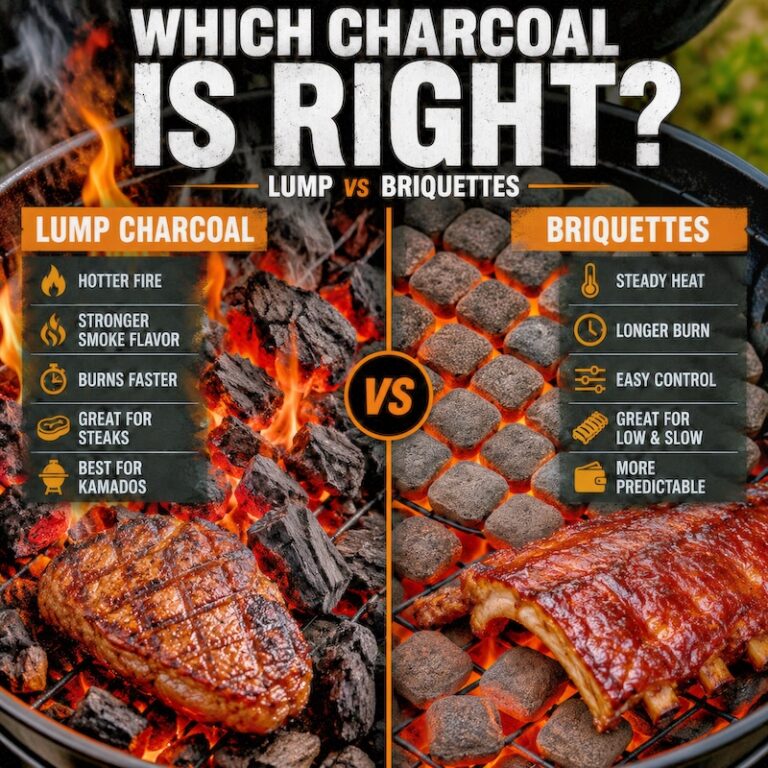
The main difference is consistency. Briquettes are manufactured to burn evenly and predictably, while lump charcoal is natural hardwood charcoal that burns hotter but less uniformly.
Do charcoal briquettes contain additives?
Yes. Briquettes include binders and ignition aids that help them hold their shape, light more easily, and burn at a controlled rate. These additives are part of what makes briquettes consistent.
Are the additives in charcoal briquettes harmful?
According to manufacturers, the added ingredients are not considered harmful. For most grillers, the more relevant consideration is how those additives affect burn behavior rather than food safety.
Does lump charcoal contain additives?
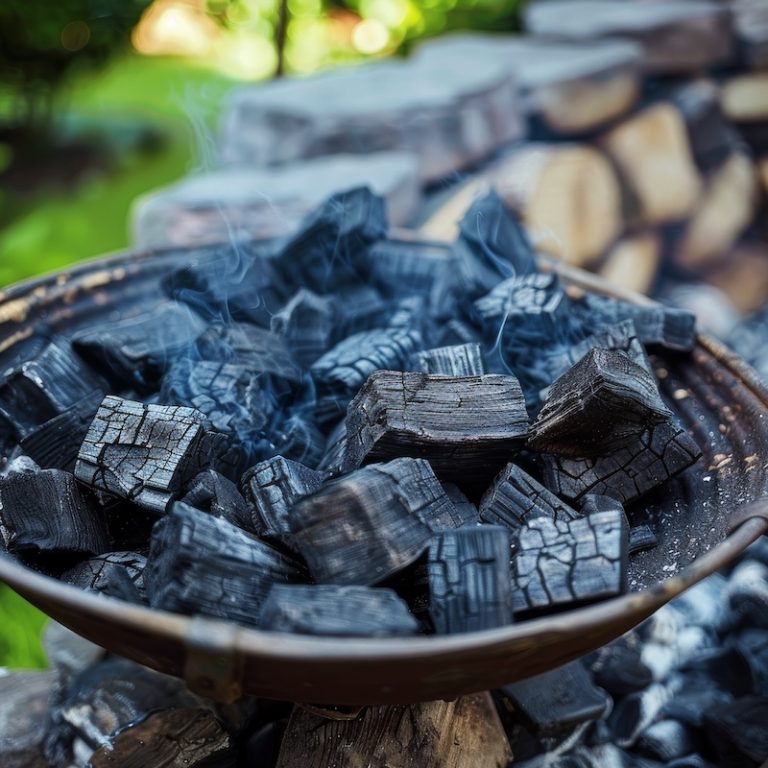
No. Lump charcoal is made by burning hardwood in a low-oxygen environment and contains no binders or fillers. What you see is what you burn.
Which type of charcoal burns hotter?
Lump charcoal generally burns hotter than briquettes and responds more quickly to airflow changes, making it well suited for high-heat searing.
Which charcoal burns longer?
Briquettes typically burn longer and more steadily than lump charcoal, which makes them better for long cooks and low-and-slow grilling.
Does briquette charcoal affect the flavor of food?
Briquettes are designed to burn neutrally, though some grillers feel the additives slightly mute smoke flavor. Lump charcoal tends to produce a cleaner, more pronounced wood aroma.
Which produces more ash?
Briquettes produce more ash due to their binders and fillers. Lump charcoal produces less ash, which can improve airflow during cooking.
Which is easier to use for beginners?
Briquettes are generally easier for beginners because they ignite predictably and maintain steady temperatures with less adjustment.
Which charcoal is better for smoking?
Briquettes are often preferred for smoking because their consistent burn makes temperature control easier over long periods.
Which charcoal is better for grilling steaks or burgers?
Lump charcoal is often favored for quick grilling and searing because it reaches high temperatures faster.
Can you mix briquettes and lump charcoal?
Yes. Many grillers mix the two to combine steady burn time with higher peak heat, especially for hybrid cooking setups.
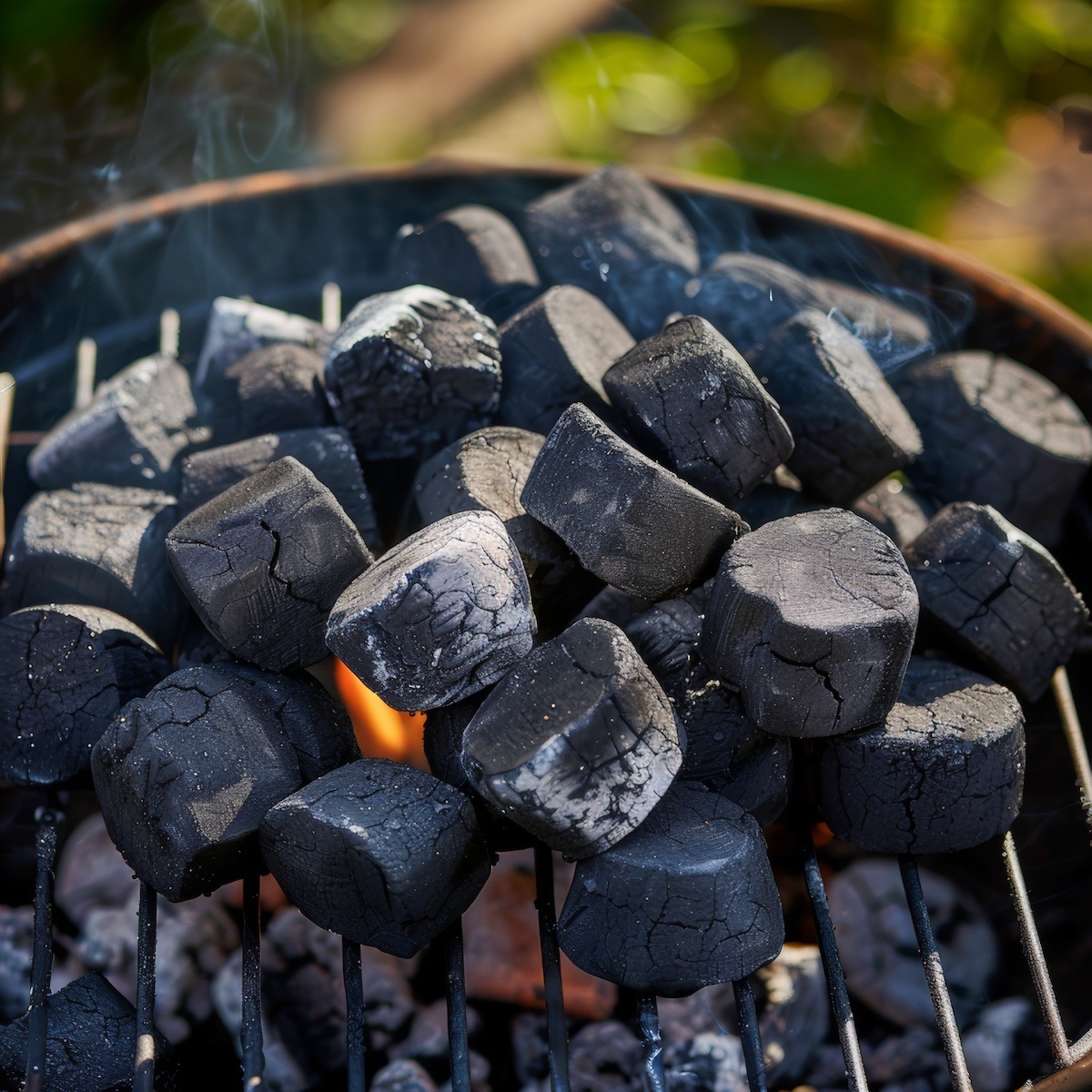
Why do briquettes look uniform while lump charcoal does not?
Briquettes are pressed into molds during manufacturing, while lump charcoal is broken into natural chunks after carbonization.
Which type of charcoal should I choose?
If you value predictability and long burn times, briquettes are a practical choice. If you prefer higher heat and hands-on fire control, lump charcoal may suit you better. Most frustration comes from expecting one to behave like the other.

6 Responses
Raw materials for charcoal briquettes are various. And it is easy to make charcoal briquettes with professional machine.
Good post. I totally agree with you that do not add any additive when making charcoal briquettes. Even a little. As a manufacturer, i can tell you that charcoal briquettes from hardwood are the best.
Hello Stephen —
I rather doubt any of us will die from using briquettes, but I urge you to be more skeptical when reading manufacturers’ press releases.
Here is a translation of the contents list.
Mineral carbon: Coal. The same stuff that the EPA regulates, because burning it releases mercury and other heavy metals. Coal is fine for stoves, but no one cooks over it.
Sodium nitrate: Chilean saltpeter. Not by my choice.
Borax: Sodium tetraborate. Ant killer. Not allowed as a food additive in the U.S. In the EU, it is classified as “toxic for reproduction.”
Your choice.
Robert
Dear Sir, Good day. Fantastic, very value information. Regarding Sodium nitrate uses in charcoal briquette, could you please provide me with the information using Sodium nitrate in order to be safe, I am using high pressure extruder in charcoal briquette, I would like to increase burning speed. REGARDS Haitham
Sodium nitrate in charcoal briquettes is added in very small amounts to help them ignite and burn consistently. It acts only as a starter and fully burns off once the briquette is lit, so it doesn’t pose a risk to your food. Using commercially made briquettes as intended—lighting them outdoors and following standard grill safety precautions—is considered safe.
Lazari lump 40.lbs @ $14
Kingsford 40 lbs $26
Not sure where you’re shopping.