
Classic Demi Glace Recipe
How to make a restaurant quality demi glace at home.
Servings: 2 cups
Ingredients
- 4 pounds beef bones a mix of marrow & knuckle bones if possible
- 1 medium onion roughly chopped
- 1 carrot roughly chopped
- 1 celery stalk roughly chopped
- 2 tablespoons tomato paste
- 8 cups cold water
- 2 sprigs fresh thyme
- 1 bay leaf
- 8 whole black peppercorns
Instructions
Roast the Bones (Build the Foundation)
- Preheat oven to 425°F
- Spread bones in a single layer on a roasting pan.
- Roast 45–60 minutes, turning once.Time: 1 hour
Bones should be deep brown, not burnt
Add Aromatics & Tomato Paste (Layer the Flavor)
- Add onion, carrot, and celery to the pan. Roast another 20 minutes.
- Stir in tomato paste and roast 10 minutes moreTime: 30 minutes
You’re building that signature deep, slightly sweet backbone.
Deglaze the Pan (Don't Waste the Gold
- Transfer everything to a stockpot.
- Place the roasting pan over medium heat. Add a splash of water and scrape up browned bits.Time: 5 minutes
- Pour into the pot.
Simmer the Stock (Low and Slow Extraction)
- Add 8 cups of cold water to the pot. Bring to a gentle simmer (not a boil). Skim foam and fat as it rises.
- Add thyme, bay leaf, and peppercorns.
- Simmer uncovered 3–4 hoursTime: 3–4 hours
You should end up with about 4–5 cups of rich stock
Strain & Reduce (The Magic Step)
- Strain through a fine mesh sieve. Discard solids.
- Return liquid to a clean pot. Simmer gently until reduced by half→ Target: ~2 cupsTime: 45–75 minutes
Final Check (The Sauce Awakens)
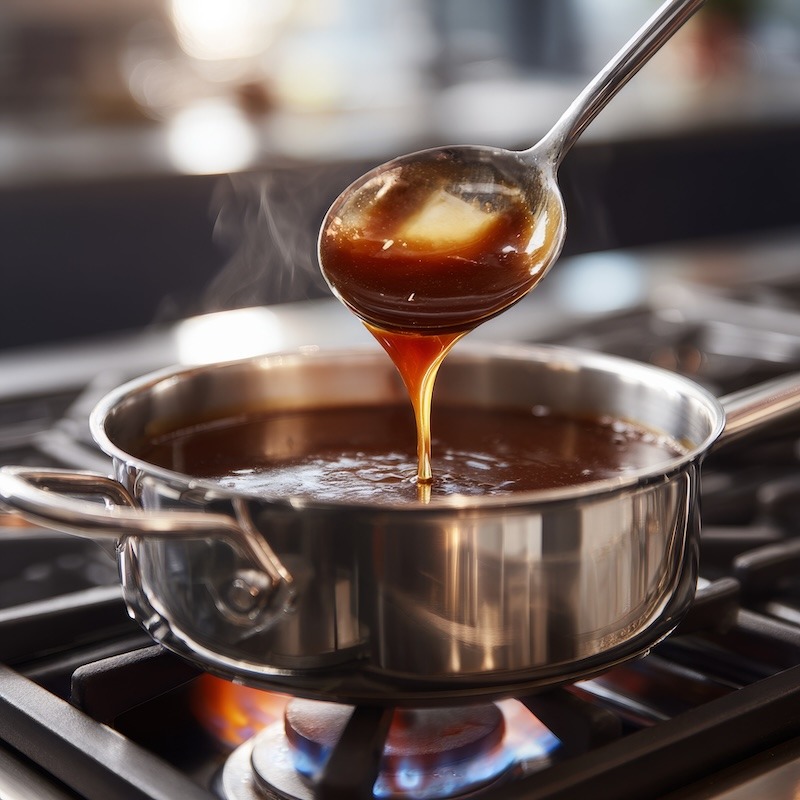
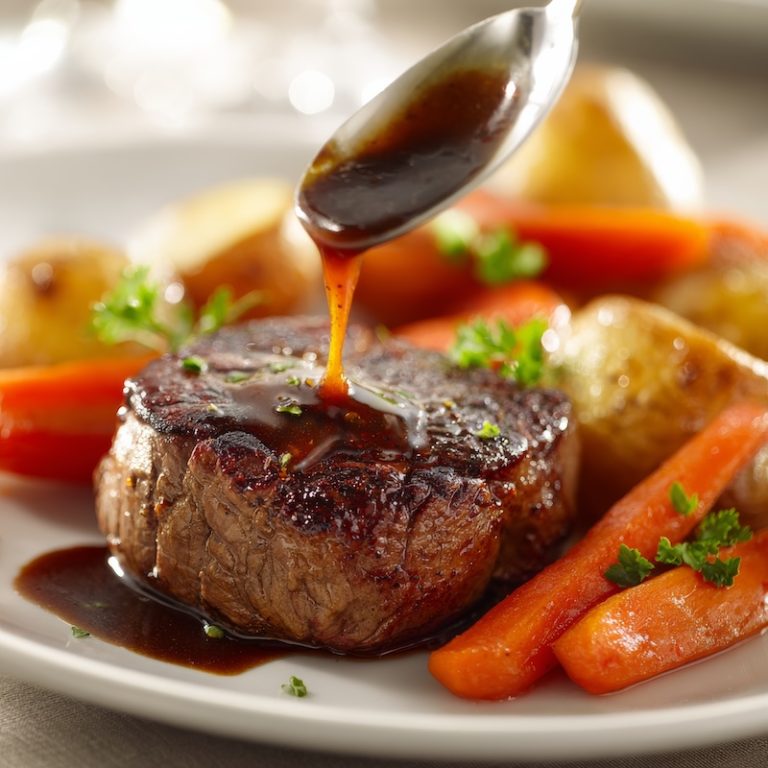
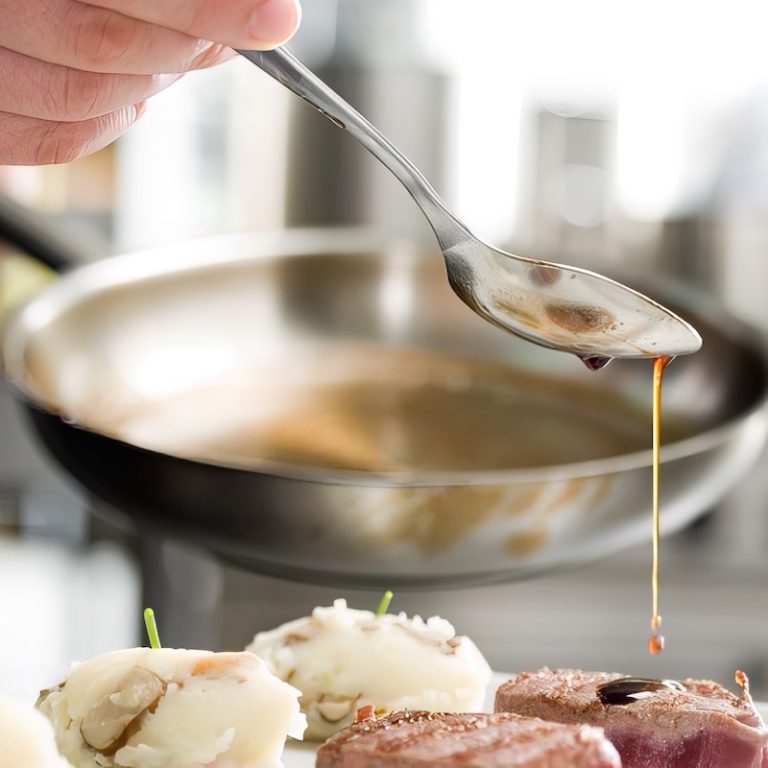
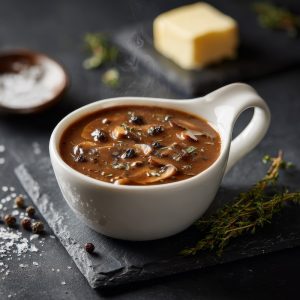
- You’re done when:👀 Deep brown and glossy🥄 Coats the back of a spoon (nappe)🌫️ Slightly syrupy consistency
30 Responses
This is a “rehash” of Emeril’s recipe. However, if you follow Emeril’s recipe, you don’t get enough brown sauce to construct the finished product. The yield in this recipe is just right and also what is necessary to end up with the desired amount of finished product. Also, veal bones are very hard to acquire outside of the commercial market. Lastly, you don’t have to use all the tomato paste.
I like the recipe and unlike Sokolov’s process, it does not take two days to complete.
This recipe is in the French tradition and developed several hundred years ago, not Emeril. The recipe is fairly basic. The reason for the veal bones and the beef bones ‘is to give’ you give you two different types of marrow. I like to cook mine with the knuckles. You can see both recipes work off the beef stock ‘with one’ reduced down with a few more spices for the Espanol and then again demi glace. Espanol is used as a base for Soups and demi glace used for sauces. That’s how I use it but the notion that this recipe is a rehash Emeril Lagasse recipe, you should probably read the origins of the sauce. In fact, the rest of the four mother sauces also ‘use’ these recipes ‘and’ have been being married for so long. People have been making the sauces for so long they tend to forget why the original sauce was made to exacting standards right down to weight.
this recipe is not the standard Escoffier recipe.
You need to take the bone broth and cook been meat in it ie shank meat.
Each time, reducing the liquid to an almost glaze like consistency.
The shank meat is essentially useless after that since all the nutrients and flavors have gone into the glaze,
What is the shelf life of this?
It says it yields one gallon, not two.
When you add 1 gallon to 1 gallon, then reduce by half… you get 1 gallon 🙂
Making demi-glace is a long process but it’s worth it. I save my bones in my freezer as I get them. As long as they are beef bones I’m happy. The reducing part is the longest part. I’ll add some madiera wine to my stock as I go. You don’t end up with much when you are done but you don’t need a lot a make a sauce. I freeze it in small containers until I need it.
I am having trouble finding cheap organic stock bones. This recipe calls for 14lbs bones (6ish kg), prices vary from £2 per kg to over £5,JUST FOR BONES! I am looking for £1 per kg but cannot find such a price.
You can scale this recipe to a smaller quantity. A gallon of Demi a a restaurant quantity. A liter, about 1/4 whats shown in this method would work well for a home kitchen. Some folks argue that making less than a gallon results in a poorer flavor. There’s no physical or rational justification for that claim and in my experience it’s just not true.
I like to use veal tail. Pretty incredible how much collagen is in one tail. Cut the final product with a knife!
I am trying this recipe again and I am not getting a dark brown colour in my Demi glaze.it more beige or light brown What are the keys to getting a dark brown Demi glacé?
I recommend a black jack -sugar and water brought past 360 degrees carefully as water once sugar is dark and use that to colour your demi
Kitchen Bouquet or even Gravy magic , Maggie.. all will add a darkening to the sauce without changing the flavor much . The way you are supposed to get the darkened color is from roasting the bones and mirepoix in the oven
Your roux is not dark enough. You’ve got to cook the roux to a dark brown but not burnt stage. The bones must be roasted well also. If not lacking in these two things will shift the entire end product as stated to a light brown weak demi.
Yes, Kevin, this is correct. Without roasting the bones properly and cooking the roux until it is dark but not burned the proper color and flavor will not be achieved. If these two steps are not performed properly the color and flavor will be weak and the ingredients and time will be practically wasted.
One trick for natural color and flavor is to coat your onions and bones with tomato paste; the technical name in French cooking for this is “pince”. This is one aspect of the procedures I do differently than the suggested manner. I coat all the bones and onions right from the start with tomato paste, the onions I quarter instead of dicing or chopping. I do this regardless when making beef stock which is the start of this process to yield demi eventually. You get natural flavor and natural coloring by adding non-traditional ingredients.
Personally I brown the bones and the veges in high heat in the oven 180°10-15 min then 220° 5-8 min this is for the bones mostly.for the veges 180°10 min is enough.then when you put the both bone n veges in stock pot,add tomatoes paste and cook until the paste produces red colour oil(sautee the bone,veges and paste)add flour and continue to cook dill the flour starts to stick to stock pot,then add water n let boil and reduce heat simmer
The reason your Demi glacé is to light because you don’t cook your bones and vegetables long enough to get darker colors, then your Roux it’s not dark enough, you should place the roasting pan on stove-top medium high, will cover 2 burners, let it cook brown bits , darker color will give you mor color and flavored before you deglaze it with wine or water.
Some random thoughts
Browning your tomato puree -frying it
Browning your roux well
Make sure your onions are almost charred.
Make sure your bones are well roasted- I will use a convection setting toward the end
Twelve hours cooking time provides a superior product.
Absolutely disgusting. Veal should be illegal.
Good thing you didn’t see what my neighbor was doing to the poor grass in his yard this morning! He was mowing it! That was disgusting! There should be a law against that!
Veal, Spring Lamb, Suckling Pig … mmmmmmmmmmmm tasty.
If this is being used for demi-glace the salting should only take place during the reduction phase, because any tasting that detects salt prior to reduction means the final product will come out twice as salty.
No, the reason for the dark color is the roux
If you live anywhere in the states there is probably a Hispanic part of town in your city. In that part of the city you will find a Hispanic bodega with a meat counter. I have found that they will give you the bones for free as they see no value in the bones since their clients don’t buy bones. To them the bones are trash.
They typically also have great cuts of meat. I always buy my other ingredients from them since they give me the bones for free.
It takes me 36 hours to make mine.
Well worth the time & effort. I used this recipe to feed a gathering of hundreds, no complaints.
I used to buy my demi glace for home use from a restaurant in Chicago. Outstanding sauce. About 5+ years ago they sold out and the new restaurant no longer made it available Would you please put me on your mailing when you have completed your look at available alternatives?
Don Dickson
Hi Don, I’m on my last puck of More Than Gourmet’s Demi-Glace Gold, so I will need to find a good alternate. I will let you know when I find one I like and compare quality to cost.