
Fast Answer
Chicken is done when the thickest part reaches 165°F for white meat and 180°F for dark meat, measured with an instant-read thermometer. Color, juice clarity, and touch are unreliable — temperature is the only test that's always right.
Start Here: The Only Method That Works Every Time
- Get a thermometer. An instant-read is the tool. Everything else — juice color, touch, timing — is guesswork dressed up as technique.
- Know your targets. White meat: 165°F. Dark meat: 180°F. These aren't interchangeable — dark meat has more connective tissue that needs higher heat to break down properly.
- Account for carryover. The chicken keeps equalizing heat after you pull it. Pull it early; let resting finish the job.
- Rest before cutting. Even five minutes makes a measurable difference in how much juice stays in the meat versus on the cutting board.
What You're Actually Trying to Do Here
Chicken is the most cooked protein in most home kitchens and also the most consistently overcooked one. The fear of undercooking it is real — salmonella is not theoretical — but the result of overcooking is dry, stringy meat that nobody wants to eat either. The fix isn’t courage or experience. It’s one number, one tool, and understanding what’s actually happening inside the bird as it cooks.
What Most Cooks Get Wrong
- Trusting juice color. Juices can run clear at 150°F and stay faintly pink past 185°F, depending on the bird, the cut, and the myoglobin content. It's not a reliable signal.
- Cooking to time, not temperature. Recipe times are estimates. Bird size, bone structure, starting temperature, and oven accuracy all affect the outcome. The number on your thermometer is the only honest answer.
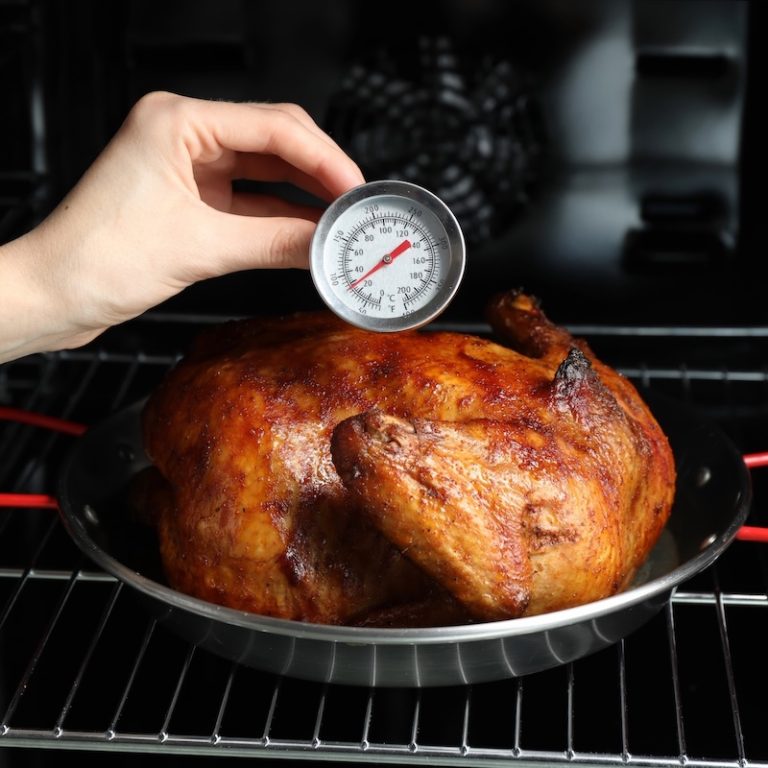
- Checking the wrong spot. The thermometer goes into the thickest part of the meat, away from bone. Bone conducts heat and reads artificially high — you'll pull undercooked chicken thinking it's done.
- Not pulling early enough. If you wait until the thermometer reads 165°F before pulling a whole bird, carryover will push it past that. For whole chickens, pull at 155–157°F and rest. For breasts, pull at 162–163°F.
Quick Fixes & Practical Tips
- Thermometer placement on the grill: Check temperature while the chicken is still on the grill — the thermometer probe isn't affected by ambient grill heat the way an oven probe would be. Insert no more than halfway into the thickest part.
- Two birds in the oven: Expect them to take significantly longer than the recipe says. Both pieces are competing for the same heat. Always cook to temperature, not to the time on the package.
- Thermometer vs. knife: A thermometer probe makes a small, clean hole — think of it like pricking a sponge with a pin. The juice loss is minimal. Cutting into the meat to check color opens a much larger wound and drains far more.
- Leave-in probe thermometers: If you're roasting a whole bird, a cable probe thermometer lets you monitor temperature without opening the oven. The probe stays in place and actually plugs the hole.
- If it reads 171°F and still looks pink: The thermometer may be touching bone, or the probe is cheap and slow. Verify placement and probe quality before assuming the reading is accurate.
Why Temperature Works When Everything Else Doesn't
- Color is produced by myoglobin, not heat. The protein responsible for meat color can behave unpredictably — chicken near the bone can stay pink well past safe temperatures, or go white before it's safe. Color tells you about myoglobin. Temperature tells you about safety.
- Carryover is heat redistribution, not cooking. When you pull chicken from the oven, the exterior is hotter than the center. During resting, that stored heat moves inward through conduction. The internal temperature rises not because cooking continues but because heat is equalizing. Small cuts: 1–2°F rise. Whole birds: up to 10–15°F.
- Dark meat needs more heat for a reason. Thighs and legs contain more connective tissue. At 165°F they're technically safe but still tight and chewy. At 180°F, collagen has had time to break down. The texture difference is substantial.
- 165°F is the safety floor, not the ideal for everything. The USDA's 165°F guideline covers all poultry across all methods. Some cooks argue chicken breast can be held at lower temperatures for longer and achieve the same kill rate — that's a time-temperature relationship, not a rule to ignore. For home cooking without precise holding equipment, 165°F remains the practical target.
| Variation | Cooking Method | Internal Temperature | Notes / How to Know It’s Done |
|---|---|---|---|
| Whole Bird | Roasted | 165ºF (breasts), 180ºF (thighs) | Thermometer in thickest thigh; juices should run clear; let rest 10–15 min. |
| Breasts | Roasted / Grilled / Pan-Sautéed | 165ºF | Use instant-read thermometer; avoid overcooking to prevent dryness. |
| Thighs | Roasted / Grilled / Braised | 180ºF | Dark meat stays moist longer; thermometer is best for accuracy. |
| Bone-in | Roasted / Grilled | 165–180ºF depending on cut | Bone slows cooking; check thickest part near the bone. |
| Boneless | Pan-Sautéed / Grilled / Roasted | 165ºF | Thinner pieces cook quickly; monitor closely to prevent dryness. |
| Grilled | Breasts, Thighs, Bone-in or Boneless | 165–180ºF | Use thermometer; avoid direct high heat for thick cuts; rest before slicing. |
| Roasted | Whole Bird, Breasts, Thighs | 165–180ºF | Thermometer in thickest part; juices should run clear; rest to redistribute juices. |
Storage & Reheating Tips
- Refrigerator: Store cooked chicken in an airtight container for up to 3–4 days.
- Freezer: Freeze cooked chicken in airtight containers or vacuum-sealed bags for up to 4 months.
- Reheating: Reheat gently in a covered pan or oven at low temperature; add a splash of broth or water to prevent drying.
- Microwave: Cover and reheat in short intervals, stirring or flipping to retain moisture.
- Tip: Avoid overcooking when reheating—chicken can dry out quickly.
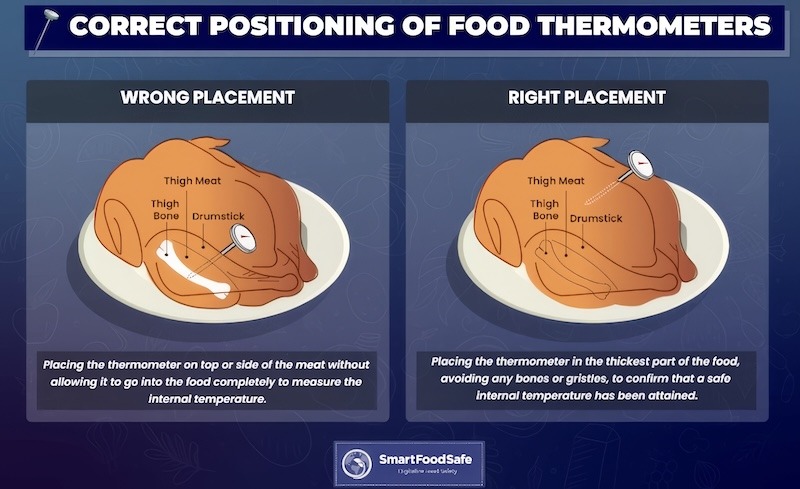
Always insert the thermometer into the thickest part of the chicken, avoiding bone, for an accurate reading.
Thermometer Basics: What You're Aiming For
- Use a Thermometer: An instant-read thermometer is the most accurate way to test doneness for any cut or cooking method.
- Where to Insert It: Pierce the thickest part of the meat, aiming for the center. Avoid the bone—it reads hotter than the meat.
- Target Temperatures:
- White meat: 165ºF
- Dark meat: 180ºF
- Food Safety First: These USDA temperatures are set for safety—especially important when cooking poultry.
- Understand Carryover Cooking: After removal from heat, chicken continues to cook.
- Small cuts may rise 1–2ºF
- Large cuts or whole birds can rise 10–15ºF
- When to Remove from the Oven:
- Whole chicken: Remove at 155–157ºF, cover, and rest to reach 165ºF
- Chicken breasts: Remove at 162–163ºF, cover, and rest to 165ºF
- Why Resting Matters: Resting allows juices to redistribute, producing moist, tender chicken.
Chicken Doneness Myths (That Can Lead You Astray)
- “The juices run clear, so it’s done.”
Juice color is unreliable and varies by bird, cut, and cooking method. - “The leg jiggles or pulls loose.”
Joint looseness depends on anatomy and cooking style, not safe doneness. - “It’s white all the way through.”
Color changes before chicken reaches a safe internal temperature. - “It feels firm to the touch.”
Firmness varies with muscle type and overcooking can feel ‘done’ too. - “Follow the recipe time exactly.”
Bird size, oven accuracy, and starting temperature all affect cook time. - “No pink means it’s safe.”
Chicken can be fully cooked and still show slight pinkness near the bone. - “Grandma always did it this way.”
Experience matters, but food safety relies on temperature—not tradition. - What Actually Works:
An instant-read thermometer in the thickest part of the meat.
Explore More on This Topic
- Roasting a whole chicken — temperatures, timing, and why resting matters more than you think.
- Grilling chicken — how to handle bone-in thighs and breasts on the grill without drying them out.
- Instant-read thermometers — what to look for, what to avoid, and why response time matters as much as accuracy.
- Brining before cooking — how a salt soak changes the way chicken holds moisture, and when it's worth the extra step.
- How carryover cooking works — the physics of what happens when meat leaves the oven, explained in practical terms.
- Meat doneness temperatures — safe internal temperatures for chicken, beef, pork, and fish in one place.
Frequently Asked Questions
What temperature should chicken reach to be done?
165°F for white meat (breasts, wings), 180°F for dark meat (thighs, drumsticks). These aren't interchangeable — dark meat has more connective tissue that stays tough below 180°F even when it's technically safe.
Can I tell when chicken is done without a thermometer?
Not reliably. Juice color, firmness, and even the color of the meat itself are all influenced by factors other than temperature — myoglobin content, bone proximity, cooking method. Some experienced cooks get close using touch or visual cues, but they're making educated guesses. The thermometer removes the guess.
Where exactly should I insert the thermometer?
Into the thickest part of the meat, aiming for the center, without touching bone. Bone conducts heat and reads hotter than the surrounding meat — you'll get a falsely high reading and pull undercooked chicken. For a whole bird, that means the thickest part of the inner thigh, angled away from the joint.
Why does chicken keep cooking after I take it off the heat?
What's happening is heat redistribution, not cooking in the traditional sense. The outside of the meat is hotter than the center. When you remove it from the heat source, that stored energy moves inward through conduction, raising the core temperature. For a chicken breast, the rise is modest — 1 to 2 degrees. For a whole bird, it can be 10 to 15 degrees, which is why you pull a whole chicken at 155–157°F and let resting carry it to 165°F.
My chicken read 165°F but was still pink inside. What happened?
A few possibilities: the probe was touching or too close to bone, which reads artificially high; the thermometer itself is inaccurate (cheap instant-reads can be off by several degrees); or the pinkness is from myoglobin near the bone, which is not an indicator of undercooking. If the thermometer was correctly placed and properly calibrated, pink chicken at 165°F is safe.
Is it true that chicken can be safe below 165°F?
Technically yes — food safety is a function of both temperature and time. Chicken held at 145°F for several minutes achieves the same bacterial kill rate as 165°F held briefly. But without precise holding equipment, the time-temperature relationship is hard to control reliably at home. 165°F is the practical target because it works without a stopwatch.
Does bone-in chicken cook differently than boneless?
Yes. Bone slows heat transfer, so bone-in cuts take longer to reach target temperature. Always check temperature in the thickest part of the meat near — but not touching — the bone. Don't use cooking time from a boneless recipe as your guide for bone-in, or vice versa.
If I put two chickens in the oven, does cooking time change?
Yes, significantly. Both pieces are pulling heat from the same oven, so neither cooks as fast as it would alone. This applies to any oven-heavy load — two turkey roulade, a sheet pan of thighs, a pair of whole birds. Always cook to temperature rather than time, and build in extra time when you're filling the oven.
Does it matter if I check temperature on the grill vs. off it?
Check it on the grill. The probe isn't affected by ambient grill heat — it's measuring the internal temperature of the meat, not the air around it. Insert the probe no more than halfway into the thickest part and avoid the bone. You'll get an accurate reading without having to move the chicken.
How long can cooked chicken be stored safely?
Three to four days in the refrigerator in an airtight container. Up to four months in the freezer in airtight or vacuum-sealed packaging. When reheating, bring it back to 165°F — low and slow in a covered pan with a splash of broth is kinder to the meat than a microwave at full power.
Your Experiences
Please share your tips for cooking delicious, moist chicken in the comment section below.

22 Responses
Finally, someone answered that question! Thanks for the help.
You are very welcome Dalesh, thanks for visiting – RG
Mostly, I cut a small opening in the thickest part of the meat and check the color on the inside. I know it isn’t the best way to do it but by now, I pretty much know how long I need to leave it in the oven for. But whenever I have to roast a whole bird, I always wish I had a thermometer to check if it is done! Thanks for all the tips!
MissGabyLee, that’s how many of us home cooks do it, because it leaks out all those important juices to keep the meat juicy but if it works for you…… – RG
I roasted two turkey roulade for Thanksgiving. One on bottom rack and one in middle. Both same size. I took them out of fridge 1 hr. before cooking, knew that my oven temp was accurate. Still they took an hour longer than the recipe said. Did having two in oven cause this?
Kathleen, most likely. Don’t forget the turkeys are both absorbing the heat of the oven so there isn’t as much heat to go around and why your time ESTIMATE might be off but I’m hoping you are using a thermometer to tell when the turkey is done and taken out of the oven.
When covering it, do you mean with aluminum foil?
Hi Peter, I usually cover it with aluminum foil that I poke a few holes in so the steam can escape but I’ve also used large pot covers if they are big enough. – RG
Hi RG, I’m wondering why sticking a thermometer in the meat doesn’t cause the juices to run out when a knife certainly does?
Great question Bonnie and one I need to ask some professional chefs about. They always say not to use a fork when turning steaks on the grill or in the pan so the juices don’t run out but then how do you stick them with a thermometer? I guess if you don’t do it repeatedly, it isn’t a problem or maybe it’s ok with chicken. I’m going to write a chef friend right now and see what he has to say. Thanks for the question. – RG
Bonnie, I checked with a professional who knows a lot about this subject and without getting too technical, here is what he had to say,
“Think about meat more like a sponge rather than a balloon. If I have a sponge full of water and I prick it with a straight pin, only a small portion is effected and only a little water will escape. Grill a thick steak and set it on your cutting board to rest. Then cut it into slices, If the meat wasn’t overcooked, the amount of liquid exuded increases proportionally as each slice is made. All the liquid doesn’t come from a single slice.”
Hope this helps, RG
There are some remote read thermometers available. stick the sensor in the meat after cooking for a while and run the cable out the oven (or grill) door. The sensor stays in place and plugs the hole so the juices don’t leak.
Hi Blackburn, I have one of these thermometers and they work very well. – RG
I normally fry chicken thighs for my family and sometime it is under cook. how do i know when the chicken with be done all the way to the bone? I don’t use flour like in regular fry chicken,, i just marinate using asian style techniques but my resluts are always different. Some time its too crispy sometimes its not always cook all the way through. help!
What a load of overstated nonsense. And if you read the FDA guidelines for meat process companies you would know this. The FDA admits the chicken and pork guidelines are based on the look and texture the US public is used to not any health related concept. That is in their own reports.
Most Salmonella is not from chicken but from fruits and nuts. Salmonella can be eradicated at 120 degrees if maintained there for long enough.
Chicken is best about 135 – 145 degrees – not jelly like but a tinge of pink. 165 is way overcooking the chicken.
We just have these old guidelines that were way over the top to begin with and have become lore without any scientific basis whatsoever.
People treat pork the same way yet the rules for pork are no different – nor should they be – from beef. Rare pork is as safe as rare beef – yet if you tried telling restaurants not to serve rare steaks they’d be up in arms – so would the public.
Yes, I would agree with your thoughts on the cause of the extra time taken. I was a Domestic Science teacher for many years – the more we filled our ovens the longer the cooking time. This happens in fan ovens and to a greater extent in those without a fan. When using a microwave oven the same situation occurs.eg. Two Baked Potatoes will take longer than one potato baked alone.
I’m boiling a chicken on the stove-top. I just checked the temp. with an instant thermometer and it registered at 171 in both the breast and the thigh. I took it out of the pot to cool and begin to debone– only to discover that it’s not done! WTF? That’s what sent me in search of the correct done temp for a chicken. I was going on the idea that it’s 165, and I’m right! Except my 170 degree chicken is still pink and rubbery. Ugh.
Hey Kate, that’s interesting. I just checked http://www.foodsafety.gov/keep/charts/mintemp.html to confirm my temperature range and they say 165F. At first I was wondering if the whole chicken was at room temperature before boiling before cooking, but that shouldn’t matter. Are you using an instant thermometer and if so, what brand? Some are better than others and the expensive ones give you a much better result faster than the cheap $6 models. Did you let it rest 5 to 10 minutes before deboning? The chicken will continue to cook for a while when resting. I wonder if the size or age of a chicken matters. So much to find out.
Good article. Definitely one of the best ways to tell if chicken is done is to use a thermometer. Here’s a really good video that will show newbies how to do this…it’s really helpful: http://www.perdue.com/how-to/knowing-when-its-done/
This is a great article. Thank you for writing it. I have a question about using the thermometer. Do you take the meat off the grill before you check the temperature or do you leave it on the grill to check? If you leave it on the grill, does that artificially give the meat a higher temperature than if you took it off and tested it? Thank you so much!!
Hi Elizabeth, great question. I personally check the meat while it’s still on the grill but have often asked myself the same question you are asking. I believe if you are careful and do not put the thermometer in more than halfway, you should get an accurate reading. Think about the thermometers you stick into a roast or turkey and leave them in the oven the entire time. They are not affected by the heat of the oven so I’m thinking it works the same way with an instant thermometer. If anyone has any other ideas, please share.
I’ve actually been reading more and more not to use the juice color because juices can run clear as low as 150 degrees and can stay slightly pink upwards of 185 degrees due to the myoglobin.
In my experience, the breast will already be overcooked and dry at 155. With Carry over cooking it will be even more so. Breast meat can safely be eaten at 144 if kept at this temperature for at least a few minutes.
As soon as the meat starts to pull away from the tips of the drumsticks the dark meat is done. Also if you press your ring finger and thumb together and tap on your hand right next to your thumb (the meaty part) this should feel the same as the Brest another way to know if your meat is done
Thanks for the tips Josh.
This is probably good advice overall but there is one problem. Temperature does not keep rising when meat is taken out of the oven, etc. Unless the room is hotter than the oven or full of microwaves! It just isn’t scientifically possible. I think there might be ongoing heat transfer from the hottest parts to the cooler parts of the meat, meaning that areas that were below 165F rise to reach it.
Hey John, you are right the chicken doesn’t continue to cook when taken out of the oven but “carry over” occurs where the the center of meat or piece of chicken will be lower than the exterior parts closest to the heat. As the chicken rests, some of that heat gets transferred to the center and raises the temperature. I suppose you could say the meat isn’t still cooking but is transferring heat energy (conduction) so some might say “transfer of heat” is in fact cooking.
This carry over is much more prevalent when cooking whole chickens so more resting time is needed but even grilling a boneless chicken breast there will be some carry over effect. So if your ideal internal temperature for a boneless chicken breast is 160°F and you cook the center right to that temperature, by the time you let the breast rest a couple of minutes and then plate and serve, the internal temperature is going to rise and the meat will be overcooked and dried out.
I’ll work at changing my copy in my article to look more at “carry over” rather than saying it continues to cook. Thanks for bringing this to my attention.