Most people think plastic cutting boards are safer. Science says otherwise.
The Best Cutting Board: Wood or Plastic? A Complete Kitchen Guide
When it comes to cutting boards, few kitchen debates are as surprisingly heated as wood vs plastic. One camp insists plastic is safer because it can go in the dishwasher. The other swears by wood, claiming it’s more durable, better for knives, and even naturally resistant to bacteria.
So who’s right?
The answer isn’t as simple as picking a winner. Food safety studies, chef preferences, and real-world kitchen habits all tell slightly different stories. What emerges isn’t a clear victory for one material, but a smarter way to use both.
Before you toss out your current board or buy a new one, it’s worth looking at what the science actually says—and how it applies to your everyday cooking.
What Today’s Science Says About Cutting Boards
Modern research is shifting the old kitchen narrative. Wood is no longer seen as “unsanitary,” and plastic is no longer automatically “safer.” The reality is more nuanced—and more interesting.
🧫 Wood pulls bacteria inward
Studies show wood absorbs moisture (and bacteria) into its grain, where microbes lose viability as the surface dries.
🧪 Plastic traps bacteria in scars
Knife grooves in plastic boards can protect bacteria from washing and even dishwasher cycles, allowing survival longer than expected.
⏳ Time + drying matter more than material alone
Most bacteria decline significantly over time on dry wood surfaces, highlighting drying as a key safety factor.
🧴 Finishes change wood behavior
Oil-coated or sealed wood absorbs less moisture, which can reduce its natural antimicrobial advantage and make it behave more like plastic.
🔬 No single “perfect” board exists
Science supports a dual-board approach: wood for general prep and plastic for raw meat or dishwasher sanitation.
🧠 Hygiene is a system, not a surface
Cleaning habits, drying time, and replacement cycles matter more than choosing a single “best” material.
The Smart Kitchen Approach
Don’t choose between wood and plastic—use both. Wood for everyday prep, plastic for raw meat and quick cleanup.
Wood vs Plastic Cutting Boards
Quick Comparison: Both materials have strengths. The best choice depends on how you use them in your kitchen.
- Food Safety:
Wood: Naturally antimicrobial; bacteria die as the board dries
Plastic: Non-porous at first, but grooves can trap bacteria over time - Knife Care:
Wood: Gentle on blades; helps knives stay sharper longer
Plastic: Harder surface; can dull knives more quickly - Maintenance:
Wood: Hand wash and oil occasionally
Plastic: Dishwasher safe and easy to sanitize - Durability:
Wood: Long-lasting; surface can self-heal slightly
Plastic: Wears down faster; deep grooves develop with use
Best Approach: Use a wooden board for everyday prep and a plastic board for raw meat and easy cleanup.
Cutting Board Care: The Full Maintenance Lifecycle
Cutting board care isn’t one step—it’s a cycle. Each stage affects hygiene, durability, and even knife performance. Think of it as a simple loop: use → clean → dry → store → replace.
🔪 Use
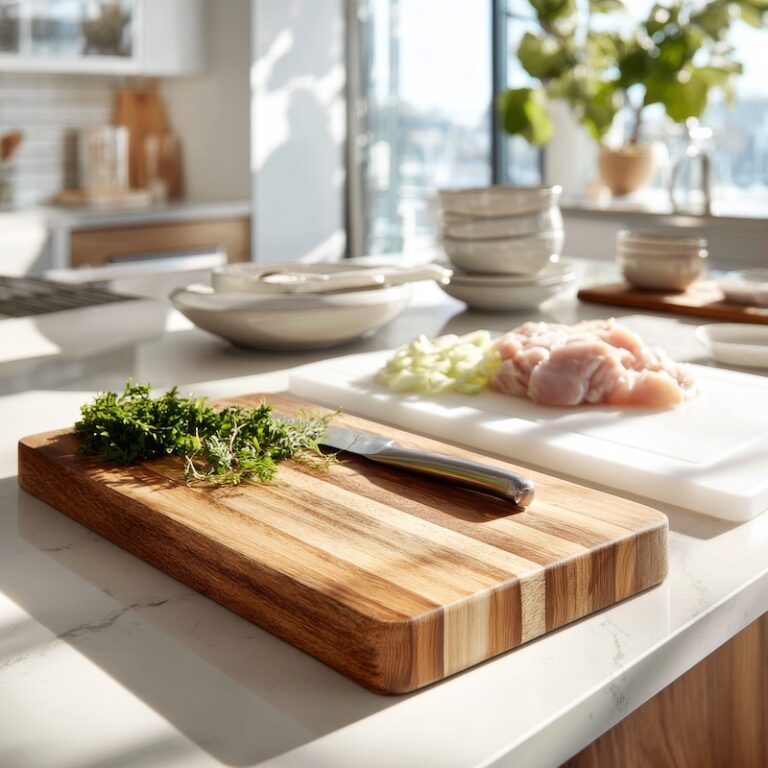
Use separate boards when possible—wood for produce, bread, and cooked foods, and plastic for raw meat. This reduces cross-contamination risk and helps each board age more predictably.
🧼 Clean
Clean immediately after use. Scrape off residue first, then wash with hot water and mild dish soap. Avoid soaking wood boards, and only use the dishwasher for plastic boards that are not deeply grooved.
💨 Dry
Drying is just as important as washing. Stand boards upright so air can circulate on both sides. Moisture trapped under a board is a major cause of warping and odor buildup.
🪵 Store
Store boards vertically or on their edge in a well-ventilated space. Avoid stacking damp boards flat or placing them in enclosed cabinets while still moist.
♻️ Replace
Replace plastic boards when deep grooves form that cannot be fully cleaned. Replace wooden boards when they crack, split, or no longer maintain a smooth, stable surface.
Bottom line: Good cutting board care is less about one-time cleaning and more about managing the entire lifecycle.
Frequently Asked Questions About Wood vs Plastic Cutting Boards
Are wooden cutting boards more sanitary than plastic?
Yes, in many cases. Studies show that wood can trap bacteria below the surface where they die as the board dries. Plastic boards, especially when deeply scored, can hold bacteria in grooves that are harder to fully clean.
Is plastic or wood better for raw meat?
Plastic is often used for raw meat because it can go in the dishwasher. However, it must be replaced once it develops deep cuts. Many kitchens actually use separate boards—plastic for raw meat and wood for everything else.
Do wooden cutting boards damage knives?
No. Wood is actually gentler on knife edges, helping them stay sharper longer compared to harder or heavily scarred plastic surfaces.
Can you put wooden cutting boards in the dishwasher?
No. Dishwashers can cause wood to crack, warp, or split. Wooden boards should be hand washed and occasionally treated with food-safe mineral oil.
How long do cutting boards last?
Wooden boards can last for decades with proper care. Plastic boards typically wear out faster and should be replaced once deep grooves develop that are difficult to clean.
What is the safest cutting board overall?
There is no single “best” option. The safest approach is using both materials correctly: wood for general prep and plastic for raw meat and quick dishwasher sanitation.
How do I know when to replace a cutting board?
Replace plastic boards when grooves are deep or uneven. Replace wooden boards if they crack, split, or no longer hold a smooth, cleanable surface.
Buying Cutting Boards (Wood & Plastic)
Why Cutting Boards Matter: A good cutting board protects your countertops, keeps your knife edges sharper, and gives you a safe, stable surface for prep. Having both wood and plastic boards lets you match the tool to the task—like choosing the right stage for each culinary performance.
Wood vs. Plastic: Wooden boards (like maple or walnut) are durable, gentle on knives, and naturally resistant to bacteria when properly maintained—ideal for vegetables, bread, and presentation. Plastic boards are lightweight, affordable, and dishwasher-safe, making them a practical choice for raw meats and quick cleanup.
Check Quality: For wood, look for thick, well-constructed boards with tight grain and a smooth finish. End-grain boards are especially knife-friendly. For plastic, choose BPA-free material with a non-slip edge or texture and enough thickness to resist warping.
Size & Features: Larger boards provide more workspace and stability. Juice grooves help contain liquids when carving meats or cutting fruits. Handles or grip edges make lifting and cleaning easier.
Where to Shop: Kitchenware stores, culinary shops, and online marketplaces offer a wide range of cutting boards in various materials, sizes, and price points.
Amazon Convenience: Amazon carries everything from budget-friendly plastic sets to premium hardwood boards. Reviews can help you compare durability, maintenance needs, and overall performance.
Care Tip: Wash boards promptly after use. Plastic boards can go in the dishwasher, while wooden boards should be hand-washed and regularly treated with food-safe mineral oil to prevent drying or cracking. Rotate boards and keep separate ones for raw proteins and produce to maintain food safety.
🛒 Check Prices for Cutting Boards on AmazonAvailable on Amazon


10 Responses
I’ve used wooden cutting boards for over 2 years now. I made my purchase from Amazon and a local retailer. I own 1 end-grain wood cutting board and 2 bamboo cutting boards. Works fantastic.
Thanks
Hi. Which is the best cutting board? Plastic? Wooden?
I just wanted to say a word on the debate which seems to continue for decades.
The material which is gentle on blades and offers high antibacterial protection has a name! It is Japanese hinoki wood (Japanese cypress). All the Best//
Good to know Iacopo, thanks.
We’re a manufacturer of hand made wooden cutting boards. We think that everbody needs to know that wood is the best material you can use for a cuttin board. For Hygien, the sharpness of your knives and for your own health (now plastic or RVS parts in your food).
I am a chef, I use a wooden chopping board, but make sure you get one that has all one solid piece, a little bit more expensive, but if you work out you use it every day for the next thirty years or so, not so bad. Also the ones with one solid piece have no glues and some of the glues have dangerous chemical, I use these Byron Bay chopping boards, they use Camphor Laurel timber (antibacterial) Its beautiful timber and hard wearing. Happy Cooking Chef Simon
Many are of the opinion that you should separate the usage of your boards. If you use the wooden board for cutting meats that aren’t meant to be eaten raw, then you shouldn’t use that for other purposes – cheese like you mentioned, or fruits, vegetables, etc.
Along with staining on the plastic boards, those ridges can harbor bacteria and be hard to clean out so really need to be scrubbed.
I have a few different boards, and generally use the wooden board for everyday non-meat use, and use the plastic one for meats.
Those Byron bay chopping boards are the best for your knives and one solid piece
I didn’t realize that there was so much to consider when choosing whether to use a wooden or plastic cutting board. However, I like a lot of the pros and cons that you make about each material and how they stand up to knives. Because of that, I’m more likely to choose a wooden cutting board since it won’t wear down my lives as quickly.
Nice debate. You have rightly pointed out all the things about cutting boards.
I love how you talk about how flexible mats and cutting boards are great to be used for quick cutting. My mom has a lot of old cutting boards that look a little worse for wear and she wants to get a few new ones that look a bit nicer so she can use them to plate food as well. We’ll have to look into finding a place that sells some nontraditional cutting boards to help her look at her options.