
Fast Answer
Wooden spoons won't scratch nonstick pans, react with acid, or conduct heat — but they're not automatically better than metal or plastic. Choose based on the task in front of you, not the material's reputation.
Why I Stopped Arguing That Wood Is Better
For years I made the case that wood beats metal and plastic. It doesn’t — not always. What wooden spoons actually do well is specific: gentle on pans, no heat conduction, no fight with acidic food.
This post covers what they’re genuinely good for, which wood holds up, how to keep one from cracking, and when a different tool is the smarter grab.
Wooden Spoons On The Water
“Wooden spoons on the water, very free and easy
Easy, you know the way it’s supposed to be.”
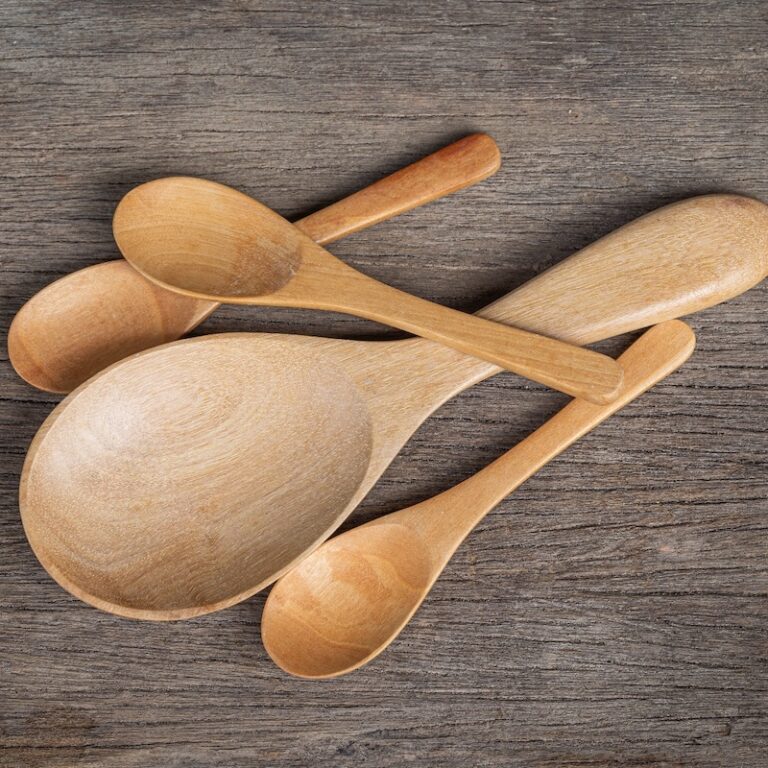
I know it’s supposed to be “wooden ships on the water” from David Crosby’s classic song, but when photographing my wooden spoons, I couldn’t get this song out of my head. Two days now!
And if you think about it, wooden spoons make cooking very easy, and that’s how it’s supposed to be. I am a big fan of wooden spoons and have one or two that I grabbed from our kitchen growing up to take to college many years ago and never gave them back. I hope my daughters take them from our kitchen and hold on to them like I did.
Several chefs have told me that wooden spoons are the way to go, but I wanted to know why. I wanted to know if it was just because they felt better in the hand or if they really had an advantage over metal spoons.
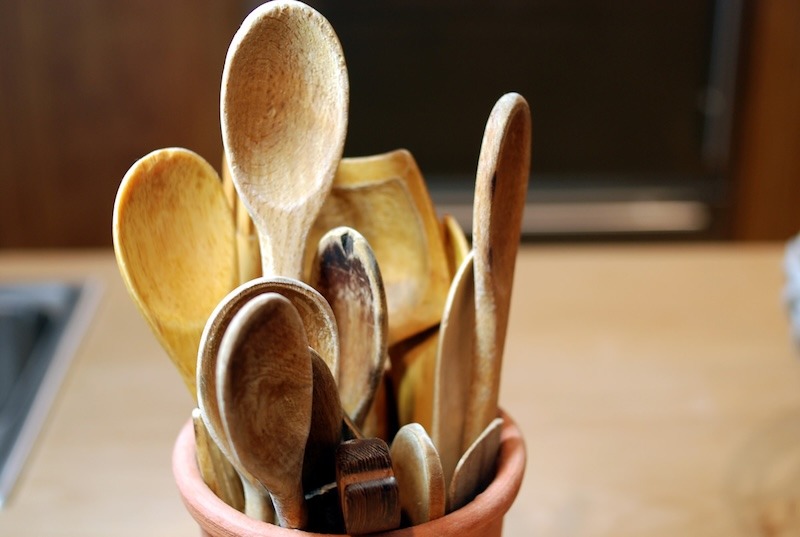
Is a Wooden Spoon Right for You?
- Good for: anyone who cooks on nonstick cookware, simmers acidic sauces, or stirs for long stretches (risotto, custard, gravy) and wants a handle that stays cool and comfortable.
- You genuinely need one if: you own nonstick pans you want to protect, or you cook a lot of tomato-based or citrus-heavy sauces where metal can leave a faint metallic edge.
- You don't need one if: your cooking is mostly deglazing, high-heat searing, or scraping stuck-on fond — a metal spoon or spatula does that job better.
- Skip it entirely if: hand-washing rules are a dealbreaker for you. A one-piece silicone spoon gets you most of the same benefits with dishwasher convenience.
What Actually Matters When You're Buying One
- Wood density: Closed-grain hardwoods (maple, cherry, beech, olive) resist cracking and hold up to years of washing better than open-grain woods like oak or ash. For most home cooks, maple or beech is the safe, affordable default.
- Spoon shape: A flat edge scrapes the bottom of a pan; a rounded bowl is better for stirring liquids; a cornered edge gets into the corners of a pot. One all-purpose spoon works fine for most kitchens — a second, flat-edged one earns its keep if you cook a lot of pan sauces.
- Size: A 12-inch spoon fits most pots and pans. If you regularly cook in a tall stockpot, a longer spoon keeps your hand away from the steam and the heat.
- Finish: Look for unfinished wood or one treated with food-grade mineral oil or beeswax. A glossy lacquer or polyurethane finish is made for looking good on a store shelf, not for repeated contact with hot food.
- Construction: Buy one piece of solid wood, not a handle glued to a different material. Glued seams are where food and moisture actually get trapped — solid wood, properly dried, doesn't have that problem.
The Woods You'll Actually Run Into
- Maple: Dense, tight-grained, widely available and affordable. The safe default for most kitchens.
- Beech: Similar performance to maple, often a little cheaper. A fine everyday choice.
- Olive wood: Dense, striking grain, pricier — often imported from Mediterranean groves. Beautiful, and it holds up, but you're paying for looks as much as performance.
- Cherry/Walnut: Good closed-grain options, usually sold as "artisan" or handcarved pieces at a higher price point.
- Bamboo: Technically a grass, not a wood. Lighter and usually cheaper, but it splinters and wears out faster than true hardwood — fine as a starter spoon, not a lifetime one.
- Skip: Softwoods like pine, which absorb oil and can pass a faint resin flavor into food, and open-grain woods like oak or ash, which are more prone to small cracks and chipping over time.
Where to Find Aged Wooden Spoons
You can often find great old wooden spoons at flea markets and garage sales for pennies. I look for them in the $1 mystery box with some other antique kitchen gadgets.
Many of them may be cheap pine but if you look, you can find a lot of hard wood (oak, maple) spoons out there just needing a little cleaning up and a bit of food grade mineral oil.
If you’re not into flea markets and garage sales, you can purchase a new one, again look for quality, cook with it for a bunch of years, and pass it down to your kids and/or grandkids. It’s a tool you will work with almost every day, so be sure to purchase a good one that feels comfortable in the hand.
I don’t think about my spoons often, but if they could talk, they would have plenty of great stories about fun meals I’ve prepared over the years before I got married and now have kids. You can think of them as little pieces of history right there in your kitchen.
What's Actually Happening When You Cook With One
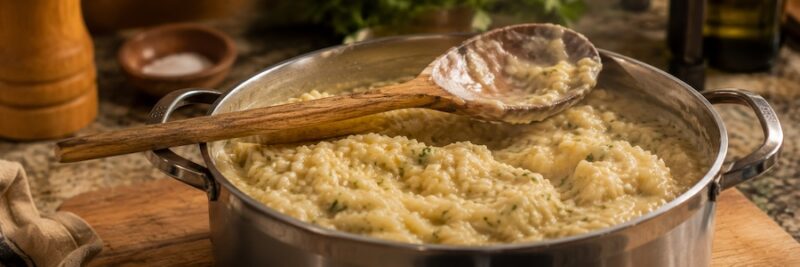
- Heat: Wood doesn't conduct heat, so the handle stays cool in your hand even after ten minutes in a hot pan — no oven mitt required. Leave it resting against a hot pan edge too long, though, and it will scorch (I've melted the tip of more than one spoon this way).
- Acid: Wood doesn't react with lemon juice, tomatoes, or wine the way some metals can, so you won't pick up a faint metallic taste in a long-simmered sauce.
- Surface: The rounded edge won't scratch nonstick coatings the way a metal spoon's edge eventually will, even a "rounded" one.
- Feel: This is the part I can't back up with science — I just like how a well-worn wooden spoon feels in my hand over a long stir. That's comfort, not performance. Your mileage may vary, and that's fine.
The One Question That Actually Matters
- The question isn't "which spoon is best?" — it's "what does this task need, and what feels good in my hand for as long as I'll be holding it?" A wooden spoon is the right tool for a lot of stirring and simmering. It's the wrong tool for deglazing a pan or searing at high heat. Buy for your own cooking, not for a marketing claim about which material wins — a good kitchen has more than one spoon in the drawer for a reason.
Eating With Wooden Spoons
As I write this, I think they may be good to cook with, but I’m not sure I would want to eat with them every day. I don’t like how food TASTES when you try it from a wooden spoon. I much prefer to use my spoon to remove it from the pot or pan, let it cool for a few seconds, and then pour it into my hand to taste. You don’t taste the wood, and there’s a lot less cleaning.
Where the Advice Usually Goes Wrong
- Myth: wood is unsanitary because it's porous. The research on this (a UC Davis cutting-board study a couple of readers linked in the comments below) actually suggests properly dried solid wood can harbor less bacteria than plastic. The real risk isn't the wood — it's a composite handle with a glued seam where food gets trapped.
- Mistake: buying the glossiest spoon on the shelf. That shine is often a lacquer or polyurethane finish meant for retail display, not repeated contact with hot food — it can crack and flake with use.
- Mistake: assuming "dishwasher safe" printed on the packaging means it's fine long-term. Heat and prolonged soaking are what actually crack wood — it'll survive a few cycles, then start failing.
- Mistake: buying one all-purpose spoon for every pot you own. A 12-inch flat-edged spoon in a small saucepan is as awkward as a short spoon in a deep stockpot.
Problem → Likely Cause → Fix
- Dark stains that won't scrub out → food pigment (turmeric, tomato, berries) soaked into the grain → normal, not a health issue. Wash promptly after use, or just let it become part of the spoon's history — I like mine.
- Fuzzy or musty-smelling spots → mold from staying wet or being stored damp → sand down the affected area or retire the spoon; store it dry with airflow, not sealed in a damp crock.
- Cracking along the length → dishwasher heat or prolonged soaking → hand wash, dry immediately, oil monthly with food-grade mineral oil.
- Handle feels rough or splintery → dried-out wood, no conditioning → rub with mineral oil, let sit overnight, wipe off the excess.
- Warping or splitting at the bowl → thermal shock from cold water hitting a hot spoon → let it cool before washing.
- Food tastes "off" from the spoon → an old spoon holding onto a strong flavor like garlic or curry → keep a couple of spoons and split them between savory and sweet, the way one of our readers below does.
Before You Buy Anything New
- A rough or sticky-feeling handle usually isn't a bad spoon — it's a factory finish that needs a light sanding and a coat of food-grade mineral oil.
- Keep two or three spoons in rotation instead of one so each gets a chance to dry out fully between uses.
- It's time to actually replace one when it's thin, has a bare round handle, and genuinely hurts to hold after a few minutes of stirring — that's a design problem, not a technique problem.
Where a Wooden Spoon Earns Its Spot
- Stirring risotto for 20 minutes straight without your hand cramping.
- Scraping the bottom of a nonstick pan while scrambling eggs.
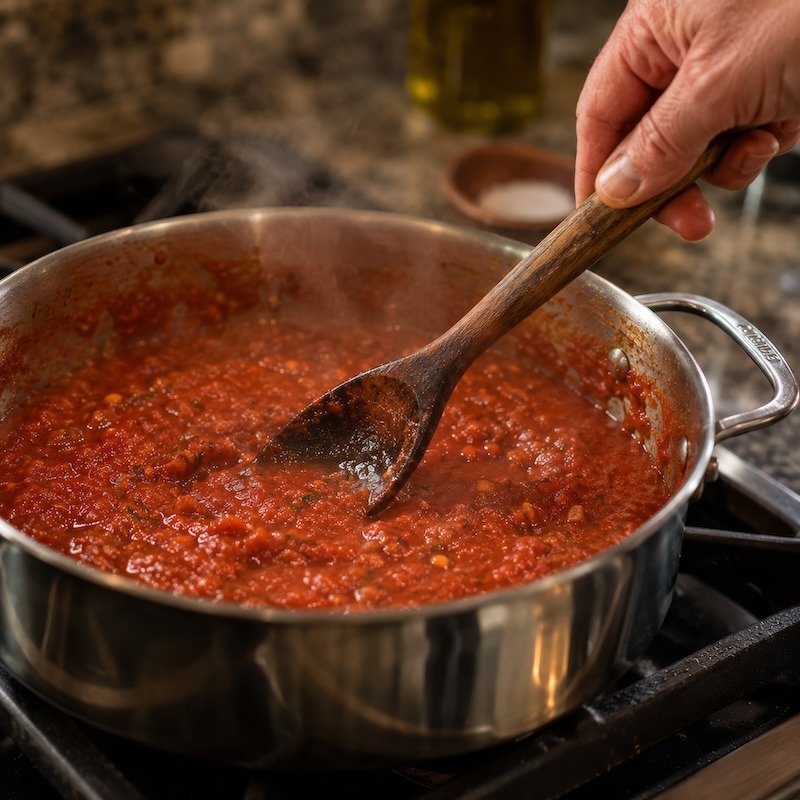
- Simmering a tomato sauce for hours without picking up a metallic edge.
- Stirring a custard until it coats the back of the spoon — wood's slight friction actually makes that visual cue easier to feel and see than it is with a smooth metal spoon.
When a Different Tool Is the Better Call
- Deglazing a pan — a metal spoon or spatula gets under stuck-on fond more effectively.
- High-heat searing, where a spoon might rest against a hot pan edge for a while and scorch.
- If dishwasher convenience matters more to you than the feel of wood in your hand — a good one-piece silicone spoon solves that without the maintenance, and there's nothing wrong with choosing that.
Kitchen Reference
- If you cook a lot of nonstick, acidic sauces, or long stir sessions → wooden spoon, closed-grain hardwood (maple, beech, cherry, olive).
- If you deglaze pans often → keep a metal spoon or flat-edged spatula in the mix too.
- If dishwasher convenience matters most → one-piece silicone.
- If you're buying as a gift → olive wood. If you're buying for daily use → maple or beech.
- If it's cracking → it's almost always a care issue (dishwasher, soaking), not a wood-quality issue.
Wooden Spoon vs. Metal Spoon vs. Silicone
- Vs. metal: metal wins for deglazing, high heat, and scraping stuck-on fond. Wood wins for nonstick pans and long stirring without a hot handle. Verdict: this isn't a replacement — most kitchens are better with both.
- Vs. silicone: silicone is dishwasher-safe and, if one-piece, sidesteps the glued-seam hygiene question entirely. Wood requires more care and offers the tactile feel a lot of cooks (myself included) simply prefer. Verdict: pick based on how much you value low maintenance versus how much the feel of the tool matters to you — neither answer is wrong.
Care and Maintenance
- Daily cleaning: hand wash in warm soapy water and dry immediately. Skip the dishwasher — especially the heated dry cycle.
- Storage: keep it dry with airflow around it, not sealed in a damp crock or drawer.
- Extending its life: rub with food-grade mineral oil about once a month, let it sit overnight, then wipe off the excess.
- What actually kills a wooden spoon: prolonged soaking and dishwasher heat cycles — not age, and not normal daily cooking use.
Wooden Spoons FAQ
Are wooden spoons sanitary? Yes — properly dried solid wood may actually harbor less bacteria than plastic, per cutting-board research a couple of readers linked in the comments below. The real risk is a composite handle with a glued seam, not the wood itself.
Are wooden spoons better than metal spoons? Not universally. They’re gentler on nonstick pans and won’t heat up in your hand, but metal still wins for deglazing and high heat — most kitchens do better with both.
Why do chefs use wooden spoons? Mostly comfort and habit — a wood spoon won’t scratch pans or heat up, and a lot of cooks simply prefer the feel of it over a long stir.
What’s the best wood for a cooking spoon? Closed-grain hardwoods — maple, cherry, beech, or olive wood — hold up better and resist cracking longer than open-grain woods like oak or ash.
Can you put wooden spoons in the dishwasher? No. The heat and prolonged wet cycle dry out and crack the wood much faster than years of hand-washing would.
Why do wooden spoons stain? Pigments from turmeric, tomato sauce, and berries soak into the grain. It’s cosmetic, not a hygiene problem — it fades or washes out over time, and honestly, I like the character it adds.
How often should I oil a wooden spoon? About once a month with food-grade mineral oil, more often if the wood starts looking dry or feeling rough.
Do wooden spoons affect the taste of food? Occasionally — a spoon used heavily for something pungent like curry can carry a little flavor into the next dish. Some cooks keep separate spoons for sweet and savory food to avoid it.
Is bamboo the same as wood? Not quite — bamboo is a grass, lighter and usually cheaper, but it splinters and wears out faster than true hardwood.
How long do wooden spoons actually last? Decades, with basic care. Mine are well over 40 years old and still going.


40 Responses
I couldn’t agree more, certain things are just as timeless now as they ever were. These also make for great gifts.
Yes, thanks for your comments.
how do I know the stains on my wooden utensils are food stains, not mold? Also what would be the best place to keep them..outside on the counter or in the cabinet drawer with other spoons?
Food stains are typically darker in color (brown, red, or yellow) and may occur from sauces, spices, or oils. These stains are often more shallow and have a smooth texture that feels like part of the wood grain. Mold usually appears as greenish, black, or white patches and often has a fuzzy or powdery texture. Mold can also sometimes have a musty odor.
Storing your wooden utensils in a drawer or cabinet is a more reliable way to protect them from the elements, moisture, and contamination. However, if you store them on the counter, make sure they’re in a clean, dry place where air can circulate freely.
I love this article, my husband and I make wooden utensils up here in Troy, Montana.
Having a hard time finding wooden utensils sold as sets.
So, non-wood spoons grow bacteria in divots scratches and gouges but wooden spoons don’t? Cmon it’s obvious you think wooden spoons are superior but you don’t need to dilute your valid arguments with bias.
Basically i think it comes down to: if you’re not using nonstick or stirring something acidic or hot (all situations where wood is superior) it’s down to personal preference or a perception of altered taste (if you can taste metallic compounds in food due to a spoon then the spoon is either old or cheap’n’nasty and is literally rusting into your food)
Personally: having done a immunology/microbiology degree at uni I prefer wood (as Id rather have a natural substance in contact with my food) but unless it’s a super dense expensive hard wood it will crack with wet/dry cycles and get worn and bacteria looooove crevices to hide in
The ‘fragile ingredient’ theory sounds like a complete load of waffle. a) if your spoon edge was sharp it’d cut your mouth, look under magnification at what an unsharpened metal edge really looks like – rounded – and b) what are these fragile foods that are ruined by a spoon edge (but not by being folded or stirred??)
Thanks for sharing your thoughts! I appreciate your insight, especially with your background in immunology and microbiology.
You’re right that both wooden and non-wooden spoons have their own set of pros and cons. It’s true that bacteria can hide in scratches or gouges on both types of spoons. Wood can harbor bacteria if not properly maintained, but I think the key difference is that, with wooden spoons, people often use oiling and conditioning to help seal the wood and reduce the risk of bacteria buildup. Proper care is definitely important for both materials.
As for the “fragile ingredient” theory, it’s a good point that most ingredients are sturdy enough to handle a rounded metal spoon edge. The idea I was trying to convey is more about the potential for certain foods (like delicate fish or egg whites) to be impacted by sharp or aggressive stirring, rather than the material itself. But I agree—good technique goes a long way, and the shape of the spoon plays a role too.
I do think wooden spoons have a charm that many people prefer, especially for their ability to work well with nonstick surfaces and not react with acidic ingredients. However, I also completely agree that personal preference is a big factor. Some people like the feel and weight of metal spoons, while others prefer the natural feel of wood.
Thanks again for sharing your perspective! It’s always great to have a balanced discussion, and I can definitely see where you’re coming from with your thoughts on the topic.
In my experience wooden spoons are the best. I’ve got couple of metal and plastic ones, but haven’t use them for a long time. I don’t know, for me wooden spoons are more handy. Feels better when you are cooking if we compare with metal, cold and heavy spoon.
There are good culinary reasons for wooden spoons. For example, when making a custard it will take longer for the mixture to “coat the back” of a metal spoon because there is less friction. Result? The custard will be overdone. The same is true of spaghetti sauce.
I’ve never oiled a wooden spoon in my life. My spoons get plenty of oil/fat in the cooking process.
Thanks for your comments.
I cannot get my head around using a wooden spoon for cooking! I’m a home brewer and one of the last things that I would use in my beer is a wooden spoon … I might as well stir it with my hand … contains the same amount of bacteria, etc., as a wooden spoon would.
I had a wooden spoon that really did pick up a certain “flavor” – if you will. I apologize that I cannot remember the exact recipe that I was using, but the wooden spoon did change the taste of the recipe. From that time, I use certain wooden spoons for sweet recipes and others for spicy main dishes exclusively.
Hello, I just wanted to say real quick as a woodworker and one thats going to be making spoons for a friends restaurant, I recommend not using oak, walnut, ash, etc. or any open grained wood. Use hard dense close/tight grained woods like Maple, Cherry, Hickory, Olive, Birch, etc. The open grained woods will be a little more prone to bacteria, chipping,etc.
Do you have a wood business? thanks for the info
I do not Ernz but there are some wonderful artists making great products out there.
David, I have recently converted to a chemical free life (food, household and personal hygiene products etc) and my daughter pointed out that my wooden spoons would have been bought containing chemicals, before they even began their work in my kitchen. Do you know if this is true?
Thank you for your thoughtful question! It’s great to hear that you’re transitioning to a chemical-free lifestyle—it’s a journey that many people are on, and it can feel empowering to make those choices for your health and the environment.
As for your wooden spoons, it’s true that many wooden utensils are treated with various finishes, oils, or preservatives during the manufacturing process to protect the wood, enhance its appearance, or prevent it from cracking. Some of these treatments might contain chemicals. For instance:
Varnishes, lacquers, or polyurethane finishes may contain synthetic chemicals.
Oils like mineral oil used to condition the wood may sometimes be refined with chemical processes, though food-grade mineral oil is usually considered safe for kitchen use.
Some lower-quality wood products might also be treated with preservatives to prevent mold or pests.
If you’re looking to avoid chemicals, it’s a good idea to check the product labels or reach out to the manufacturer for information about how the spoons were treated. You can also find untreated, all-natural wooden utensils that are finished with food-safe, natural oils like beeswax or coconut oil, which might be more in line with your chemical-free goals.
Additionally, you can recondition your wooden spoons yourself using natural oils like olive oil or coconut oil if you want to ensure they are chemical-free moving forward.
It’s definitely something to consider, and your daughter’s observation is a good reminder that even everyday kitchen items can come into contact with chemicals. Keep up the great work on your chemical-free journey!
woow goodie
And as luck would have it, there’s something of a spoon-making Renaissance happening among woodworkers these days. It’s getting easier and easier to find really ergonomic wooden spoons that are much nicer than the ones you usually find in department stores. You can find quite a few spoon makers on the internet now.
I’m an amateur woodworker myself, and I have made a lot of wooden spoons, including all the ones in my own kitchen. It’s true that hardwoods tend to be better than softwoods, and that close-grained woods are better than open-pored woods, but most any wood can make a good spoon. Maple, beech, cherry, and walnut are all good choices. The important thing is that it’s comfortable in your hands.
And contrary to popular supposition, wooden utensils are not more prone to harboring bacteria than are other common kitchen materials, especially plastics. The studies done on wooden cutting boards indicate that wood may actually harbor less bacteria than plastics do. Here’s a link: http://faculty.vetmed.ucdavis.edu/faculty/docliver/Research/cuttingboard.htm
I should start out by saying, I’m biased: I make handcarved wooden spoons for sale.
With that out of the way, great article! Wooden spoons are so common and seemingly simple that a lot of cooks forget how essential they are – it’s how we manipulate the food we’re cooking – so it’s terrific to find someone singing their praise.
Nice to see that you’ve a selection to choose from too, a brilliant sauce spoon won’t toss around a stir fry or get under the edge of an omelet as well as one that’s made for the job and having handmade kitchenware adds something extra, just in the same way that homemade food always tastes the best.
On the hygiene issue, wood is naturally anti-bacterial and studies into chopping boards have found wood to be a more hygienic material than plastic. http://faculty.vetmed.ucdavis.edu/faculty/docliver/Research/cuttingboard.htm
I have my own website blog where I write about the carved wooden spoon scene in the UK, including an annual spoon carving celebration, Spoonfest!
best wishes, Steve Tomlin
Thanks Steve for you comments and information about hygiene. I’ll be over to look at your site later today.
I do not know about all the woods mentioned here and have actually put off purchasing wooden spoons until I had more information on the best ones for a home kitchen. I do know from personal experience that Burch is a great hard wood and is known for its non-warping trait. I use to own a house built in 1940 that was made of lathe and plaster which was also 10 miles from the beach. The house had a floor furnace in the living room that only serviced some of the room and not all of them so in the winter it could get pretty cool. In the summer it would get so hot from the sun beating down that it would create condensation on the plaster wall because houses were built without insulation in those days. A carpenter must have been the first or one of the first people who owned the house because besides the closets in each bedroom which were built into the walls, birch was used in the bathroom wall cabinet, the hall linen closet, the kitchen cabinets, both top and bottom. Birch was also the wood chosen to build a mini secretary with a place to set the old hand held phones, a telephone book shelf, and 3 drawers for miscellaneous things like dishtowels and cookbooks.
My family lived in this house for 49 years and none of these cabinets, the doors, the drawers or closets ever warped with all the moisture they were exposed to. The only reason I every would have replaced the kitchen cabinets would have been to update it and not because they warped (the house was under 700 square feet and the kitchen cabinets were only 18 inches on the bottom and 12 inches on the top. The top ones were only large enough to place a large dinner plate with not much room to spare. A place for everything and everything had to be in its place). Thanks for all the information. I will be purchasing my new wooden spoons in the near future now that I am armed with the proper information.
Wood spoons are definitely the way forward! I love the way that a well used wooden spoon tells a story: the way the edge gets worn from how you stir, the singed spot from when you were distracted by a phonecall, the slight yellow colouration from that time you cooked a curry. Plastic and metal utensils just don’t build up a character in the same way wooden ones do.
I agree Tom Bartlett. A wooden spoon tells a story. And they do build up character.. I have a dozen of my own that must be 40 years old. I have my mom’s spoons that are probably 70 years old. There are spoons to make gravy with, blueberry compote, strawberries and cream, pasta sauce, custards, beef stew, lobster bisque…never mind the fact that some of these spoons I remember cooking with my mother.
Why do you focus on metal spoons as an alternative? I didn’t even know those large metal spoons are used for cooking for the very same reasons you criticize them. I only use ceramic spoons as I find wooden spoons somewhat disgusting. It appears to me that they would soak with water and nutrients and form a perfect bacteria herd, that i could never wash properly.
I like my wooden spoons and have been cooking with them for years. There are some who disagree with this but I’ve been told the wood has properties to prevent bacteria from growing on them. Whether that’s true or not, I am not a food scientist but I have also never become sick from using them for over 40 years of cooking. I do wash them with soap and water each time I use them. I do like the idea of ceramic spoons and will have to pick some up. Thanks for sharing.
Great article! Cooking is a very delicate precedure and the utensils play an important role, not only concerning the taste, but also our health. Due to the fact that I live in Corfu, Greece, and we have acres full of olive trees, we use olive wood for manufacturing spoons, spatulas, chopping boards, glasses,etc.
I am glad that more and more people use wood and not plastic, and that there people like you that share their knowledge about issues like that!
Thanks for sharing!
Awesome blog, I got too much information about wooden spoon.
I use only wooden utensils in my kitchen. There is nothing than a wooden spoon for cooking rice or fry onions. I love your post and your spoons. But on my mind you need to buy a set of new good quality spoons :-). I recommend beechwood – perfect hard wood material for wooden tools in kitchen. Beech wood is growing in North Europe and is great for cutting boards, wooden spoons, trivets and other tools.
Wood is a popular traditional choice for some utensils, such as spoons and bowls. Wooden spoons are utensil commonly used in food preparation. Wooden spoons are some of the most important utensils to have in the kitchen.
I love this post, I use wooden spoons and they are very comforting. It makes me feel rustic in my modern kitchen. Thanks for sharing.
What about bamboo spoons?
Hi Allen, Bamboo spoons can be a great alternative to traditional wooden spoons, especially for those aiming for a more eco-friendly and chemical-free lifestyle. Bamboo spoons can align with a chemical-free lifestyle, especially if you seek out uncoated, natural options and ensure they are free from added chemicals. They offer a sustainable, eco-friendly alternative to traditional wood, and with proper care, they can last a long time without the need for synthetic treatments. If you’re concerned about chemicals, always look for brands that specify natural finishes and avoid harsh coatings or adhesives.
Hello,
Wooden spoons are especially useful when stirring on a non-stick surface. Metal spoons can scratch nonstick coatings, while smooth wooden spoons will not harm non-stick surfaces.
thanks
I would also recommend wooden spoons in every kitchen. lovely post Thanks for sharing.
I loved that you mentioned the feel of wood spoons and kitchenware can match. My husband and I are thinking about how to choose kitchenware for our house, and we are looking for advice. I will let him know about your recommendations to choose the right kitchenware to help us.
Great wooden spoons are available at Wudlab. All kinds, shapes, and sizes.
Not Oak…it is ring-porous and will be less food safe than other hardwoods.
Same for chopping boards. People, do your homework.
No need to get snippy bob. Oak is a strong, durable hardwood, which makes it a good choice for kitchen utensils. It can withstand heat and moisture, which are common in cooking. Yes, oak is ring-porous, but that doesn’t mean it does not make a fine kitchen utensil. It does mean that more care has to be given to it than maple, beech, or cherry.