How to Make Veal Marsala the Right Way — Technique & Sauce

Think you know Veal Marsala? Think again. This isn’t some soggy, bland restaurant knockoff—this recipe hits all the right notes: tender cutlets, rich Marsala sauce, and mushrooms that actually matter. If you’ve ever wanted to cook like a pro without losing your mind, this is your kitchen wake-up call.

Fast Answer

Veal Marsala is a quick Italian pan sauce dish built on three things: veal cutlets sautéed fast over high heat, a Marsala-and-demi-glace reduction built from the fond left in the pan, and cold butter whisked in at the end to finish the sauce. The whole dish takes about 30 minutes once you understand the sequence.

Start Here: What You Need to Know Before You Cook

  • Mise en place is non-negotiable. Veal cooks in under two minutes per side. If you're still mincing shallots when the cutlets hit the pan, something will go wrong.
  • Cook in batches of three. An 8–10 inch pan handles three cutlets well. Crowd the pan and the veal steams instead of sears.
  • Do NOT cover the resting veal. The cutlets are thin. Foil traps steam and turns them rubbery. Leave them uncovered — you'll add them back to the sauce at the end.
  • Use real Marsala wine. Grocery-store "Marsala cooking wine" is salted, cheap, and will wreck the sauce. Buy a bottle of dry Marsala from the wine or liquor section.
  • Demi-glace is the secret weapon. It adds body and depth that no amount of Marsala reduction alone can provide. Store-bought concentrate works fine.

Why This Recipe Works

  • Mise en Place Matters: Prepping everything ahead ensures the thin veal cooks quickly without overcooking and the sauce comes together perfectly.
  • Tender Veal: Flattening and tenderizing the cutlets creates even thickness for juicy, consistent cooking.
  • Layered Flavors: Cooking mushrooms separately and mounting the sauce with cold butter adds richness and depth without overpowering the Marsala.
  • Quick Cooking: Veal cooks fast; careful timing keeps it tender and juicy, never rubbery.
  • Flavor Control: Taste and adjust seasoning at key steps so the wine and demi-glace shine.

Veal Marsala Recipe with Marsala Sauce That Really Tastes Like Something

Veal Marsala is one of those dishes that looks straightforward until you make a bad version of it. The sauce is thin. The veal is tough. The mushrooms disappear into the background.

What separates a restaurant-quality Marsala from a forgettable one isn’t the use of exotic ingredients — it’s understanding why each step exists. This recipe, learned from Chef Ricco DeLuca, whose mother cooked for Frank Sinatra’s family for fifteen years, gets into all of it.

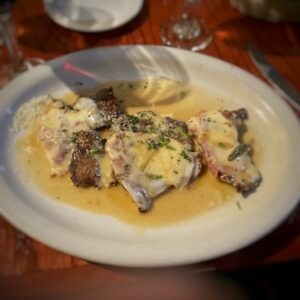
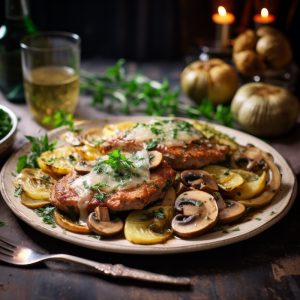
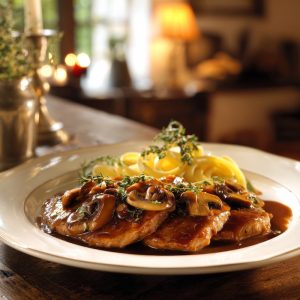
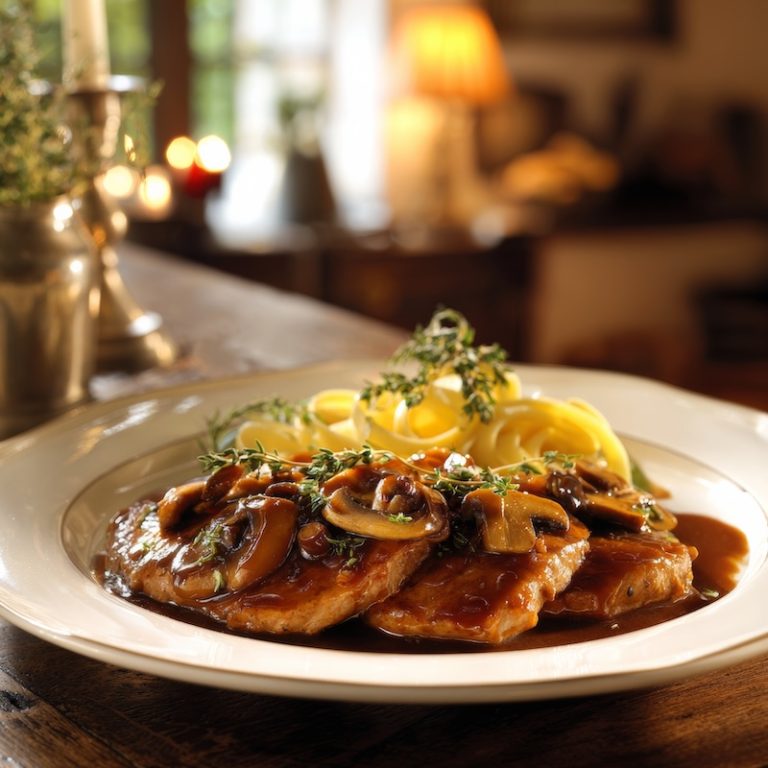
A beautifully plated dish of Veal Marsala on a large, elegant white plate
Print Recipe
5 from 1 vote

Veal Marsala Perfected

How to make the best veal Marsala you've ever had.
Prep Time15 minutes
Cook Time15 minutes
Total Time30 minutes
Course: Main Course
Cuisine: Italian
Servings: 3

Ingredients

  • ½ tablespoon butter
  • ½ tablespoon oil
  • 6 veal cutlets or scaloppini
  • 1 medium shallot minced
  • 1 sprig of thyme
  • ¼ cup Marsala
  • ¼ cup demi glace
  • salt and white pepper to taste

For the mushrooms

Instructions

Before You Start

  • Before You Start
    Get everything prepped before anything touches the pan. Veal cutlets cook in under two minutes. If you're still mincing shallots when the meat is in the pan, you've already lost control of the dish.
    Mince the shallot finely
    Strip and chop the thyme
    Measure out the Marsala and demi-glace and set them within reach
    Have a clean plate ready for the resting veal

Prep the Veal

  • If your cutlets are thicker than ¼ inch, they need to be flattened. Place each cutlet between sheets of plastic wrap. Use the flat side of a meat mallet (or the bottom of a heavy pan) to press them to an even thickness. Then give each one a few passes with the textured tenderizing side — this breaks up the membrane in the cut and makes the meat more tender, not just thinner.

Cook the Mushrooms First

  • Get your mushrooms going before the veal. Heat 2 tsp butter and 2 tsp olive oil in a separate small pan over medium-high heat. Add the sliced mushrooms in a single layer — don't crowd them or they'll steam.
  • Cook until they're golden and just tender, about 4–5 minutes. Season with salt and pepper. Remove from the pan and set aside. They don't need to stay hot — you'll either reheat them in the sauce at the end or use them as a garnish.
  • Why separate? Mushrooms give off liquid. Cook them in the sauce, and that liquid dilutes everything you're building.

Sear the Veal - Batch One

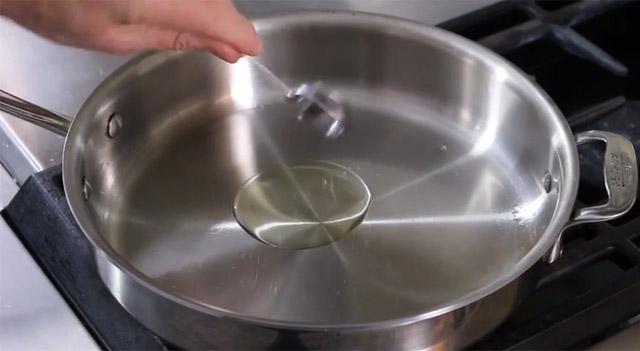
  • Heat your 8–10 inch pan over medium-high heat until it's genuinely hot. Add ½ tbsp butter and ½ tbsp oil. Wait until the butter stops foaming and the oil shimmers — that's when the pan is ready.
  • Add three cutlets. Don't touch them. Cook for exactly 1 minute, then flip and cook 1 minute on the other side. The veal should have color but still look slightly underdone — it will finish in the sauce.
  • Transfer to a plate. Do not cover with foil. The cutlets are thin and retain heat. Foil traps steam and turns them rubbery. Leave them out.
  • Pour off any accumulated juice from the plate and save it — it goes into the sauce.

Sear the Veal - Batch Two

  • Add the remaining ½ tbsp butter and ½ tbsp oil. Repeat the same process with the other three cutlets. Transfer to the same plate.

Build the Sauce

  • Discard any excess oil left in the pan, but leave the fond — those browned bits are the flavor foundation of the sauce. Reduce the heat to medium.
  • Add the minced shallot, thyme, salt, and white pepper directly to the dry pan. Keep stirring constantly.
    Chef Ricco cooks them without added fat here — the goal is a light, slightly dry sauté that concentrates their flavor without browning. If you're not comfortable with a dry pan, leave a thin film of residual oil. Cook for about 1 minute, until the shallot softens.
  • Add ¼ cup of Marsala. You'll hear it sizzle and the fond will release immediately — scrape the bottom of the pan as the liquid comes up. Reduce by half, which takes about 2 minutes over medium heat.
  • Add ¼ cup of demi-glace. Stir to combine and let the sauce cook for another 1–2 minutes. Taste it now. If it's flat, add a pinch of salt. If the Marsala flavor isn't coming through, add a small splash more. If it's too sweet, a tiny squeeze of lemon balances it.
  • The sauce should coat the back of a spoon and hold a clean line when you run your finger through it. If it runs off immediately, reduce a bit more.

Mount the Sauce

  • Pull the pan off direct heat or reduce to the lowest setting. Add 1 tablespoon of cold butter — cold is important, not room temperature. Whisk it in steadily until fully incorporated. The sauce will turn glossy and slightly thickened.
  • If you want a richer sauce and are adding more than one tablespoon, add the butter one piece at a time, whisking each piece fully into the sauce before adding the next. Adding all the butter at once risks breaking the sauce — separating it into liquid and fat.

Finish & Plate

  • Add the reserved veal juices to the pan. Return all six cutlets to the pan. Let them sit in the sauce for 30–45 seconds, spooning sauce over the top.
    You're reheating and finishing, not continuing to cook — don't let this go longer, or the veal will toughen.
  • Add the mushrooms now if you want them integrated into the sauce, or plate the veal first and arrange the mushrooms on top as a garnish.
  • Serve immediately.
“Have you made Veal Marsala before — and what gave you the most trouble? The sauce consistency, finding good veal, something else? Leave a comment below. Real questions get real answers here.”

Frustrated cook making common mistakes.

What Most Cooks Get Wrong

  • Overcrowding the pan. Too many cutlets at once drops the pan temperature, and the veal braises in its own liquid instead of searing. Cook in batches.
  • Covering the veal while it rests. Foil traps steam. Thin cutlets keep cooking and turn rubbery in minutes. Rest them uncovered on a plate.
  • Using cheap Marsala. Supermarket cooking wine is salted and stripped of flavor. A mid-range bottle of dry Sicilian Marsala costs $10–$15 and makes a real difference.
  • Skipping demi-glace. Without it, the sauce is thin and one-dimensional no matter how much you reduce it. Demi-glace provides the body the dish depends on.
  • Adding all the butter at once. If you're mounting with more than one tablespoon of butter, add it piece by piece. Adding it all at once risks breaking the sauce — separating it into liquid and fat.
  • Not tasting before serving. Marsala varies in sweetness and intensity by brand. Always taste the sauce before plating and adjust with a pinch of salt or a small splash of wine.
Quick Fixes & Pro Tips

  • Sauce too thin? Reduce it a bit longer before mounting with butter, or add a small extra measure of demi-glace. Don't add flour — it will cloud the sauce and change the texture.
  • Sauce too thick? Add a small splash of Marsala or unsalted chicken stock to loosen it. Taste again after adjusting.
  • Sauce too sweet? Swap in dry Marsala if you've been using sweet, or add a squeeze of lemon juice to balance the sweetness.
  • Veal hard to find? Chicken breast pounded thin (chicken Marsala) works with this same method. The sauce technique is identical.
  • Flour or no flour? Chef Ricco prefers without — cleaner flavor, more delicate texture. The flour version holds sauce better and has a slightly more substantial crust. Try both and decide for yourself.
  • Making a bigger batch? The sauce scales easily. The veal still needs to cook in batches regardless — crowding the pan is always the wrong move.

What to Serve With Veal Marsala

  • Pasta. A simple buttered egg tagliatelle or fettuccine lets the sauce shine without competing with it.
  • Risotto. A plain Parmesan risotto makes a natural base for the Marsala sauce. Rich on rich works here because the portions are balanced.
  • Mashed potatoes. Creamy mashed potatoes soak up the pan sauce well and keep the focus on the veal.
  • Sautéed greens. Spinach wilted in garlic and olive oil, or broccolini with a little lemon, cuts through the richness of the sauce.
  • Wine pairing. Dry Marsala in the sauce, so dry Marsala in the glass makes sense — but a medium-bodied red like a Barbera d'Asti or a Sicilian Nero d'Avola also works well. Avoid anything heavily tannic; it will fight the sauce.

Storage & Make-Ahead

Storage: Refrigerate leftover veal and sauce separately if possible. The sauce holds for 3 days. The veal is best eaten the day it's made — reheating thin cutlets a second time risks drying them out.

Reheating: Warm the sauce gently in a pan over low heat. Add the veal back for 30–45 seconds to reheat, no longer. Do not microwave the veal.

Make-ahead: The mushrooms can be cooked up to a day ahead and refrigerated. The sauce can be made through the demi-glace step, then refrigerated and finished with butter just before serving. The veal itself does not benefit from being made ahead.

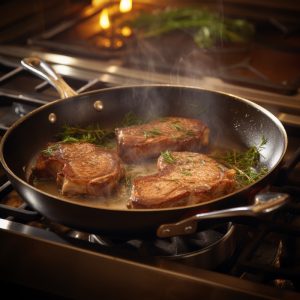
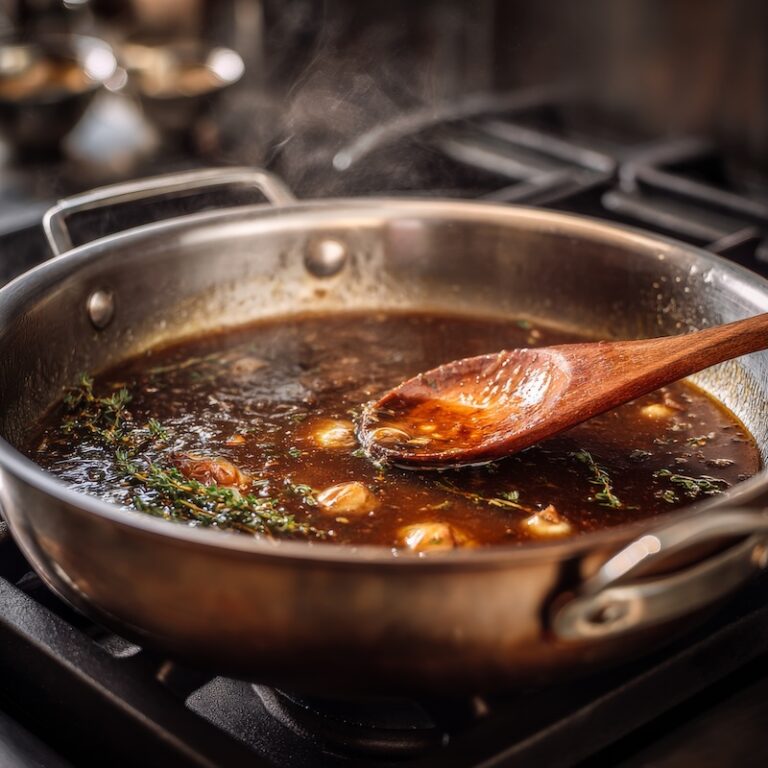
A stainless steel sautepan on a gas burner with a deeply amber Marsala sauce reducing

What Type Of Cooking Pan For Veal Marsala?

This section looks at the best cookware for making this dish at home, but these are only suggestions from Chef Ricco. They are by no means absolute requirements.

If your kitchen is equipped with other cookware, don’t feel like you have to go out and buy additional pans to make this dish. Instead, use what you have and adapt your cooking to your tools.

How Hot Should Your Pan Be When Frying or Sauteing

Ideally, Chef Ricco recommends using an 8 – 10 inch sauté pan or frying pan and cooking three at a time. Never crowd a pan when sautéing, or the meat will steam rather than fry properly.

Besides, you will add the meat back to the pan to reheat when the sauce is done.

I had a question about using my large frying pan. Ricco explained:

  • A smaller pan holds heat better, especially on smaller home stovetops. Large 14-inch pans work well in commercial kitchens with high-BTU stoves. But most home stoves don’t have enough power to heat big pans properly or keep them hot.
  • All pans, like ovens, have hot spots. Larger pans create bigger hot spots, leading to uneven cooking.
  • Smaller pans handle heat more efficiently. They maintain proper temperatures for better cooking. When you add meat to a hot pan, the pan cools down temporarily. Chef Ricco always reminds me, “Heat is your friend when cooking.” A smaller pan bounces back faster from sudden temperature drops.
  • On my stove, larger pans don’t fit the burners well. So, for now, I stick with smaller pans until I can upgrade to a new stove.


Not a good idea for this dish. We want the pan to get hot and create a fond (the brown bits stuck to the pan after sautéing, also called sucs) that will add flavor to the sauce. It doesn’t work well with nonstick pans because nothing sticks to the pan to create fondness.

Copper

Experienced cooks love copper pots and pans for their excellent heat conductivity. Turn up the heat, and copper heats up quickly. This works great if you know what you’re doing, but it’s easy to overcook or burn food without paying close attention.

Another advantage of copper is its even heating. Copper pans don’t have hot spots, so the entire pan cooks evenly.

They also look beautiful, but there’s a trade-off. Copper cookware is expensive and requires a lot of maintenance to stay in top shape.

Stainless Steel

Stainless steel is an excellent choice for this dish. The veal will stick slightly, creating a fond—flavorful base for a pan sauce. Many people prefer nonstick pans because they don’t want food to stick. That makes sense for foods like eggs and fish. But when making a pan sauce, stickiness is an advantage.

Stainless steel is also more affordable than copper. It doesn’t conduct heat as quickly, making it easier for beginner and intermediate cooks to manage. Plus, stainless steel requires much less upkeep. Many brands are dishwasher-safe, making cleanup easy.

Stainless steel is also versatile. Unlike copper or aluminum, it doesn’t react to acidic foods.

The downside is its heat conductivity. Stainless steel doesn’t distribute heat as evenly as copper, so you’ll get more hot spots. But with careful cooking, you can work around that.

Aluminum and Hard Anodized Aluminum

So, what’s the difference? Anodized aluminum means manufacturers place aluminum in chemical baths. Then, they apply an electrical charge. This process thickens the oxide layer, making it stronger, harder, and less likely to corrode.

I love hard-anodized aluminum pans. They conduct heat well—better than stainless steel but not as well as copper. Plus, they’re tough. They’re twice as hard as stainless steel and much more durable than regular aluminum. You can toss them around on the stove or in cabinets without much worry.

These pans also perform well. They heat quickly and evenly, though not as fast as pure aluminum. Maintenance is simple. When I started teaching myself to cook 25 years ago, I bought anodized aluminum pots and pans. I still use them, but they’ve started to warp, so I’m slowly replacing them.

Here’s the downside: all anodized aluminum pans today are nonstick. I haven’t found any that aren’t. This frustrates me because I want some foods to stick. It helps me make great pan sauces.

I know little about pure aluminum pans, but I decided to try them. I found a restaurant supplier and bought a few. They conduct heat exceptionally well, cost less than stainless steel or copper, and are standard in professional kitchens.

But there’s a catch. Pure aluminum reacts with acidic foods and can leach into the dish. Research on this issue goes both ways. I recommend doing your homework before buying any pan, regardless of material. That’s where I’ll leave it.

Blends

I just purchased this incredible Vollrath 3 Quart Saute Pan from an online restaurant supply store I love. It has a 3-ply construction with an 18-8 stainless interior and an aluminum core to provide even heat on the bottom of the pan and side walls. With a silicone-coated handle that is oven-safe to 450°F, it feels great in my hand; I can’t wait to see how it performs.

Another blend is copper with stainless steel; I’m sure there are others. Depending on your budget and cooking needs, there’s something for everyone.

The best pan for making this dish is the one you have in your kitchen cabinet. You’ll do better if you use a pan that is not nonstick, but if all you have is nonstick, don’t let that stop you from making this veal Marsala perfected. If you plan to make more pan sauces, you can purchase one of the pans I described above.

The Quick & Easy Version of Veal Marsala

If you are already proficient in the kitchen or are not that particular about the details, here’s Chef Ricco’s Veal Marsala Recipe with no explanations. They are easy to follow and will produce a fantastic dish for two people. Of course, if you want to serve more, adjust the recipe for four or more people.

You can find veal already scallopini style, which means pounded thin into quick-cooking servings, but if you can’t, you can purchase veal cutlets and pound them yourself with a meat pounder or the bottom of a heavy cooking pan.

Ricco likes to cook the mushrooms separately from the sauce and serve them as a garnish when plating or add them to a saucepan right before serving.

Print Recipe
5 from 1 vote

Simplified Veal Marsala Recipe

My friend Chef Ricco taught me how to make this incredible veal marsala dish.
Prep Time15 minutes
Cook Time10 minutes
Total Time25 minutes
Course: Main Course
Cuisine: Italian
Servings: 3 persons

Ingredients

  • 3 tablespoons butter
  • 1 tablespoon oil
  • ¼ pound mushrooms clean and thinly sliced
  • 6 veal scallopini cutlets depending on cutlet size or your appetite.
  • 1 medium shallot minced
  • 1 sprig of thyme finely chopped
  • salt and white pepper to taste
  • ¼ cup Marsala
  • ¼ cup demi glace

Instructions

  • Prep the veal if necessary so you end up with 6 thin scallopini styled cutlets.
  • Before you start cooking the veal, prep the mushrooms and saute in 1 tablespoon of butter until just tender. Transfer to a plate and reserve.
  • Heat a frying pan large enough to cook all 6 cutlets over medium-high heat. If you don't have a pan big enough to accommodate all 6, cook the cutlets in batches of 3.
  • Add the oil & 1 tablespoon of butter to the pan.
  • While the butter melts and the oil heats up, dredge each cutlet in seasoned flour. Be sure to shake off all excess or the flour will burn and stick to the pan.
  • Pan fry the cutlets for approximately 1 minute per side. Transfer the veal to a plate and cover with foil to keep warm.
  • Discard remaining oil in the pan and reduce heat to medium.
  • Add shallot, thyme, salt and pepper and cook for 1 minute. Remember to keep stirring so nothing burns.
  • Add Marsala wine and reduce by half.
  • Add demi glace, stir and cook until the sauce is thick enough to coat the back of a spoon. At this time I like to add the remaining tablespoon of butter to the pan. It's called mounting and helps "finish" the sauce.
  • At this time, I may add the previously cooked mushrooms back to the pan to reheat in the sauce or I may just add them to the top of veal as a garnish. You decide.
  • Taste and correct seasonings with salt & pepper.
  • Transfer the cooked veal cutlets back to the pan to reheat before serving. I like to spoon the sauce over the cutlets at this time while they are heating up.
  • Serve with pasta or rice and a favorite vegetable side dish.

If you are interested in my chicken marsala recipe, I think you will be delighted.

Veal Marsala FAQ

Q: What is the best Marsala wine to use for cooking? Use a dry Sicilian Marsala from the wine section — not the “cooking wine” in the grocery aisle. A bottle in the $12–$18 range is all you need. Florio and Pellegrino are reliable, widely available brands.

Q: Can I make Veal Marsala without demi-glace? You can, but the sauce will be thinner and less complex. If you can’t find demi-glace, a high-quality beef or veal stock reduced by half is a reasonable substitute. Avoid using plain canned broth — it won’t reduce to the right consistency.

Q: What cut of veal should I buy? Look for veal scallopini or veal cutlets from the leg. They should be thin — ideally under ¼ inch. If they’re thicker, pound them flat yourself with a meat mallet or the bottom of a heavy pan.

Q: Should I use flour on the veal or not? Chef Ricco prefers this recipe without flour — cleaner flavor, more delicate result. But flour does help hold the sauce to the meat and creates a slightly more substantial texture. If you’re serving guests, try the flour version. If you want a lighter dish, skip it.

Q: Why cook the mushrooms separately? Two reasons. First, mushrooms release a lot of liquid that dilutes the sauce. Second, cooking them separately keeps their flavor distinct — they become a garnish that adds a separate layer to the dish, rather than disappearing into the sauce.

Q: My sauce broke. What happened? The sauce breaks (separates into liquid and fat) when the butter is added too quickly or the pan is too hot. Next time, lower the heat before mounting and add butter one piece at a time, whisking continuously until each piece is fully incorporated before adding the next.

Q: Can I substitute chicken for veal? Yes. This exact technique works for chicken Marsala using pounded chicken breast. The cook time is slightly longer — about 2–3 minutes per side depending on thickness.

Q: How do I know when the sauce is ready? The sauce should coat the back of a spoon and hold a clean line when you run your finger through it. If it runs immediately, reduce a bit more. After mounting with butter, it should be glossy and slightly thickened.

7 Responses

  1. 5 stars
    Hey Stephen! I am just finding your blog. There is so much great information on here, thanks for taking the time! I have a question about cooking the shallots in a dry pan. What is the benift of cooking them this way? Am I correct in assuming you want to brown them without burning? Does this method extend to cooking vegetables in general or just for onions and garlic to start preparation for a sauce?

    1. Hi Brian, great question and I don’t have an answer. I asked Chef Ricco how to cook the shallot in a dry pan but I should have asked him WHY. I personally never cook a shallot, garlic or onion in a dry pan and always use a little oil, butter or both. Unfortunately, I have not been able to track Ricco down for a number of years to ask him. When I did a quick search, I found there is such a think as roasting a shallot in a dry pan. It takes 15 to 20 minutes to roast and they are not chopped or minced but they do give the shallot a “smoky dimension” which I guess is what Ricco is looking for and he is one of the best cooks I’ve ever met so I won’t argue. If you are more comfortable, by all means, add a little oil to saute the shallots.

      1. Thanks Stephen! I appreciate your thoughtful reply. I like the idea of adding that “smokey dimension” to my dishes. I’ll give it a try for an extra layer of flavor.

        Cheers!

  2. I found your article very helpful. In preparing this dish prior to reading your article I found my dish lacked the signature Marsala flavor. I used moderately priced dry Marsala in the sauce, but while delicious, it lacked that flavor that I make this dish for. What could be the problem?

    1. Anne, that would be very difficult for me to figure out without tasting the dish. You don’t want the sauce to be overwhelming Marsala but you may want to try a little more next time and see if this makes a difference.

    1. Hi Karen, although the details talk about coating the veal with flour, Chef Ricco prefers the taste without it and did not include it in his recipe. I’ll fix that by making it optional. You would flour the veal just before adding to the frying pan. Try flouring a couple, leave the others flour-free, and see which you prefer.

Leave a Reply

Your email address will not be published. Required fields are marked *

Recipe Rating


This site uses Akismet to reduce spam. Learn how your comment data is processed.