
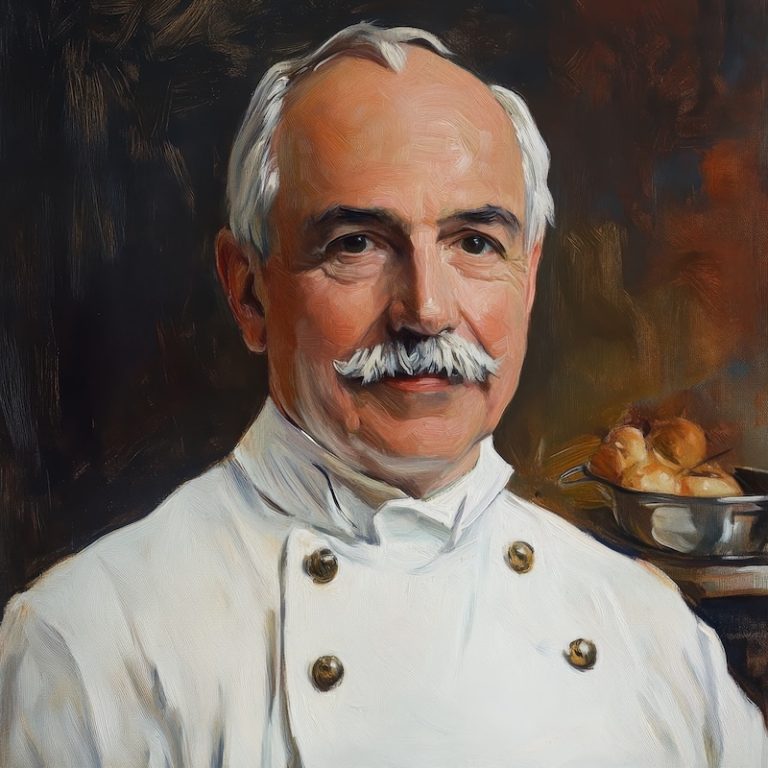

I didn't fully appreciate how much Auguste Escoffier shaped the way professional kitchens work until I started cooking seriously. The brigade system, the structured menu, the mother sauces — all of him. If you've ever worked from a classical French recipe, you've been cooking his way without knowing it.
The Most Influential Chef You've Probably Never Cooked For
Auguste Escoffier transformed professional cooking from chaotic kitchen craft into a disciplined, modern system still used today. Known as the “Father of Modern French Cuisine,” Escoffier created the brigade system, refined the structure of the five mother sauces, and authored Le Guide Culinaire, one of the most influential cookbooks in culinary history.
Working alongside hotelier César Ritz at legendary establishments such as the Savoy Hotel and the Ritz Paris, Escoffier elevated restaurant kitchens into organized, efficient operations that balanced elegance with precision. His reforms shaped fine dining, culinary education, and restaurant management worldwide.
In this guide, you’ll discover who Auguste Escoffier was, how he revolutionized the professional kitchen, and why his influence remains embedded in every well-run restaurant and every properly executed sauce today.
Who Was Auguste Escoffier?
Auguste Escoffier transformed professional cooking from a chaotic, grueling craft into a disciplined, modern system that still runs kitchens around the world today. Born in 1846 in Villeneuve-Loubet, a small village near Nice in southern France, he came from a working-class family — his father was a blacksmith — and began his culinary apprenticeship at 13 in his uncle’s restaurant in Nice.
That early start in Provence shaped everything that came after. Growing up surrounded by Mediterranean ingredients — tomatoes, olives, garlic, fresh herbs, seafood — gave him a lifelong preference for simplicity, balance, and restraint that would later distinguish his approach from the elaborate excess of the era. He learned discipline and respect for ingredients early, and he never lost either.
By the time he was thirty he had cooked in Paris, served as a military chef during the Franco-Prussian War — an experience that deepened his interest in preservation and efficiency — and begun building the reputation that would eventually make his name synonymous with modern French cuisine.
Auguste Escoffier’s Early Life in Provence
- Born: 1846 in Villeneuve-Loubet, near Nice, France
- Family Background: Working-class; father was a blacksmith
- Started Cooking: Apprenticed at age 13 in his uncle’s restaurant, Le Restaurant Français in Nice
- Regional Influence: Grew up surrounded by Mediterranean ingredients like tomatoes, olives, garlic, herbs, and fresh seafood
- Core Lessons Learned: Discipline, respect for ingredients, seasonal cooking, and kitchen organization
- Lasting Impact: His Provençal roots shaped his lifelong preference for simplicity, balance, and refined restraint in haute cuisine
Escoffier and César Ritz: The Partnership That Changed Fine Dining
The partnership between Auguste Escoffier and César Ritz is one of the great collaborations in the history of hospitality — a chef and a hotelier who understood, almost instinctively, that what happened in the dining room and what happened in the kitchen were inseparable.
They met in the early 1880s at the Grand Hotel in Monte Carlo, where Ritz was managing the property and Escoffier was running the kitchen. The chemistry was immediate. Ritz was a visionary who understood luxury as an experience — not just beautiful rooms but impeccable service, refined food, and an atmosphere that made guests feel they were somewhere extraordinary. Escoffier gave him the kitchen to match.
Together, they moved through some of the most prestigious addresses in Europe. At the Savoy Hotel in London, which they transformed into the defining luxury hotel of the era, Escoffier reorganized the kitchen completely — introducing the brigade system, streamlining the menu, and producing food at a level of consistency and elegance that London had never seen. The clientele included royalty, heads of state, opera stars, and the wealthiest families in Europe. Escoffier cooked for all of them and remembered their preferences.
Their time at the Savoy ended abruptly in 1898, when both men were dismissed — officially for financial irregularities, the specifics of which were never fully made public. It barely slowed them down. Within two years, they had opened the Ritz Paris, followed by The Carlton in London, cementing their legacy as the team that invented the modern luxury hotel dining experience.
Ritz suffered a mental breakdown in 1902 and never fully recovered, leaving Escoffier to carry their shared vision forward alone. He did so for another eighteen years, retiring in 1920 with the Légion d’Honneur — France’s highest civilian honor — to his name.
The Brigade System: How Escoffier Brought Order to the Professional Kitchen
Before Escoffier, professional kitchens were genuinely chaotic places. Cooks worked overlapping roles with unclear responsibilities, service was inconsistent, and the pressure of a busy dinner service regularly produced something close to organized chaos. The food that emerged was often excellent — French cuisine had centuries of technique behind it — but the process of producing it at scale, consistently, night after night, was brutal and inefficient.
Escoffier changed that by borrowing an idea from the military. Having served as a chef during the Franco-Prussian War, he understood how a hierarchical command structure could bring order to a large, high-pressure operation. He applied the same thinking to the kitchen.
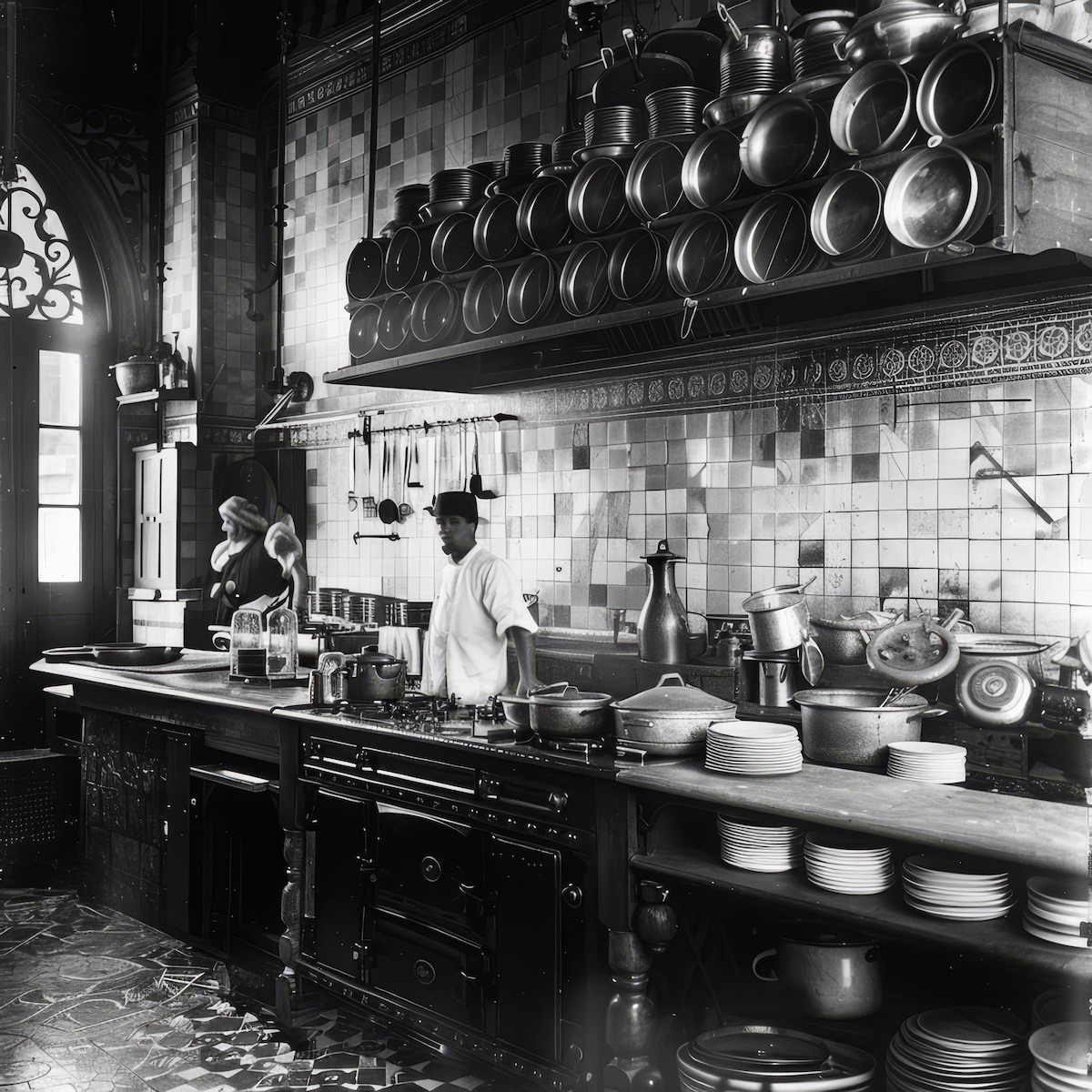
The brigade system divided the kitchen into clearly defined stations, each with its own specialty and its own chain of command. At the top sat the Chef de Cuisine — the executive chef responsible for the entire operation. Below him, the Sous Chef managed day-to-day execution. Below that, Chefs de Partie ran individual stations: the saucier for sauces, the poissonnier for fish, the rôtisseur for roasted meats, the pâtissier for pastry. Junior cooks — Commis — worked under each station chef, learning their craft by doing rather than watching.
The result was a kitchen where everyone knew exactly what they were responsible for, where problems could be isolated and corrected quickly, and where a dining room of two hundred covers could be served with the same quality and timing as a private dinner for twenty.
What makes the brigade system remarkable is not just that it worked in Escoffier’s era — it’s that it still works today. Walk into any serious professional kitchen in the world and you’ll find some version of his structure operating exactly as he designed it over a century ago. The titles may vary and the stations may be consolidated in smaller operations, but the logic is identical: clear roles, clear accountability, clear chain of command.
For a man who spent his career in kitchens, that may be his most enduring contribution of all.
Le Guide Culinaire and the Five Mother Sauces
In 1903, Escoffier published Le Guide Culinaire — a cookbook in the technical sense, but really something more than that. It was a codification of an entire culinary system: 5,000 recipes, organized by technique and category, written with the professional kitchen in mind rather than the home cook. It remains in print today, over 120 years later, which tells you something about how thoroughly it got things right.
The book’s most lasting contribution was what it did with sauces. French cuisine had long operated around a complex, sprawling sauce classification that traced back to the early 19th century chef Marie-Antoine Carême. Carême’s system was comprehensive but unwieldy — dozens of sauces organized in ways that were difficult to teach and harder to standardize. Escoffier simplified it.
He identified five foundational sauces — what he called the mother sauces — from which virtually every other sauce in the classical French repertoire could be derived:
Mother Sauce | Base | Classic Derivatives |
Milk + white roux | Mornay, Cream sauce, Soubise | |
Light stock + white roux | ||
Brown stock + brown roux | ||
Butter + egg yolks | Béarnaise, Choron, Maltaise | |
Tomatoes + stock | Creole, Portuguese, Provençale |
The elegance of the system is in its logic. Master the five mother sauces and you have the foundation for hundreds of classical preparations. Every culinary school in the world still teaches it this way because no one has come up with a better framework in the century since.
It’s worth noting that Escoffier didn’t invent these sauces from scratch — Carême had identified versions of most of them decades earlier. What Escoffier did was rationalize, simplify, and standardize them in a way that made them teachable at scale. That’s a different kind of genius than invention, and arguably a more practically useful one.
If you’ve ever made a béchamel for a lasagna, whisked a hollandaise for eggs Benedict, or reduced a demi-glace for a pan sauce, you’ve been working from Escoffier’s framework without necessarily knowing it.
Escoffier’s Most Famous Dishes
One of the things that distinguished Escoffier from the chefs who came before him was his understanding that a dish could be as much a social gesture as a culinary one. Many of his most famous creations were named for the celebrated figures he cooked for — opera singers, actresses, royalty — and the naming was deliberate. A dish bearing your name in an Escoffier kitchen at the Savoy or the Ritz was a mark of prestige that money alone couldn’t buy.
Peach Melba is the most famous example. Created in 1893 for Dame Nellie Melba, the Australian opera soprano who was the defining celebrity of her era, the dish is almost absurdly simple by classical French standards: poached white peaches served over vanilla ice cream with a raspberry sauce. What made it extraordinary wasn’t the technique — it was the restraint. In an era of elaborate, heavily garnished presentations, Escoffier stripped it back to three perfect components and let them speak for themselves. It’s still on menus around the world.
Melba Toast came from the same source, though less glamorously. Dame Nellie was unwell and on a restricted diet during one of her stays at the Savoy. Escoffier had thin slices of bread toasted until crisp and dry, and sent them up to her room. She reportedly loved them. The name stuck.
Tournedos Rossini is the most luxurious dish in his repertoire — a filet mignon topped with a seared slice of foie gras and shaved black truffle, finished with a rich Madeira demi-glace. It was named for the Italian composer Gioachino Rossini, who was famously devoted to both music and food. The dish is a study in classical excess done with complete confidence, and it remains one of the great preparations of French haute cuisine.
Poularde Derby — poached chicken with rice, foie gras, and truffles — showed a different side of Escoffier: his ability to take a simple protein and elevate it through composition and technique rather than elaborate sauce work.
Fraises Sarah Bernhardt, named for the legendary French actress, pairs strawberries with pineapple sorbet and Curaçao — a combination that sounds improbable yet works beautifully, which describes many of Escoffier’s best ideas.
What runs through all of these dishes is the same quality that defined his approach to everything: elegance through simplicity. The instinct to do less, and to do it perfectly, rather than to do more and overwhelm. It’s a lesson that remains as relevant in a home kitchen today as it was in the Savoy dining room in 1895.
Escoffier’s Legacy
Auguste Escoffier retired to Monte Carlo in 1920 at the age of seventy-three, having spent sixty years in professional kitchens. He didn’t stop working. He continued writing, corresponding with chefs, and thinking about food until his death in 1935 at eighty-eight — outliving César Ritz by nearly three decades and living long enough to see his ideas become the unquestioned foundation of professional cooking worldwide.
The Légion d’Honneur he received in 1920 was the French government’s acknowledgment of something the culinary world already knew: that Escoffier had done more than cook well. He had professionalized an entire industry.
His specific contributions are easy enough to list — the brigade system, Le Guide Culinaire, the five mother sauces, the streamlined menu format that replaced the endless Victorian carte with something a diner could actually navigate. But the larger contribution is harder to quantify. Before Escoffier, cooking was a trade. After him, it was a discipline with standards, structure, and a codified body of knowledge that could be taught, learned, and built upon.
Every culinary school in the world teaches from frameworks he established. Every professional kitchen operates on organizational principles he developed. Every classical French sauce traces back to the system he standardized. And every chef who has ever worked a station in a busy kitchen — whether they know his name or not — has benefited from the order he brought to a profession that badly needed it.
He also changed the culture of the kitchen in ways that are easy to overlook. Escoffier was deeply concerned with the dignity and professionalism of kitchen work. He banned alcohol from his kitchens at a time when drinking on the job was commonplace. He insisted on cleanliness, discipline, and respect — both among the brigade and toward the guests they served. He wanted cooking to be taken seriously as a profession, and he spent his career demonstrating why it deserved to be.
There is a museum dedicated to him in his birthplace of Villeneuve-Loubet, near Nice — the Musée Escoffier de l’Art Culinaire — housed in the building where he was born. It’s worth a visit if you’re ever in the south of France and want to understand where all of this began: a small Mediterranean village, a blacksmith’s son, and sixty years of work that changed the way the world eats.
Frequently Asked Questions About Auguste Escoffier
What is Escoffier best known for?
Auguste Escoffier is best known for modernizing French cuisine and creating the brigade system of kitchen organization. He transformed chaotic 19th-century restaurant kitchens into structured, professional operations with clearly defined roles. He also codified classical recipes in Le Guide Culinaire, a foundational text that still shapes culinary education today.
What were the five mother sauces Escoffier defined?
In Le Guide Culinaire, Escoffier formalized five foundational sauces that serve as the base for countless variations:
- Béchamel
- Velouté
- Espagnole
- Hollandaise
- Tomato
While the original classification began with Marie-Antoine Carême, Escoffier simplified and standardized the system, making it practical for professional kitchens and culinary schools worldwide.
What is the brigade system, and why is it important?
The brigade system is a hierarchical kitchen structure created by Escoffier that divides the kitchen into specialized stations, such as saucier, pâtissier, and poissonier, under the leadership of a chef de cuisine. This system improves efficiency, consistency, and accountability. It remains the foundation of organization in professional restaurants around the world.
Did Escoffier invent any famous dishes?
Yes. Escoffier created or popularized several iconic dishes, including Peach Melba, Melba Toast, and Tournedos Rossini. Many were named after prominent cultural figures of the era, blending culinary refinement with social prestige.
Where did Escoffier work?
Escoffier worked in several of Europe’s most prestigious establishments, including the Savoy Hotel in London and the Ritz Paris. His partnership with César Ritz helped redefine luxury hospitality and fine dining at the turn of the 20th century.
Where did he retire?
Escoffier retired in Monte Carlo, Monaco, in 1920. He spent his final years there continuing to write and correspond with chefs until his death in 1935.
Did Escoffier receive any awards?
Yes. In 1920, he was awarded the Légion d’Honneur, one of France’s highest honors, in recognition of his contributions to French culture and gastronomy.
What made Escoffier different from other chefs of his time?
Escoffier stood apart because he combined culinary artistry with organizational discipline. While many chefs focused solely on elaborate presentation, he prioritized efficiency, simplicity, and structure. He professionalized kitchen behavior, reduced excess in haute cuisine, and emphasized respect, cleanliness, and consistency.
Did he have influence outside France?
Absolutely. Escoffier’s work in London and his association with luxury international hotels spread French culinary standards across Europe and beyond. His brigade system and culinary codification became global benchmarks for professional kitchens and culinary education.
How much did he make at the height of his career?
Exact figures are difficult to confirm, but Escoffier was among the highest-paid chefs of his era, earning a substantial salary at the Savoy and Ritz properties. In addition to salary, he benefited from book royalties and international prestige, placing him financially and socially among elite professionals of his time.
Did he have children, and did they become chefs?
Escoffier had children, but they did not follow him into professional culinary careers. His lasting legacy was not dynastic but institutional, carried forward by generations of chefs trained under his system and influenced by his writings.
One Response
Thanks for the read. Very insightful. I’m doing a report on him