Buying Kitchen Knives
Why Knives Matter: A good kitchen knife is the foundation of efficient cooking. It improves speed, safety, and precision, and reduces fatigue during prep. Most home cooks only need a few well-chosen knives to handle almost everything.
Check Quality: Look for a comfortable handle, balanced weight, and a solid feel in the hand. A full tang adds stability and durability. The knife should feel controlled during chopping, not overly light or flimsy.
What to Buy First: Start with an 8-inch chef’s knife. Add a paring knife for precision work and a serrated knife for bread and soft foods. These three cover the majority of home cooking tasks.
Where to Shop: Kitchen specialty stores let you handle knives and test balance in person. This is the best way to understand comfort and fit before buying.
Amazon Convenience: Amazon offers a wide range of kitchen knives across all price points, with reviews and comparisons to help evaluate forged vs stamped, steel types, and blade lengths before purchasing.
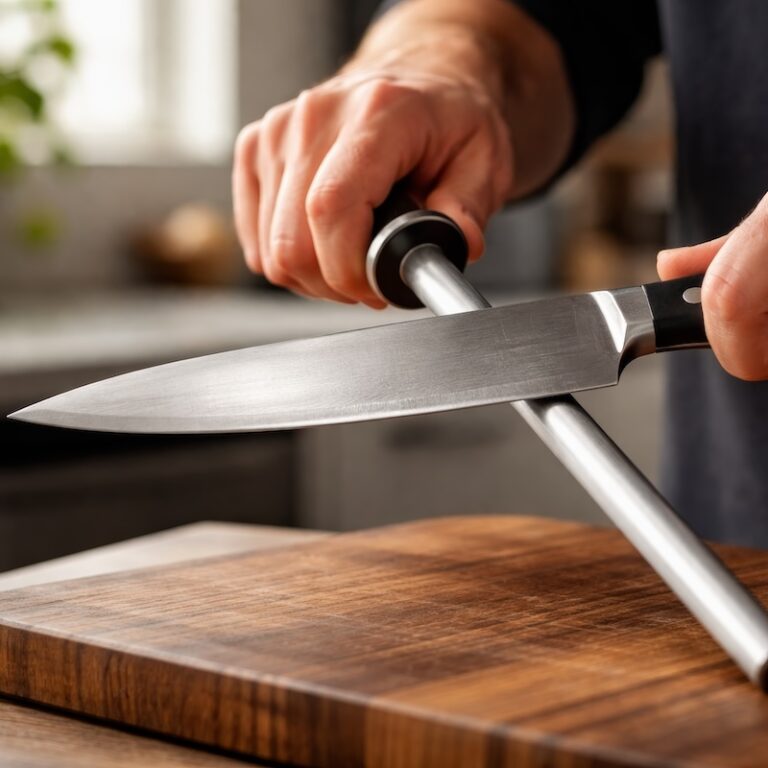
Care Tip: Hand wash only, dry immediately, and store in a knife block, magnetic strip, or blade guard. Regular honing keeps the edge aligned and improves long-term performance.
🛒 Check Prices for Chef Knifes on Amazon
Available on Amazon










11 Responses
Hello there, I always love to cook. I am looking for a fair price set of knives. But I would like them to be made in the USA
I know of Chef’s Choice, Cutco, Lamson, Dexter/Russell. What other ones are there?
thanks
Rob
Best everyday value: Dexter-Russell, Rada
Best traditional craftsmanship: Lamson, Warther
Best premium modern performance: New West KnifeWorks
Best artisan/collector tier: Kramer Knives
Best known household brand: Cutco
There are a few more knives made in the USA, the ones that you know, Chef’s Choice, Cutco, Lamson. They are all high-carbon steel, and the steel is made in Germany.
Dexter/Russell is stainless steel made in the USA, but there is one company in Southern Indiana that makes its own high-carbon steel. It’s called Old Hickory. Very nice steel, but not as good as the Germany steel.
“…Global knives so much are that they are made out of steel that is softer and lighter than traditional high-carbon steel…”
I thought Global’s were harder than other knives, that’s why they say you should use diamond or ceramic to sharpen them. Am I wrong?
My son sold Cutco knives during college (excellent training in sales) and I’m sold. A good set of knives makes life (and cooking) so much more fun. The next stop is a Boos cutting board :).
I purchased a set of Henkels (Twin Cuisine) knives several years ago. I am very happy with them. They are a bit heavier than the Global but, they feel great in my hands and they are of excellent quality. I don’t expect to buy another set for many years to come
As a cutlery store owner, I’d like to add my input. It’s excellent advice to handle knives and ask all the necessary questions of your sales rep in a local brick and mortar store. However, if you then trot right out to the internet, consider the impact to the merchant whose expertise and time you used. All major brands, Global, Henckels, Wusthoff, Shun, have mandated MAP pricing. What that means is – you won’t find a cheaper price online. Every Wusthoff santoku sells at the same price. Bottomline. If a merchant drops their price, they run the risk of losing the vendor. You might not have to pay tax online. But you will likely pay shipping. My company offers added value by providing free knife sharpenings with every purchase. The advise to trot home and buy on line is troubling to me and it’s not because I don’t sell on line. I do. But, if we continue to support only online merchants, we will not find stores filled with quality products (like good cutlery) as they usually have low margins. We will reap what we sow. Want to buy it cheap? You’ll start losing your local merchants or they’ll start stocking crap from China.
Great info CK, thanks for sharing.
America’s Test Kitchen thinks that Wusthof makes the best french cook knives, and Forschner are the best value.
I am a big fan of Test Kitchen, but I think you need to go to the store and get a feel for the knife and buy one that feels right for you. – RG
Great article! Solid, practical advice on keeping kitchen knives sharp for years through smart daily habits — hand washing and immediate drying, using proper cutting boards, regular honing, and safe storage. The simple “Knife Care in 10 Seconds” summary is especially useful. Excellent reminder that good maintenance beats buying expensive replacements every year. Thanks for the straightforward guide!
Hi Kamp, thanks for the positive comments.