

Fast Answer: Essential Cooking Utensils
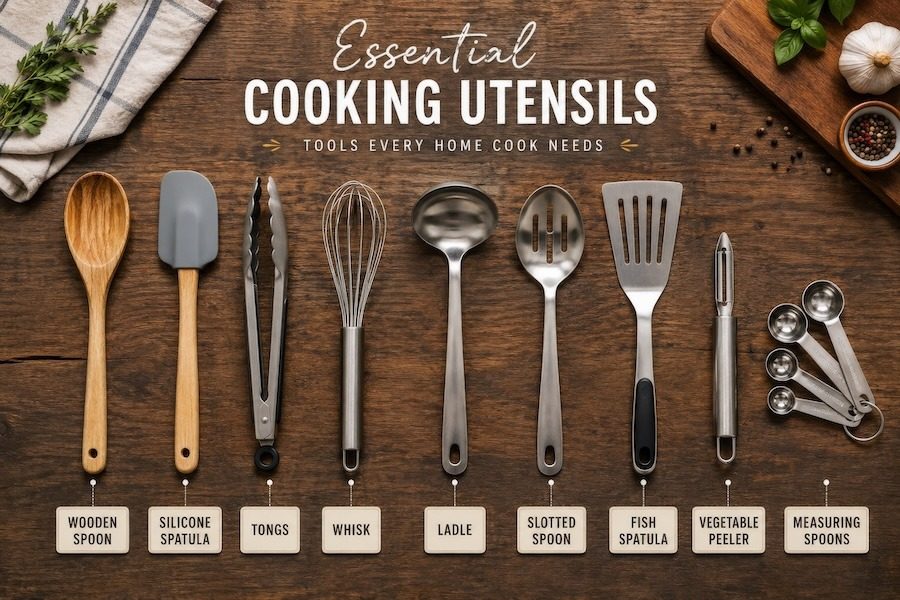
- If you only buy a few cooking utensils, start with a chef’s knife, silicone spatula, wooden spoon, tongs, whisk, peeler, ladle, and slotted spoon.
- Silicone utensils are best for nonstick cookware.
- Wooden utensils are gentle and comfortable but need more care.
- Stainless steel utensils are durable and ideal for high-heat cooking.
- The best kitchens are built slowly with tools you actually use, not giant gadget sets.
Essential Cooking Utensils for Beginners and Home Cooks
Cooking utensils are the everyday kitchen tools that help you stir, flip, whisk, scrape, serve, and cook more efficiently. From wooden spoons and silicone spatulas to tongs, ladles, and whisks, the right cooking utensils can make preparing meals easier, safer, and far more enjoyable.
In this guide, you’ll learn which kitchen utensils every home cook actually needs, how different utensil materials compare, and which tools are worth the drawer space versus the gadgets quietly collecting dust beside the melon baller.
Start Here: Build Your First Utensil Collection
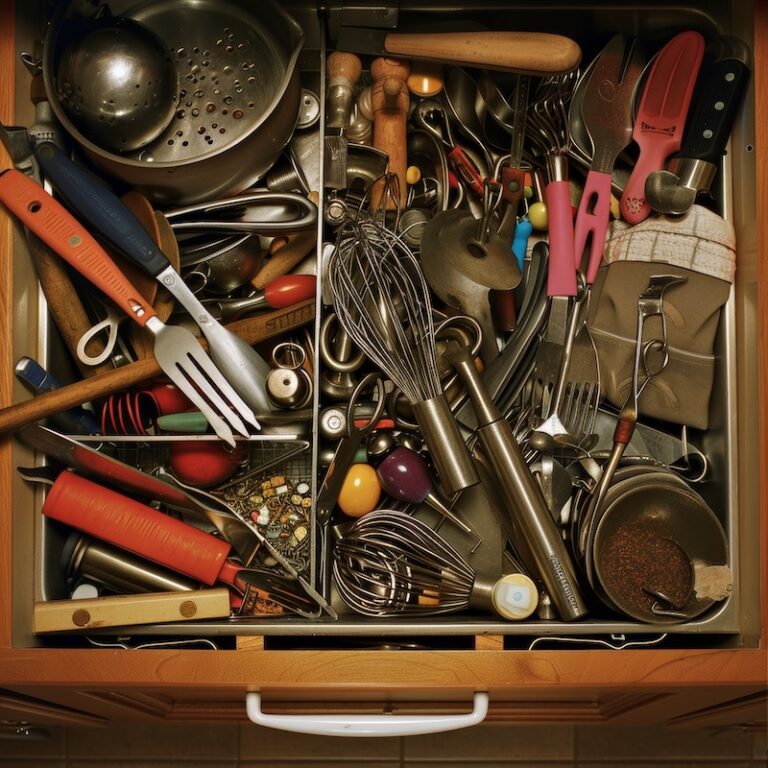
You do not need a drawer packed with gadgets to become a better cook. Most home cooks can handle nearly every everyday recipe with a small collection of reliable utensils that earn their keep week after week.
🥄 Stirring Tools
Best Choices: Wooden spoon or silicone spoonula
- Great for soups, sauces, pasta, and sautéing
- Wood stays comfortable even in hot pans
- Silicone is ideal for nonstick cookware
🍳 Flipping & Turning
Best Choices: Fish spatula or silicone turner
- Perfect for eggs, pancakes, burgers, and fish
- Thin edges slide easily under delicate foods
- Fish spatulas are surprisingly versatile
🔥 Grabbing & Moving
Best Choice: Spring-loaded tongs
- Use for grilling, tossing pasta, and flipping meat
- Acts like an extension of your hand
- Avoid flimsy tongs that wobble like shopping cart wheels
🧁 Scraping & Mixing
Best Choice: Silicone spatula
- Scrapes bowls clean with almost suspicious efficiency
- Excellent for baking and folding batters
- Heat-resistant versions can go straight into pans
🍲 Soup & Pasta Helpers
Best Choices: Ladle and slotted spoon
- Ladles portion soups and sauces neatly
- Slotted spoons lift foods while draining liquid
- Essential for pasta, vegetables, and poaching
🥚 Whisking & Blending
Best Choice: Balloon whisk
- Whips eggs, dressings, sauces, and cream
- Creates smoother sauces with fewer lumps
- One of the simplest tools that quietly saves recipes
Bottom line: A small set of versatile utensils beats a cluttered drawer full of single-purpose gadgets every time.
| Utensil | Category | Best Use | Best Material | Nonstick Safe? | Notes |
|---|
| Material | Best For | Pros | Cons |
|---|---|---|---|
| Silicone | Nonstick cookware, baking, scraping bowls | Heat resistant, flexible, gentle on pans, easy to clean | Some tools feel too soft or floppy for heavier foods |
| Wood | Everyday stirring, sauces, soups | Comfortable grip, gentle on cookware, won’t conduct heat | Requires hand washing and occasional oiling |
| Stainless Steel | High-heat cooking, grilling, heavy-duty tasks | Extremely durable, strong, dishwasher safe | Can scratch nonstick cookware |
| Nylon | Budget-friendly everyday cooking | Affordable, lightweight, safe for many pans | Can melt, warp, or stain over time |
| Bamboo | Eco-friendly cooking and serving | Lightweight, renewable, gentle on cookware | Less durable than hardwood utensils |
| Plastic | Basic serving and light prep tasks | Inexpensive and widely available | Can crack, melt, discolor, or absorb odors |
For a look of my top 12 kitchen utensil picks and why I think they are important, click here
Choosing the right utensil material matters almost as much as the utensil itself. Some protect delicate cookware, while others handle blazing heat like tiny culinary superheroes.
What Most Cooks Get Wrong About Utensils
- Buying giant utensil sets before knowing what they actually use
- Using metal utensils on nonstick cookware
- Keeping melted or warped plastic tools too long
- Buying single-purpose gadgets that clutter drawers
- Ignoring comfort and grip when choosing tools
- Thinking expensive automatically means better
What Were the Earliest Cooking Utensils?
Long before nonstick pans and silicone spatulas, early humans cooked with whatever nature handed them. Some of the first cooking utensils were simple, practical tools made from stone, wood, bone, clay, shells, and leaves.
Some of the Earliest Cooking Utensils Included:
The discovery of fire changed everything. Cooking became safer, food became easier to digest, and humans slowly developed more advanced kitchen tools over thousands of years. Today’s kitchen gadgets may look more polished, but somewhere deep down, your wooden spoon still has prehistoric energy. 🔥🥄
Frequently Asked Questions About Cooking utensils
What are cooking utensils?
Cooking utensils are handheld kitchen tools used to prepare, cook, serve, and handle food. Common examples include spoons, spatulas, tongs, whisks, ladles, peelers, turners, and slotted spoons.
What cooking utensils does every home cook need?
Most home cooks should start with a wooden spoon, silicone spatula, tongs, whisk, ladle, slotted spoon, vegetable peeler, and a flexible turner or fish spatula. These basic kitchen utensils handle most everyday cooking jobs.
What is the difference between kitchen tools and cooking utensils?
Cooking utensils usually refer to handheld tools used during cooking, such as spatulas, spoons, tongs, and whisks. Kitchen tools is a broader term that can include knives, cutting boards, measuring cups, graters, strainers, and other prep equipment.
What are the best cooking utensils for beginners?
The best cooking utensils for beginners are versatile, durable, and easy to use. Start with tools you will reach for often: a wooden spoon, silicone spatula, tongs, whisk, ladle, slotted spoon, peeler, and turner.
More FAQs
Which cooking utensils are best for nonstick cookware?
Silicone, wood, bamboo, and nylon utensils are best for nonstick cookware because they are less likely to scratch the surface. Avoid metal utensils on nonstick pans unless the manufacturer specifically says they are safe.
Are silicone cooking utensils safe?
Yes, food-grade silicone cooking utensils are generally safe for everyday cooking when used within their heat limits. Look for sturdy, heat-resistant silicone tools that do not feel flimsy, sticky, or cheaply made.
Are wooden spoons sanitary?
Wooden spoons are sanitary when washed properly and dried completely. Hand wash them with warm, soapy water, avoid soaking them, and replace them if they crack, split, or develop deep grooves.
Are stainless steel utensils better than silicone utensils?
Stainless steel utensils are stronger and better for high-heat cooking, grilling, and heavy-duty tasks. Silicone utensils are better for nonstick cookware, scraping bowls, and delicate surfaces. Most kitchens benefit from having both.
What utensils should I avoid using on nonstick pans?
Avoid metal spatulas, forks, whisks, and spoons on nonstick pans because they can scratch the coating. Use silicone, wood, bamboo, or nylon tools instead.
How many cooking utensils do I really need?
You do not need a giant utensil set. A small collection of 8 to 10 well-chosen utensils can handle most home cooking. Buy based on how you cook, not on how impressive the drawer looks when it is opened.
Are expensive cooking utensils worth it?
Sometimes. Expensive utensils are worth it when they feel comfortable, last longer, and solve a real cooking problem. They are not worth it if they duplicate tools you already own or only perform one tiny job once a year.
What cooking utensils do professional chefs use most?
Professional chefs rely on simple, durable tools such as tongs, spoons, spatulas, whisks, ladles, bench scrapers, peelers, and offset spatulas. Fancy gadgets usually take a back seat to tools that work hard every day.
What is the most useful cooking utensil?
Tongs may be the most useful cooking utensil because they can grab, flip, lift, toss, and serve food. A good pair of spring-loaded tongs quickly becomes an extension of your hand, minus the fingerprints on hot chicken.
How should I store cooking utensils?
Store everyday utensils where you can reach them easily, either in a countertop crock, drawer organizer, or wall-mounted rail. Keep sharp, delicate, or rarely used tools separate so your drawer does not become a utensil junk drawer with ambition.
When should I replace cooking utensils?
Replace cooking utensils when they crack, melt, warp, rust, splinter, peel, or become difficult to clean. Damaged utensils can scratch cookware, hold food residue, or make cooking harder than it needs to be.


2 Responses
I am looking for a large, long-handled wooden spoon. Do you know where I can purchase one?
Hi Barbara, there are so many good sources for long-handled wooden spoons, and I have been seeing lots of them at various Farmers Markets where you may find several booths selling them.